
What if the primary cause of dimensional drift and scrap in your articulated surgical tools isn’t your core design, but a fragmented supplier base? Engineering leaders recognize that minimally invasive surgery instrument contract manufacturing leaves zero margin for error. Balancing sub-millimeter tolerances across complex multi-axis assemblies while preparing for strict FDA QMSR audits and EU MDR deadlines creates immense operational friction. When precision machining, surface passivation, and cleanroom assembly happen under separate roofs, validation bottlenecks and inconsistent yields quickly follow.
You don’t have to absorb high scrap rates or delayed timelines to commercialize sophisticated surgical devices. This guide provides a clear framework to evaluate, qualify, and select the ideal CDMO partner for complex minimally invasive surgical instruments. You’ll learn how to establish a unified, reliable workflow spanning design for manufacturability (DFM) through cleanroom assembly and sterile packaging, accelerating your time-to-market while reducing regulatory exposure. Ahead, we outline the critical micro-machining capabilities, automated in-line inspection systems, and quality frameworks required for dependable volume production.
Key Takeaways
- High-reliability minimally invasive surgery instrument contract manufacturing requires consolidating multi-axis Swiss machining, wire EDM, and cleanroom assembly under a unified quality system to eliminate supplier fragmentation.
- Implementing early Design for Manufacturability (DFM) combined with automated in-line inspection prevents micro-scale dimensional stack-up and mitigates mechanical articulation failures before pilot production.
- Sustained regulatory readiness hinges on robust IQ, OQ, and PQ process validation protocols that satisfy both FDA QMSR expectations and stringent EU MDR compliance milestones.
- A structured five-phase qualification roadmap provides medical device OEMs with a repeatable framework to audit CDMO metrology infrastructure, cleanroom controls, and micro-precision production capabilities.
What Defines High-Reliability Minimally Invasive Surgery Instrument Contract Manufacturing?
High-reliability minimally invasive surgery instrument contract manufacturing represents the comprehensive outsourcing of technical design, micro-machining, sub-assembly, and validation under rigorous quality systems. Unlike traditional open-surgery hand tools, which feature rigid, monolithic bodies with loose mechanical allowances, modern laparoscopic, arthroscopic, and robotic instruments demand extreme dexterity inside confined anatomical workspaces. Achieving this clinical performance requires dimensional tolerances consistently held below five microns (±0.005 mm) on articulated features.
Consolidating these requirements with a single CDMO safeguards design integrity across the entire product lifecycle. Fragmented supply chains introduce micro-dimensional drift, cumulative stack-up errors, and cross-vendor accountability gaps that derail validation. In contrast, an integrated contract manufacturing workflow aligns design for manufacturability (DFM) with precision fabrication, surface finishing, and assembly, preventing scrap spikes before production scales.
Anatomy of Modern Minimally Invasive Surgical Devices
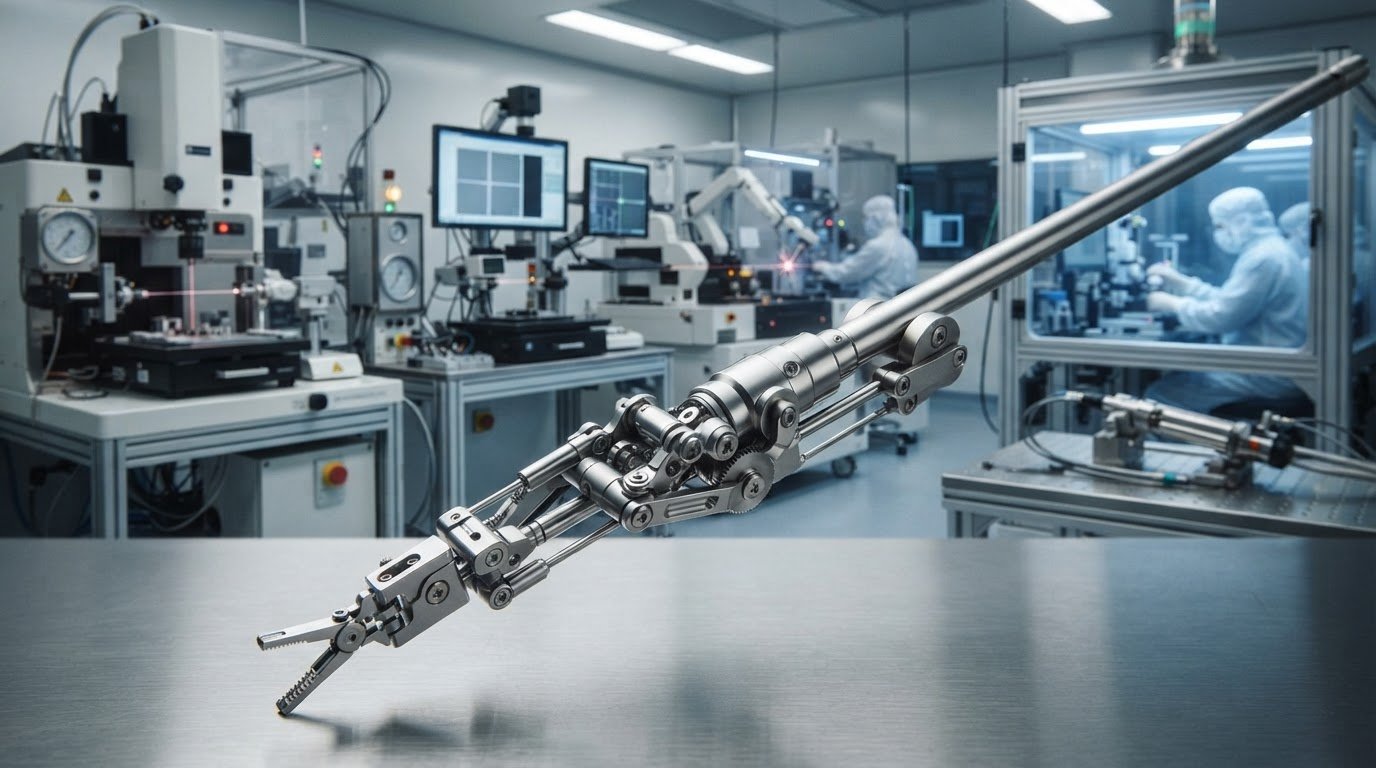
Modern MIS instrumentation relies on miniature, multi-axis mechanical linkages to mimic or exceed human wrist dexterity. These systems integrate several high-stress subsystems into narrow form factors:
- Articulated wrists and jaws: Multi-link micro-clevises, miniature gear teeth, and flexure joints that transmit smooth gripping or cutting torque through compact pitch-and-yaw mechanisms.
- Acoustic and electrosurgical channels: Balanced ultrasonic scalpel couplers designed for high-frequency resonance alongside insulated shafts that conduct RF monopolar or bipolar energy without thermal leakage.
- Concentric lumen structures: Multi-lumen hypotubes, laser-cut flexible shafts, calibrated pull rings, and radiopaque marker bands paired with integrated fluid channels for continuous suction and irrigation.
Material Science and Biocompatibility Demands
Material selection in minimally invasive surgery instrument contract manufacturing dictates mechanical endurance, electrical isolation, and biological safety. Medical-grade 17-4 PH and 316LVM stainless steels remain workhorses for structural shafts and jaws, while MP35N alloy provides the high fatigue resistance needed for miniature drive cables. Superelastic Nitinol (ASTM F2063) enables shape-memory articulations that withstand tight bend radii without permanent plastic deformation.
For non-metallic components, engineering thermoplastics like PEEK, Radel (PPSU), and high-dielectric polyimides provide dimensional stability during high-temperature autoclaving while preventing inadvertent electrical arcing during electrosurgical activation. Finally, critical sub-assemblies undergo tailored surface treatments: electropolishing to remove micro-burrs, chemical passivation to prevent corrosion, and diamond-like carbon (DLC) coatings to reduce friction and extend the wear life of moving articulated surfaces.
Key Technical Capabilities to Evaluate in an MIS Instrument CDMO Partner
Evaluating an engineering partner for minimally invasive surgery instrument contract manufacturing requires auditing verifiable machining tolerances rather than accepting broad capability claims. Medical device OEMs require micro-scale features that perform reliably across thousands of articulation cycles without material fatigue. To determine whether a CDMO can deliver consistent sub-assembly precision, engineering teams must evaluate core competencies against strict mechanical thresholds:
- Multi-Axis Swiss Turning: Shaft runout held within ±0.003 mm; ideal for ultra-thin drive rods, pivot pins, and micro-fasteners down to 0.2 mm diameter.
- 5-Axis Micro-Milling: Surface profiles within ±0.005 mm; essential for complex 3D contours on end-effector jaws and articulated clevis joints.
- Wire Electrical Discharge Machining (EDM): Corner radii under 0.02 mm with zero mechanical stress; critical for hardened tool steels and slotting flexible wrist links.
- Femtosecond Laser Micromachining: Heat-affected zones under 1 micron; required for cutting intricate patterns in Nitinol and stainless steel hypotubes.
Precision Micro-Machining and Multi-Axis Milling
Modern surgical graspers and scissor inserts demand multi-axis continuous contouring. Utilizing high-speed 5-axis CNC machining centers eliminates the secondary setups that typically introduce cumulative datum shift. For long, slender components like inner drive tubes and articulation rods, high-precision Swiss turn-mill centers prevent deflection using guide-bushing support, producing micro-threads and concentric bores in a single cycle. Wire EDM addresses hardened alloys where traditional milling bits introduce burrs or tool wear, preserving sharp cutting edges on biopsy tools.
Advanced Laser Processing and Joining Technologies
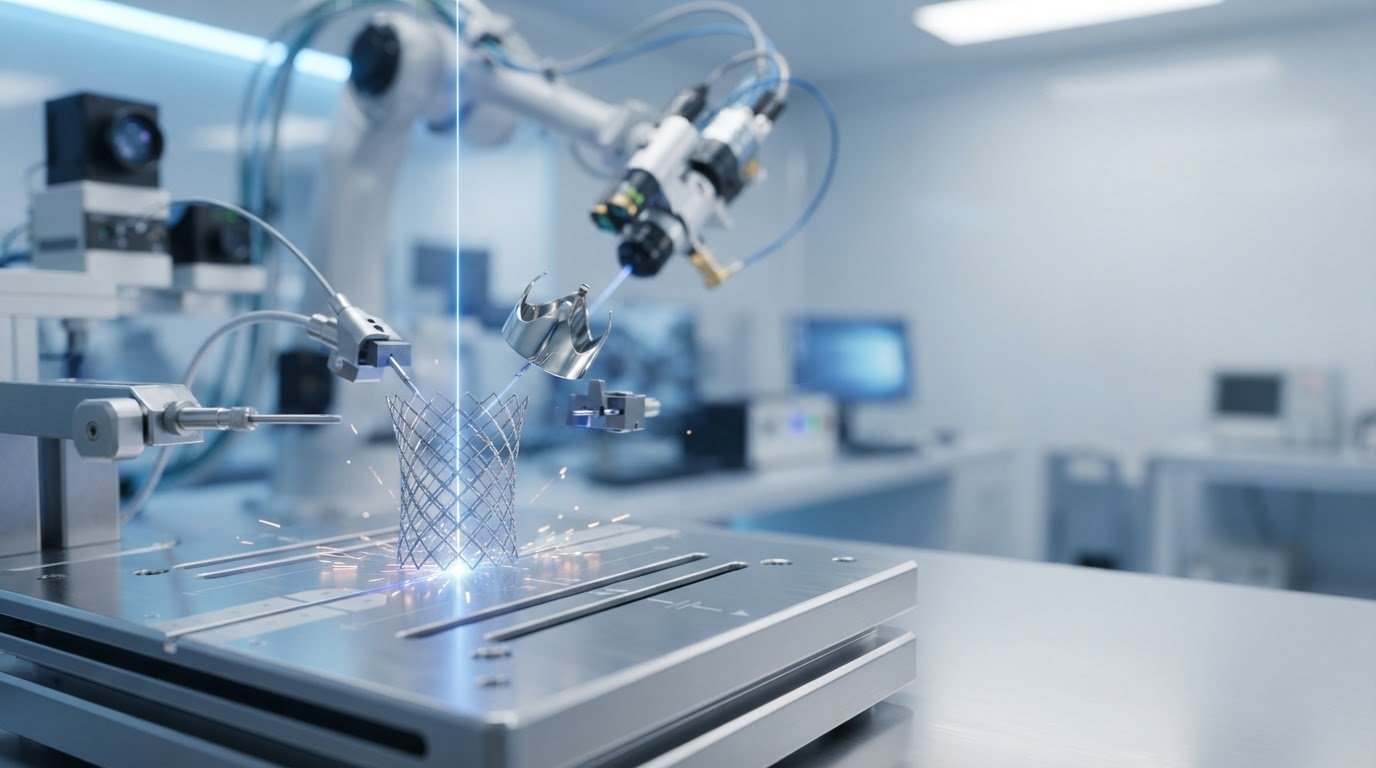
Laser processing has replaced conventional thermal joining for compact instrument assemblies. Femtosecond laser cutting generates cold ablation, creating complex flexible hinges and micro-lumen ports in hypotubes without dross or metallurgical alteration. For electrosurgical shafts requiring hermetic sealing, 5-axis fiber laser micro-welding provides precise weld seams that prevent fluid ingress without annealing adjacent thin-wall sections. Ultrashort-pulse laser marking produces black corrosion-resistant surface marks that withstand repetitive sterilization without degrading passivation layers.
Smart Manufacturing and Metrology Automation
Human inspection cannot reliably verify micron-level dimensions across high-volume production runs. Comprehensive medical device contract manufacturing services solve this by deploying automated metrology directly alongside production equipment. Integrating 24-hour unmanned coordinate measuring machines (CMM) and multi-sensor optical vision systems ensures immediate feedback on tool wear. When paired with robotic loading cells, automated production runs maintain statistical process capability (Cpk > 1.33) by eliminating manual handling errors. If your production roadmap demands strict dimensional repeatability, connecting with our technical engineering team can help identify potential process bottlenecks before initiating pilot runs.
Overcoming Design and Assembly Pitfalls in Articulated Surgical Tools
Articulated minimally invasive instruments face severe mechanical stresses in clinical environments. Actuation failures rarely stem from a single defective component; rather, they emerge from microscopic friction losses, thermal distortion during micro-welding, and kinematic hysteresis across multi-link wrist assemblies. In high-dexterity robotic tools, even negligible mechanical play multiplies across successive pivot points, resulting in lost motion, jaw misalignment, or dielectric breakdown during electrosurgery. Resolving these operational risks requires embedding medical device design for manufacturability (DFM) protocols at the concept stage, well before tooling commitment.
Mitigating Tolerance Stack-Up in Miniature Assemblies
When six or more micro-machined links chain together in an articulated wrist, individual component variances quickly compound. A minor variance of ±0.005 mm per clevis joint can generate millimeters of angular tip deflection under gripping loads. Contract manufacturers manage this behavior by applying specialized geometric dimensioning and tolerancing (GD&T) schemes that establish clear datum hierarchies on dynamic mating surfaces. In high-precision minimally invasive surgery instrument contract manufacturing, engineering teams also implement matched-pair assembly and precision selective shimming. Grouping micro-components with complementary dimensional profiles ensures uniform mechanical resistance and eliminates backlash without demanding unachievable fabrication tolerances.
Cleanroom Assembly and Ultrasonic Joining Protocols
Integrating micro-scale surgical mechanisms requires strict environmental controls to prevent particulate entrapment and bioburden contamination. Device sub-assembly workflows take place within certified Class 8 (100k) cleanrooms equipped with dedicated micro-handling work cells. Within these zones, operators execute specialized joining operations:
- Automated micro-dispensing: Applying sub-microliter drops of UV-curable, medical-grade adhesives to bond optical components and structural bushings without excess squeeze-out.
- Calibrated cable swaging: Executing controlled crimping routines on tungsten and MP35N actuation cables to guarantee tensile pull strength without crushing core filaments.
- Particulate-free cleaning regimes: Deploying multi-stage ultrasonic degreasing and vacuum drying cycles that remove all traces of cutting fluid and microscopic swarf, ensuring compliance with particulate limits before final packaging.
Quality Management, Regulatory Validation, and Risk Mitigation Protocols
Robust Quality Management System (QMS) adherence forms the structural foundation of minimally invasive surgery instrument contract manufacturing. With the FDA Quality Management System Regulation (QMSR) in full effect as of February 2, 2026, the agency has embedded ISO 13485:2016 directly into its regulatory framework. This harmonizes domestic oversight with international benchmarks like the EU Medical Device Regulation (EU MDR 2017/745). To protect product safety and clear global audits, contract partners must substantiate mechanical reliability through rigorous documentation, closed-loop CAPA workflows, and total trace-level accountability.
Executing systematic Process Failure Mode and Effects Analysis (PFMEA) early in production allows cross-functional teams to calculate Risk Priority Numbers (RPN) for every cutting, joining, and finishing stage. By isolating potential failure modes, such as laser weld micro-cracking, dielectric insulation thinning, or swage slippage, engineers implement poka-yoke fixtures and calibrated optical triggers to eliminate defects before pilot volume builds. Navigating these requirements smoothly requires mastering mastering medical device manufacturing compliance across domestic submissions and upcoming EU MDR transitional deadlines.
Process Validation Framework: IQ, OQ, and PQ
Transferring complex surgical instruments to volume manufacturing hinges on a defensible, data-backed qualification sequence:
- Installation Qualification (IQ): Verifies that high-precision 5-axis machining centers, femtosecond lasers, and automated cleanroom cells match structural design schematics, environmental criteria, and utility supply tolerances.
- Operational Qualification (OQ): Challenges the manufacturing envelope through multi-factor worst-case testing, validating that changes in cut feeds, laser beam pulse energy, or crimp pressures consistently generate compliant geometry.
- Performance Qualification (PQ): Demonstrates steady-state volume capability across consecutive commercial-scale runs, verifying that critical dimensions sustain a process capability index (Cpk) exceeding 1.33 under production conditions.
Risk Management and In-Process Verification
Translating ISO 14971 risk management standards to the shop floor demands multi-point physical verification rather than end-of-line spot checks. High-voltage dielectric withstand testing confirms that polymer insulation layers on electrosurgical shafts remain free of pinholes under extreme electrical potential. For suction-irrigation instruments, automated differential micro-leak decay systems verify hydraulic integrity without introducing wet contaminants. Each component carries digital serial tracking tied to mill melt certifications, laser run parameters, and environmental lot numbers, creating an airtight Device History Record (DHR). To establish a compliant validation framework for your clinical product launch, schedule a technical compliance consultation with our regulatory specialists.
Qualify and Transition to an Advanced Surgical CDMO Partner
Executing an orderly transition to a contract development and manufacturing partner requires a structured qualification roadmap. Sourcing teams cannot treat minimally invasive surgery instrument contract manufacturing as standard part procurement; it demands rigorous validation of equipment capabilities, environmental controls, and data integrity. Transitioning complex articulated tools involves five sequential phases: initial capability screening, technical on-site audits, collaborative DFM refinement, formal process validation, and final commercial transfer. Managing the transfer of the Design History File (DHF) and establishing an unassailable Device Master Record (DMR) ensures that production lines reproduce clinical functionality without regulatory deviation.
The CDMO Audit Checklist for Sourcing Teams
On-site audits should probe the physical limits of production facilities rather than reviewing superficial quality binders. Technical evaluation teams should systematically review three critical areas:
- Machining infrastructure: Audit spindle runout logs, machine fleet maintenance schedules, and kinematic calibration records across multi-axis milling and Swiss turning centers.
- Controlled environments: Inspect certified Class 8 (100k) cleanroom monitoring logs, differential air pressure differentials, and HEPA filter integrity records to ensure compliance with particulate cleanliness standards.
- Sub-tier vendor qualification: Evaluate approved supplier lists for secondary processes, checking audit histories and material certifications for electropolishing, passivation, and DLC coating vendors.
Accelerating Design Transfer to Mass Production
Successful tech transfer relies on tight operational alignment between OEM designers and the manufacturing plant. Creating joint engineering teams accelerates the design freeze by identifying non-critical tolerances that drive up scrap rates unnecessarily. Formal pilot production gates stress-test specialized assembly jigs and automated inspection fixtures before scaling up output. Implementing real-time statistical process control (SPC) across these pilot batches confirms that all critical dimensions remain centered within specification limits, protecting yield integrity prior to commercial launch.
Partnering with Fong’s Engineering for Surgical Innovation
Medical device innovators require stable, technically sophisticated partners who understand the demands of micro-scale instrumentation. Fong’s Engineering (FSP Group) brings over 40 years of precision engineering experience, founded in 1982, to advanced surgical device programs. Operating proprietary smart manufacturing lines equipped with 24-hour unmanned CMM inspection, automated optical systems, and robotic handling, Fong’s Engineering minimizes operator variance while holding sub-micron dimensional repeatability across multi-axis MIS sub-assemblies. Supported by comprehensive ISO 13485 certification, dedicated Class 8 cleanrooms, FDA 510(k) clearance support, and CE Mark compliance, the company delivers end-to-end CDMO services spanning DFM through complex device assembly. To evaluate your next-generation surgical program, explore technical manufacturing partnerships directly via Fong’s Engineering & Manufacturing.
Scale Your Next-Generation Surgical Devices with Confidence
Commercializing complex surgical tools demands far more than isolated micro-machining capabilities. Navigating the stringent demands of minimally invasive surgery instrument contract manufacturing requires unifying multi-axis Swiss turning, laser micromachining, and cleanroom sub-assembly under a single, disciplined quality system. By eliminating supplier fragmentation, engineering teams successfully resolve tolerance stack-up in articulated wrists, curb micro-welding distortion, and maintain seamless compliance with FDA QMSR and EU MDR benchmarks.
Sustaining sub-micron repeatability across high-volume production requires an experienced partner with proven infrastructure. Backed by over 40 years of precision engineering experience founded in 1982, Fong’s Engineering combines ISO 13485-certified Class 8 cleanrooms with proprietary smart manufacturing lines featuring 24-hour unmanned optical and CMM verification. From initial DFM refinement and worst-case OQ parameter testing to final complex device assembly, our technical specialists protect design integrity at every production gate. Accelerate your surgical device commercialization with Fong’s Engineering and secure a dependable manufacturing foundation for your next clinical innovation.
Frequently Asked Questions
What tolerances can advanced contract manufacturers maintain for micro MIS components?
Advanced facilities consistently maintain tolerances below ±0.005 mm (5 microns), with specialized Swiss turning and wire EDM holding ±0.002 mm to ±0.003 mm on micro-diameters and pivot centers. Maintaining these tight boundaries requires temperature-controlled machining floors, in-process tool monitoring, and high-resolution automated vision or touch-probe CMMs. These controls prevent radial runout on miniature drive shafts, multi-link clevis pins, and articulated wrist links, ensuring flawless mechanical kinematics across high-volume production builds.
How do contract manufacturers ensure biocompatibility in multi-material MIS instruments?
Manufacturers verify biocompatibility by sourcing certified medical-grade raw materials compliant with ISO 10993 standards and maintaining strict raw melt traceability. In minimally invasive surgery instrument contract manufacturing, combining metals like 17-4 PH stainless steel or Nitinol with engineering polymers like PEEK requires validated passivation and ultrasonic cleaning. These cleaning regimes strip away residual machining coolants and microscopic swarf. Qualified contract facilities also conduct cytotoxicity, systemic toxicity, and hemocompatibility testing on finished multi-material sub-assemblies.
What is the difference between an OEM supplier and a full-service medical CDMO?
An OEM parts supplier typically manufactures discrete components to customer-provided specifications, whereas a full-service medical CDMO manages the entire product lifecycle from early DFM through sterile packaging. While component vendors only handle machining or molding, a CDMO takes responsibility for design optimization, risk management (PFMEA), precision sub-assembly, regulatory documentation support, and formal IQ/OQ/PQ validation. Partnering with a CDMO eliminates supply chain fragmentation by centralizing production and quality oversight under a single ISO 13485-certified system.
Why is ultrashort-pulse laser marking necessary for reusable surgical instruments?
Ultrashort-pulse laser marking is essential because it modifies surface optical properties without melting or breaching the underlying stainless steel passivation layer. Traditional thermal lasers alter the material microstructure, creating a heat-affected zone vulnerable to pitting and rust during harsh autoclave steam cycles. Ultrashort-pulse cold laser processes produce dark, high-contrast UDI barcodes and depth markers that remain fully legible and corrosion-resistant across hundreds of repeated sterilization cycles, satisfying FDA and MDR identification mandates.
How does an MIS instrument manufacturer validate cleanroom assembly lines?
Cleanroom line validation follows the ISO 14644-1:2015 standard alongside rigorous Installation, Operational, and Performance Qualification (IQ/OQ/PQ) protocols. In certified Class 8 environments, engineers document environmental stability by measuring airborne particulate counts, airflow velocities, humidity, and positive air pressure differentials. The assembly workflow itself undergoes challenge testing at process limits, confirming that semi-automated adhesive dispensing, laser joining, and packaging seal integrity sustain sterile barrier performance under standard operating conditions.
Can contract manufacturers support both disposable and reusable MIS instrument programs?
Yes, advanced contract partners support both single-use disposable devices and multi-use reusable surgical instruments by adapting materials and validation protocols accordingly. Disposable tools emphasize high-volume automated assembly, ultrasonic plastic welding, and validated ethylene oxide (EtO) or gamma sterile blister packaging. Reusable programs require medical-grade stainless alloys, biocompatible coatings, hermetic laser welds, and extensive cleaning validation to ensure mechanical resilience and corrosion resistance through repetitive clinical autoclave cycles.
What documentation is required when transferring an existing surgical tool to a new CDMO?
A seamless transfer requires comprehensive Device Master Record (DMR) documentation and historical Design History File (DHF) technical data. OEMs must provide complete 2D and 3D CAD models with GD&T specifications, approved bills of materials (BOM), raw material certs, assembly process instructions, and inspection criteria. In minimally invasive surgery instrument contract manufacturing, transferring past risk management files (PFMEA) and clinical validation data accelerates regulatory gap analyses, ensuring rapid requalification under the receiving CDMO’s quality management system.