
Does your drawing call for a slender, intricate component, or are you considering Swiss screw machining because a supplier lists Swiss-type equipment? For swiss screw machining for medical parts, geometry and process evidence matter more than the machine label. A guide bushing supports material close to the cutting point, which can make the process worth evaluating for long, narrow components. It won’t automatically suit every design or production requirement.
Before a project reaches validation, you need confidence in both manufacturability and quality controls. This guide explains when Swiss-type machining may fit a medical component, which design details to review, and what evidence to request when comparing suppliers. It also covers inspection, traceability, process validation, and manufacturing readiness, so you can identify gaps early.
Fong’s Engineering & Manufacturing has confirmed medical-device machining and quality-system capabilities, but Swiss-type machining availability must be verified for each project. Use the guidance below to assess process fit and supplier readiness before requesting a manufacturing proposal.
Key Takeaways
- Assess whether swiss screw machining for medical parts fits the component’s proportions, features, and production needs before selecting a process.
- Consider how bar feeding, workpiece support, tooling, setup, and material condition may affect repeatability.
- Compare Swiss-type turning, conventional CNC turning, and milling against the part geometry, operation sequence, and inspection requirements.
- Use a structured supplier review to examine equipment evidence, operator controls, measurement systems, and documented process history.
- Fong’s confirmed capabilities include auto-lathes, turn-mill, CNC milling, wire-cut EDM, centreless grinding, CMM inspection, and process validation. Confirm Swiss-type machining availability for your project.
Swiss screw machining for medical parts: what the process does well
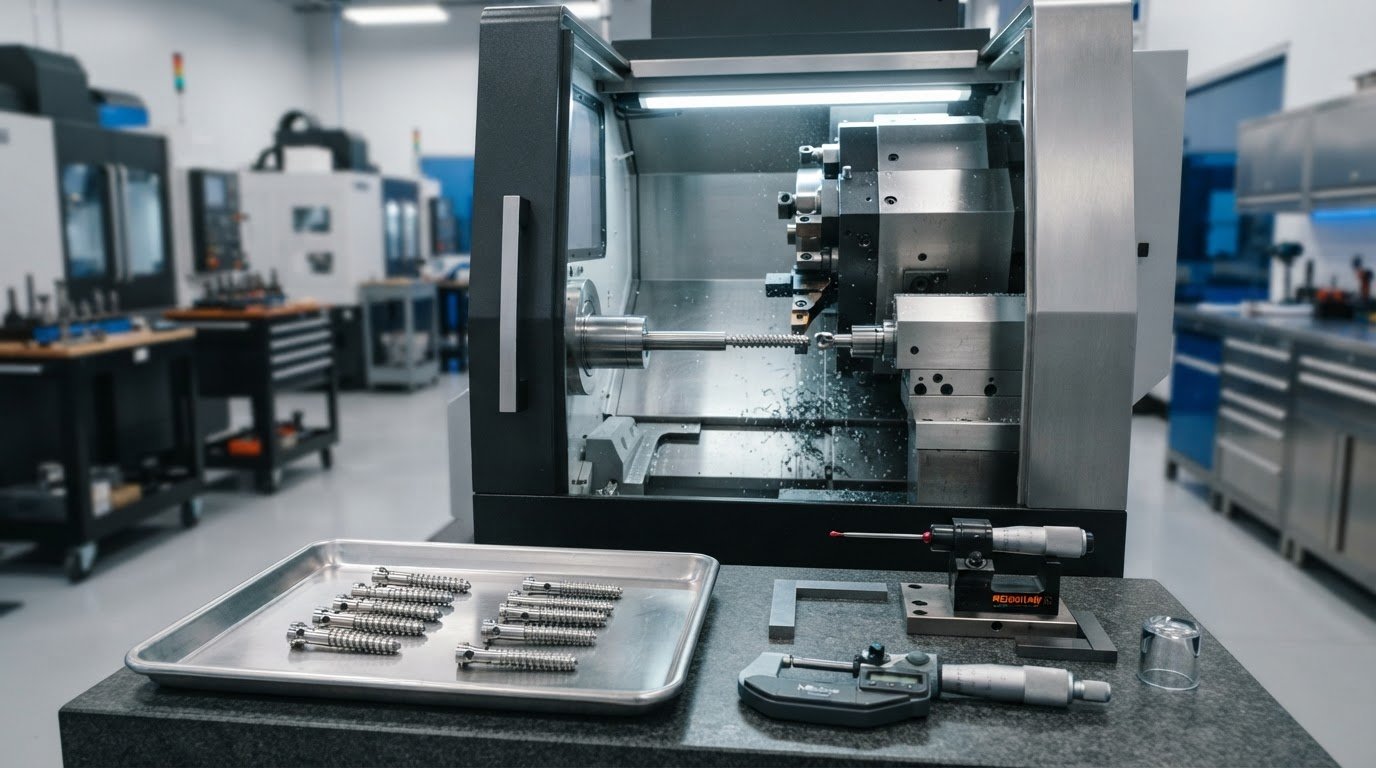
Swiss-type screw machining is a form of precision turning generally used for small, slender parts with controlled features along their length. Bar stock advances through a guide bushing that supports the workpiece near the cutting area. This support can help manage deflection on long, narrow components, although results depend on the part, material, machine configuration, tooling, and setup. Swiss screw machines are a subtype of automatic lathes.
Depending on the machine and tooling, operations may include turning diameters, cutting grooves or threads, and adding features such as flats or cross-holes. Bone screws, shafts, guide-wire components, and dental implant components are examples that may warrant a Swiss-type feasibility review. They are not automatic process matches: suitability depends on the drawing and manufacturing requirements.
Which medical component geometries may suit Swiss-type turning?
Long, slender turned components are a common reason to evaluate this process. Suitability also depends on the part’s diameter-to-length relationship, feature locations, tool access, and how the workpiece can be supported and held. A machine may complete multiple operations in one setup, depending on its configuration, but feature access and inspection needs still require review. Ask engineering to assess the component drawing before selecting the process.
What Swiss-type machining does not establish by itself
A machine label doesn’t demonstrate that a supplier can repeatedly meet your drawing requirements. Ask for evidence relevant to the part, including process controls, measurement methods, and documented manufacturing history. Dimensional conformance addresses specified measurements; by itself, it doesn’t establish cleanliness, biocompatibility, or finished-device performance. Address those requirements through the applicable manufacturing and product qualification activities.
Process selection determines how a part may be made; product qualification determines whether the finished device meets its requirements. A component supplier’s machining process is one part of the broader evidence needed by the device manufacturer. Confirm each party’s responsibilities, and assess machining alongside inspection, finishing, assembly, and validation needs. Swiss screw machining for medical parts may suit a particular geometry, but confirm its suitability for the specific design and production plan.
How Swiss-type machining produces precise medical components
A Swiss-type production sequence begins with bar stock fed through the machine and positioned by a guide bushing near the cutting zone. As the stock advances, turning tools shape the exposed section. Depending on the machine configuration and drawing, additional tools may drill, groove, or form threads, sometimes while other operations continue on the part. The component is then cut off, or parted, from the remaining bar.
From bar stock to a finished turned feature
Tool movements may be coordinated to complete multiple features within a setup, but the sequence depends on the part and equipment. Tool selection, alignment, setup parameters, and bar condition can all affect the result. Material consistency and how the stock behaves during cutting matter too. If the drawing includes features that the turning setup cannot produce effectively, operations such as milling or grinding may be considered as secondary processes.
Don’t rely on generic claims about achievable tolerances, cycle times, or material compatibility. Ask the supplier to review the drawing and confirm what the proposed equipment and process can demonstrate for your component. The defined sequence should reflect the part’s geometry, material, required features, and production plan.
Inspection and process controls for medical parts
Start inspection planning with the drawing. Identify critical-to-quality characteristics, such as specified diameters, lengths, threads, or feature locations, then agree on how and when each will be measured. The method must suit the feature: a coordinate measuring machine (CMM) may be useful for certain geometries, while other characteristics may call for different instruments or in-process checks. Documented records help connect results to defined requirements.
Repeatable machining is meaningful when inspection evidence shows that the defined requirements were met. Ask how measurement equipment is controlled, how inspection results are recorded, and what happens when a result falls outside the acceptance criteria. For medical-device projects, clarify how supplier controls fit with the legal manufacturer’s responsibilities. The FDA device regulation overview provides context on U.S. device requirements.
For swiss screw machining for medical parts, connect the machining plan to inspection and any required secondary operations before finalizing the process. Fong’s confirms capabilities including unmanned CMM inspection and real-time in-process monitoring, but Swiss-type machining availability and component fit must be verified directly. Engineering and sourcing teams can discuss component manufacturing requirements and confirm which capabilities apply to a specific project.
Swiss screw machining vs. other processes: choose by part requirements
Base process selection on the drawing and production plan, not a machine label. Geometry, feature orientation, material, tolerances, inspection requirements, and expected volume can all affect the right approach. Use the comparison below as a starting point for engineering review, not as a ranking of processes.
| Process | Geometry that may suit it | Operations and inspection considerations | Production considerations |
|---|---|---|---|
| Swiss-type turning | Slender, turned components with features along their length | Turning and, depending on configuration, drilling, grooving, or threading may be combined. Plan inspection around drawing-critical features. | Assess bar stock, setup, tooling, volume, and the supplier’s demonstrated process capability. |
| Conventional CNC turning | Shorter or more rigid rotational parts, depending on workholding and machine capacity | Turning features may require additional setups or processes when feature access is limited. | Compare setup and handling needs with the component’s geometry and production plan. |
| Milling | Prismatic forms, flats, slots, or features oriented across multiple faces | Tool access, workholding, and the number of setups can affect how features are made and measured. | Evaluate operation sequence and inspection needs for the complete feature set. |
When conventional CNC turning or milling may be a better fit
A relatively short turned part may not need the slender-workpiece support associated with Swiss-type turning. Cross-holes, flats, or features on several faces may instead point toward milling or a combined process. Consider how tools can reach each feature, how the part can be held, and how finished characteristics will be verified. Ask engineering to compare feasible routes against the actual drawing.
How secondary operations change the comparison
Some drawings call for operations beyond turning or milling. Wire-cut EDM may be considered for specific profiles, while centreless grinding may suit certain external cylindrical surfaces. Laser processing or finishing may also be relevant when the design requires them. Each added step can introduce another handoff, setup, or inspection point. Combining operations may reduce handling, but it doesn’t remove the need to control and document the process.
For medical parts, assess process controls in the context of applicable quality-system requirements, including the FDA’s Quality Management System Regulation (QMSR) where relevant. Fong’s confirmed capabilities include turn-mill, CNC milling, wire-cut EDM, and centreless grinding. Confirm project-specific process fit and availability with engineering. If the project extends beyond components, review medical device contract manufacturing services as part of the broader manufacturing discussion.
For swiss screw machining for medical parts, compare the complete route, including inspection and secondary operations. Don’t assume one process is inherently more precise, faster, or economical.
How to qualify a Swiss screw machining supplier for medical parts
Qualify the supplier against the component’s documented requirements, not an equipment list alone. Before requesting a proposal, organize the drawing, intended use, critical-to-quality features, material requirements, expected volumes, and applicable inspection or validation needs. This gives engineering and sourcing teams a shared basis for assessing manufacturability and comparing supplier evidence.
Questions to ask before requesting a manufacturing proposal
- Can you review the drawing and intended use? Identify critical features and clarify which specifications need particular process controls or inspection.
- Is Swiss-type equipment available for this component and production plan? Request project-specific confirmation, including relevant machine capacity and evidence of experience with comparable geometry.
- Can you meet the specified material and tolerances? Ask how the supplier will verify conformance, which measurement methods apply, and whether any requirements need clarification.
- Which operations are included? Confirm whether the proposal covers only machining or also specified secondary processes, and clarify any handoffs to other suppliers.
- Who owns process validation and acceptance? Agree on responsibilities for validation, change control, records, and acceptance criteria before work begins.
If design changes remain possible, an early medical-device design-for-manufacturability review can help identify features that affect process choice, inspection access, or production planning.
Evidence that supports a controlled medical manufacturing process
Ask for evidence that applies to the manufacturing site and proposed process. Review the scope of the supplier’s quality system, including applicable ISO 13485 controls, and clarify how material and process traceability are maintained. Discuss how nonconforming product is identified, contained, investigated, and addressed, including the supplier’s corrective and preventive action (CAPA) process and controls over sub-tier suppliers.
Where process validation is required for the project, establish whether and how installation qualification (IQ), operational qualification (OQ), and performance qualification (PQ) will be addressed. Review relevant risk documentation, measurement-system controls, process records, and history for comparable work. Confirm that the evidence supports the specific component and site. A general capability statement is not a substitute for project-relevant documentation.
Fong’s states ISO 13485 quality-system capability and validation frameworks that include IQ, OQ, and PQ. Its supplied information does not confirm Swiss screw machining, so buyers should verify process availability, component fit, materials, tolerances, inspection methods, and volumes directly. For a project-specific discussion, contact Fong’s about your component requirements.
Assessing Fong’s for medical component machining and manufacturing
Fong’s Engineering & Manufacturing is a medical-device CDMO with confirmed precision machining capabilities that include auto-lathes, turn-mill, 2-axis and 5-axis CNC milling, wire-cut EDM, and centreless grinding. Its supplied capabilities also include real-time in-process monitoring, unmanned CMM inspection, and process validation frameworks that include IQ, OQ, and PQ. These capabilities provide a basis for a project-specific discussion, but they don’t confirm that Swiss-type screw machining is available.
Where Fong’s confirmed capabilities may support a project
Machining is one part of manufacturing readiness. Depending on the device and project scope, buyers may also need to coordinate secondary processes, inspection, assembly, or downstream requirements. Fong’s confirms Class 8 cleanroom assembly, alongside its machining and quality-system capabilities. Confirm directly whether specific needs such as laser processing, testing, finishing, or packaging are within the proposed scope; they are not established by the capability information provided here.
Fong’s states ISO 13485 quality-system capability. Confirm which quality-system scope and site apply to the project, and which validation activities are appropriate for the process. For further design considerations, see this micro precision medical components engineering guide.
What to provide for an engineering fit review
A focused review is more useful when the team can assess the complete component and its intended manufacturing context. Prepare:
- Current drawings and material specifications.
- Critical dimensions, tolerances, and other critical-to-quality characteristics.
- Forecast production volumes and any known design or process constraints.
- Inspection requirements and acceptance criteria.
- Downstream finishing, assembly, packaging, and validation needs.
This information helps engineering assess process options, equipment suitability, measurement methods, and any secondary operations. It also identifies requirements that need confirmation before a proposal is prepared.
For swiss screw machining for medical parts, Fong’s requires project-specific confirmation of Swiss-type process availability and component fit. Share your drawings and manufacturing requirements with the engineering team to discuss whether its confirmed capabilities align with your project.
Contact Fong’s to discuss your component requirements.
Make the next manufacturing decision with confidence
Select Swiss screw machining for medical parts according to component geometry, inspection needs, and documented process capability, not equipment labels alone. Compare Swiss-type turning with conventional turning, milling, and required secondary operations against the drawing. Then qualify suppliers by reviewing process controls, measurement evidence, traceability, and validation responsibilities before requesting a proposal.
Fong’s confirmed medical manufacturing capabilities include precision machining, real-time in-process monitoring, and unmanned CMM inspection. Its stated ISO 13485 quality-system capability and IQ, OQ, and PQ validation frameworks may be relevant to a project’s manufacturing readiness. Swiss-type machining availability and component fit are not confirmed, so discuss them directly with the engineering team.
Share your component requirements to explore suitable process options and the evidence needed for a thorough review. Discuss your medical component requirements with Fong’s engineering team. Establishing the right technical questions early can help your team move forward with greater clarity.
Frequently Asked Questions
What is Swiss screw machining for medical parts?
Swiss screw machining is a turning process often considered for long, slender, or feature-rich components. Bar stock is supported near the cutting area while tools form the specified features. Suitability depends on the drawing, material, dimensions, production needs, and inspection plan. The process name alone doesn’t confirm a supplier’s capability or establish that a medical device is qualified for its intended use.
Which medical components can be made using Swiss-type machining?
Small turned components may be candidates, but no universal list guarantees process fit. A component’s length-to-diameter ratio, material, feature access, tolerances, and downstream requirements all affect the decision. Ask engineering to review the drawing and confirm suitable equipment, tooling, inspection, and validation needs. Treat Swiss-type turning as a process option to evaluate, not a selection made from a component category alone.
Is Swiss screw machining more precise than conventional CNC turning?
No process is automatically more precise in every application. Results depend on machine condition, tooling, material, setup, measurement systems, and process controls. Swiss-type equipment may suit certain slender or complex turned geometries, while conventional CNC turning may fit other components. Compare supplier evidence against the drawing’s critical characteristics, proposed inspection methods, process controls, and demonstrated capability rather than relying on a machine label.
How do I choose between Swiss machining and milling for a medical part?
Start with the component’s geometry and required features. Turning may suit parts that are primarily cylindrical, while milling may be appropriate for prismatic features or features oriented across different faces. Some designs require more than one process. Review material, tolerances, production volume, inspection needs, and secondary operations with engineering. A manufacturability review can help define a suitable process route before production planning begins.
What quality documentation should I request from a medical machining supplier?
Ask about the applicable quality-system scope, drawing and revision controls, material traceability, inspection records, nonconformance handling, and change management. Determine whether process validation is required and clarify who is responsible for IQ, OQ, and PQ activities. Request evidence showing how critical-to-quality characteristics connect to measurement methods and retained manufacturing records. The documentation needed depends on the product, process, site, and project requirements.
Does Fong’s offer Swiss screw machining for medical parts?
Fong’s supplied capability information lists auto-lathes, turn-mill, CNC milling, wire-cut EDM, and centreless grinding, but doesn’t explicitly confirm Swiss screw machining. Don’t infer availability from related machining capabilities. Share the component drawing and requirements with Fong’s engineering team to confirm whether the relevant equipment, processes, inspection methods, and quality controls are appropriate for the specific project.