
What if the manufacturing commitment that signals progress today becomes a constraint before your next funding milestone? For medical device manufacturing for venture-backed startups, the right scope depends on more than prototype performance. A successful prototype doesn’t yet demonstrate validated, repeatable production, and limited runway makes premature commitments difficult to absorb.
A manufacturing partner should support regulatory readiness without pushing your company into a production model it hasn’t funded. The key is to align manufacturing decisions with product maturity, the applicable regulatory pathway, and the evidence investors need to see.
This guide explains how to assess manufacturing scope against development stage and funded milestones, build an investor-ready plan for quality systems and process validation, and identify the capabilities needed for scale-up. It also covers how integrated engineering, manufacturing, assembly, and validation can support a measured path from development toward production, with near-term commitments grounded in the device’s actual readiness.
Key Takeaways
- Align manufacturing commitments with design maturity and funded milestones, distinguishing prototype readiness from validated production.
- Map device complexity to process needs, quality controls, and a credible scale-up path.
- Compare in-house manufacturing, specialist outsourcing, and integrated CDMO support by control, capability, and operational responsibility, not assumed cost savings.
- For medical device manufacturing for venture-backed startups, organize diligence into documented evidence, forecasts, open risks, and decisions that depend on further design maturity.
- Assess how engineering, machining, laser processing, cleanroom assembly, and smart manufacturing capabilities could support your device’s development through production.
Why venture-backed startups need a stage-aligned medical device manufacturing plan
Limited runway makes manufacturing decisions a matter of capital discipline as well as engineering. Commit too early to equipment, capacity, or production volumes, and the startup may fund requirements the design or market hasn’t established. Wait too long to address manufacturing, and a promising prototype can reach a financing or regulatory milestone without a credible route to repeatable production. Medical device manufacturing for venture-backed startups should advance in measured steps, with each commitment tied to evidence and an upcoming decision gate.
Those steps are distinct. Prototype readiness means a device can demonstrate its intended function in a development context. Design transfer turns design outputs into specifications and instructions that can guide production. Validation generates documented evidence that defined processes can consistently produce conforming output under specified conditions. Commercial production adds the controls, capacity, and supply planning needed to meet actual demand. A general Medical Device Overview can help orient teams to device categories and the broader regulatory context, but a startup’s manufacturing plan must reflect its own device and pathway.
Manufacturing readiness is the evidence-backed capability to repeat a controlled process and produce output that meets defined requirements. A working prototype alone doesn’t establish that capability.
What manufacturing readiness means before commercial launch
Before launch, assess whether product requirements can be translated into defined, transferable processes. Document design inputs, identify manufacturing assumptions, and track unresolved technical risks, such as whether a material, joining method, or assembly sequence can be controlled consistently. Requirements traceability connects each design input to its outputs and verification evidence. Recording decisions, rationale, owners, and open actions makes development more disciplined and gives later transfer and validation work a clearer foundation.
How funding milestones shape production decisions
Start with the next financing or board milestone, then define the manufacturing evidence needed to support it. A pilot build may expose process challenges and inform design refinement; validation planning can specify which processes need qualification and what evidence will be generated. Keep these deliverables distinct from completed validation. A forecast of future commercial volume is an assumption, not a confirmed production requirement, until demand and design maturity justify the commitment.
Make decision gates explicit. For each milestone, record what is known, what remains uncertain, and what evidence would change the next investment decision. For example, a board update might distinguish completed prototype builds from a proposed pilot build, list open process risks, and identify decisions that depend on design maturity. This gives investors a credible view of progress without presenting projections as established capability.
In practice, a stage-aligned plan links:
- Current evidence: Requirements, design outputs, and results already documented.
- Next-stage deliverables: Process definition, pilot-build learning, or validation planning aligned to the milestone.
- Decision conditions: Unresolved risks and the evidence needed before expanding scope or committing to higher volumes.
This structure helps teams protect runway while showing how manufacturing decisions support the route from development toward production.
Matching Manufacturing Partners to Development Stages
A partner should fit the work your device needs now and the transition you expect next. Start with the design, intended production processes, quality requirements, and current development evidence. Then assess whether a focused component scope or broader engineering and manufacturing support best matches the project. Neither model is inherently superior: the right fit depends on product complexity, internal capabilities, and what the next stage must demonstrate.
Use this sequence to structure the assessment:
- Define device needs. Identify the components, assemblies, materials, tolerances, and operating requirements that shape production. Separate established design inputs from open decisions so manufacturing assumptions don’t become mistaken for fixed specifications.
- Assess process fit. Map each component and assembly to the processes it requires. CNC machining may suit precision components; laser processing may address specific cutting or joining needs; molding, cleanroom assembly, and testing may be relevant depending on device design and use. Fong’s capabilities include 2-axis and 5-axis CNC machining, laser processing, molding, assembly, and testing.
- Examine quality. Review how the quality system supports controlled processes, records, change management, and risk documentation. ISO 13485 quality processes and a product-specific quality plan should connect requirements to controls and evidence.
- Plan transfer. Define how design information, process instructions, inspection methods, and acceptance criteria will move into production. Agree on responsibilities for unresolved design questions and for generating transfer and validation records.
- Confirm the scale path. Consider what would need to change as output grows, including process controls, equipment, assembly capacity, testing, and packaging. A scale plan should describe assumptions and decision points, not treat a forecast as a confirmed volume commitment.
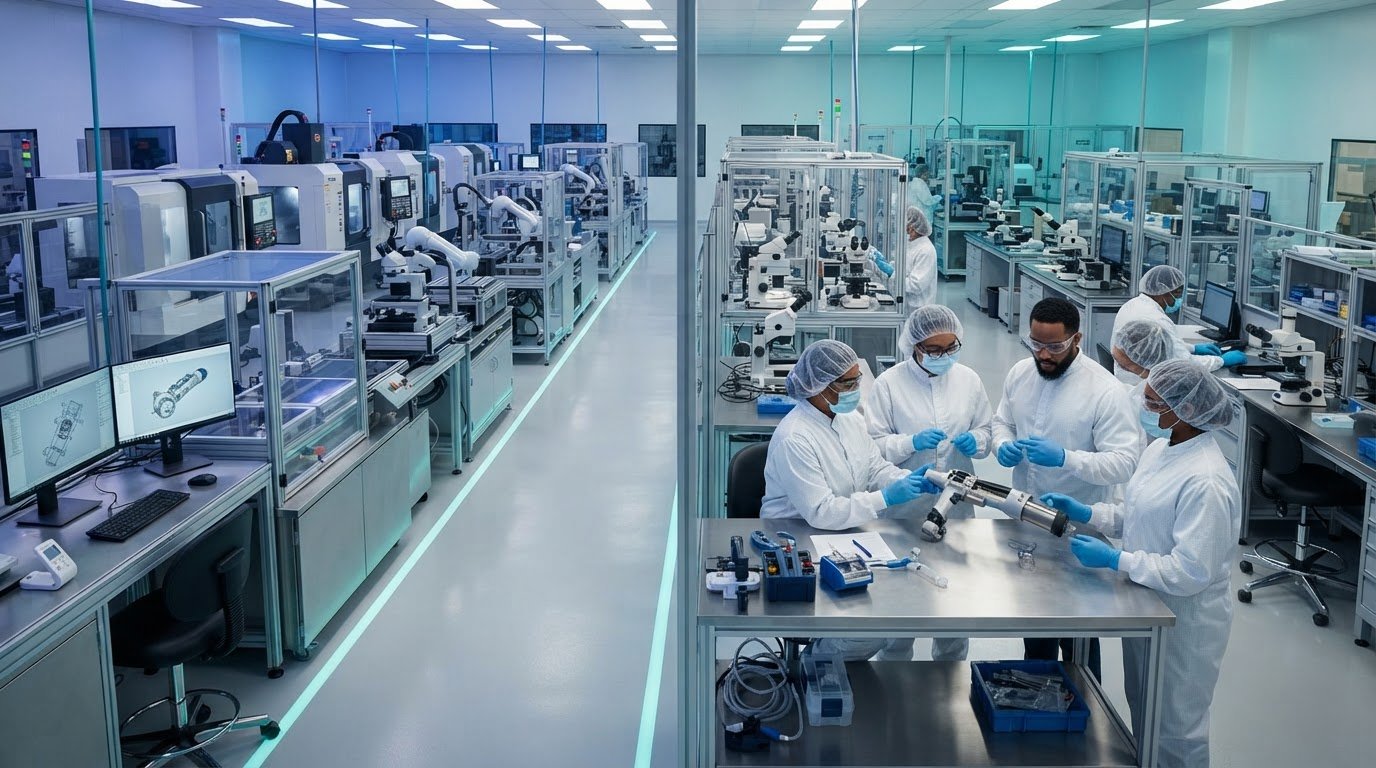
Complexity determines which capabilities matter. A device built around a few precision components may need a tightly defined machining scope and clear inspection criteria. For companies engineering complex diagnostic hardware, such as Animage with its multi-modality imaging platforms, aligning intricate mechanical assemblies with rigorous production standards is critical. A product with interdependent parts, delicate joining operations, or controlled assembly conditions may call for coordinated engineering, laser processing, molding, Class 8 cleanroom assembly, and testing. The objective isn’t to select the broadest capability set. It’s to establish process fit without adding scope the design doesn’t yet require.
Distinguish equipment or process availability from proven performance on your specific device. A partner may have laser processing or cleanroom capability, but device-specific outcomes depend on the design, defined process parameters, acceptance criteria, and appropriate evidence. For processes requiring validation, establish a plan for Installation Qualification (IQ), Operational Qualification (OQ), and Performance Qualification (PQ), with responsibilities and acceptance criteria defined for each. Clarify who owns product submissions and approval activities. Manufacturing support can contribute records and technical information, but it doesn’t guarantee regulatory outcomes.
For a broader view of coordinated development and production, see this full-service medical device contract manufacturing guide. To frame the scope around current evidence and next-stage requirements, start a manufacturing conversation with Fong’s.
How to compare manufacturing options without overcommitting startup runway
Manufacturing models differ in more than where work is performed. They allocate control, technical capability, quality responsibilities, and process knowledge differently. For medical device manufacturing for venture-backed startups, compare options against the work required now, uncertainty in the demand forecast, and the responsibilities your team can manage. Avoid selecting a model on the assumption that one structure is always less costly or more suitable for an early-stage company.
Which manufacturing model fits the startup’s current constraints?
In-house production can suit a team with established engineering, equipment, and quality resources that needs direct operational control. Specialist outsourcing can provide access to defined processes without requiring the startup to build every capability internally. An integrated CDMO can coordinate development, engineering, manufacturing, validation, and assembly when the project needs those activities connected. A full-service scope may exceed an early-stage need, so define the required work package rather than buying breadth by default.
Compare options across these decision factors:
- Control: In-house teams direct day-to-day work; outsourced models rely on agreed specifications, communication, and oversight. Establish who approves process changes and product dispositions.
- Capability: Internal resources may offer close design access; specialist outsourcing addresses a defined technical gap; integrated support may coordinate multiple processes and development activities.
- Responsibility: Identify who maintains records, manages suppliers, controls changes, and prepares process evidence. Responsibilities should be explicit, not inferred from the service label.
- Scope flexibility: Tie the initial scope to current design maturity and decision gates. Define how additional processes or production capacity would be considered as evidence and demand develop.
A narrow component engagement can be appropriate when the design is stable and the main need is a specific manufacturing process. Broader support may be useful when engineering changes, assembly methods, or process development must be coordinated. The distinction is functional, not a ranking: choose the arrangement that covers real dependencies while leaving unneeded capacity and services outside the initial commitment.
Protect flexibility, intellectual property, and future scale
Before work begins, document intellectual-property ownership, confidentiality obligations, access to technical files, and the records each party will maintain. Define change-control procedures, including how proposed design or process changes are reviewed, approved, and recorded. These agreements help protect sensitive information and clarify how process knowledge can support a future transfer or increase in output.
Forecast uncertainty should shape commitments. Separate expected demand from confirmed requirements, and identify which equipment, tooling, or process investments depend on forecast growth. Ask whether production records and process instructions will be sufficiently clear to support continuity if volumes increase or manufacturing arrangements change. This isn’t a reason to avoid outsourcing; it’s a reason to make transferability part of the scope.
Automation can also form part of the comparison. Fong’s smart manufacturing lines use real-time monitoring, robotic handling, and automated inspection. Assess these capabilities against the product’s process and control needs, not as a substitute for product-specific evidence or an assurance of outcomes. A discussion with Fong’s engineering team can help define a scope around your device’s current requirements and next-stage plans.
Build an investor-ready manufacturing diligence and milestone checklist
Manufacturing diligence is most useful when it shows what the team has demonstrated, what it expects, and what remains unresolved. For medical device manufacturing for venture-backed startups, that distinction helps founders communicate progress without presenting forecasts as evidence. Maintain one working checklist for technical reviews and investor updates, with an owner and status for each item.
Evidence to review before committing to a manufacturing scope
Review records against the current design and proposed production approach. The medical device manufacturing compliance guide can help frame the quality and compliance questions that belong in this review.
- Requirements: Trace design inputs to outputs, verification evidence, and unresolved requirements.
- Process risks: Review process flows and, where relevant, PFMEA records showing potential failure modes, effects, and planned controls.
- Quality records: Identify applicable records, including nonconformance and CAPA documentation, and define how changes are reviewed and approved.
- Inspection strategy: Document proposed inspection methods, acceptance criteria, and the rationale for monitoring critical process characteristics.
- Supply chain: Record key material and component dependencies, known supplier risks, and assumptions that could affect continuity.
- Scale assumptions: Separate forecast volumes from confirmed requirements; note which capacity decisions depend on design maturity or demand evidence.
Validation must be tied to defined processes and acceptance criteria. Evidence is meaningful only in relation to the conditions and outputs it was designed to evaluate.
Milestones from engineering builds to production readiness
Set gates that show what has been completed, who owns the next action, and what evidence supports a decision. A design-for-manufacturability review can surface production constraints early; this medical device design-for-manufacturability guide provides related considerations.
- Prototype refinement: Confirm design inputs and build records; assign owners to open technical risks and document changes needed before the next build.
- Pilot build: Define its purpose, process flow, inspection approach, and learning objectives. Record deviations and decisions rather than treating a successful build alone as proof of process validation.
- Validation planning: Identify processes requiring validation, protocols, acceptance criteria, responsibilities, and required records. Track planned evidence separately from completed results.
- Production transfer: Review approved specifications, work instructions, quality records, training needs, and remaining risks before authorizing the defined transfer activities.
For each gate, label information as confirmed evidence, forecast, open risk, or a decision pending design maturity. This makes board updates clearer and keeps investment decisions connected to documented progress. Discuss your manufacturing diligence and milestone plan with Fong’s to align development, engineering, validation, and production scope with the device’s current stage.
When Fong’s can support a startup from device development through production
Fong’s provides coordinated engineering, manufacturing, assembly, and validation support for medical-device projects, from defined processes to broader CDMO programs. The right scope depends on the device’s current design and next milestones. A focused engagement can address a specific manufacturing need, while broader CDMO support can connect related development and production activities as the project matures.
For medical device manufacturing for venture-backed startups, assess capabilities against product requirements and support them with appropriate process evidence. Fong’s supports medical-device manufacturers with precision machining, advanced laser processing, molding, assembly, testing, and packaging. Its Class 8 cleanroom facilities support disposable and reusable device assembly. These capabilities provide a basis for evaluating technical fit, not a promise of a specific product outcome or regulatory clearance.
Match Fong’s capabilities to the device’s technical needs
Start with the device architecture and identify which features drive manufacturing complexity. Micro-precision components may call for 2-axis or 5-axis CNC machining. Designs that depend on laser processing should be assessed against the required feature, material, and process controls. Assembly needs may call for Class 8 cleanroom conditions, while testing and packaging requirements depend on the product and agreed scope. If sterilization is part of the product plan, define the process interface and ownership within the project requirements rather than assuming it is included in manufacturing scope.
Fong’s smart manufacturing lines use real-time monitoring, robotic handling, and automated inspection. Consider these capabilities where the project’s process-control approach calls for them. Their relevance depends on the process, inspection criteria, and evidence required; automation alone doesn’t establish that a device-specific process is validated or that a product will meet a regulatory outcome.
Fong’s integrated manufacturing platform supports medical-device projects from development activities through production planning. Align capacity and site planning with the project’s actual requirements, timing, and intended milestones, without treating future capacity assumptions as current production commitments.
Prepare for a focused manufacturing conversation
A useful initial discussion is grounded in project facts. Prepare a concise summary of device maturity, intended manufacturing processes, known technical risks, forecast assumptions, and the next funding, board, or development milestones. Distinguish established design requirements from estimates that may change as the design develops. This helps keep the proposed manufacturing scope proportionate to current evidence.
Also identify the quality and operational questions that need joint planning: which party owns design and process records, how changes are controlled, what validation activities are anticipated, and what evidence is needed before expanding production. Where the project includes complex assembly or multiple processes, clarify how engineering, manufacturing, testing, sterilization, and packaging activities will be coordinated. These details help establish a practical route from development work to production readiness without treating future volume as a present commitment.
To discuss device requirements, development stage, and intended milestones, discuss your medical device manufacturing requirements with Fong’s.
Set your next manufacturing decision in motion
Turn your upcoming financing or development milestone into a defined manufacturing decision: what evidence must be ready, which process risks need resolution, and what scope can wait until the design matures? That discipline keeps medical device manufacturing for venture-backed startups tied to progress the team can demonstrate, rather than capacity built around assumptions. Define what you’ll commit to now and what evidence will trigger the next expansion of scope.
Fong’s Engineering & Manufacturing was founded in 1982 and brings more than 40 years of experience supporting medical-device manufacturers. Its combined platform includes more than 1,000 production staff and over 500,000 square feet of facilities. These resources provide a basis for planning how development needs may evolve toward production, with your requirements and milestones at the center.
Bring your current design information, key uncertainties, and next decision gate to the conversation. Plan a manufacturing discussion with Fong’s around the evidence your team needs to advance.
Frequently Asked Questions
Is a contract manufacturer suitable for an early-stage medical device startup?
Yes, a contract manufacturer can support an early-stage startup when the work is clearly scoped to its current needs. For example, a team may outsource a precision component or assembly operation while retaining design decisions and product-level responsibilities internally. Define deliverables, decision authority, documentation, and change procedures before work begins. A contract relationship doesn’t require committing to full commercial production; the engagement can focus on a specific development need.
How can a venture-backed startup control manufacturing risk before raising its next round?
Control risk by limiting commitments to work that advances a defined technical or financing milestone. In medical device manufacturing for venture-backed startups, useful controls include tracking design changes, recording process assumptions, assigning owners to open risks, and maintaining evidence from each build. Separate completed results from planned validation or forecast demand in investor materials. This helps the team show what has been demonstrated and which decisions depend on further design or funding.
What should a startup include in a medical device manufacturing RFP?
Include a device overview, intended use, design maturity, drawings or specifications, materials, expected processes, quality expectations, and the requested scope. State forecast volumes as estimates, not firm requirements, and identify the regulatory pathway under consideration. Ask respondents to describe proposed deliverables, validation responsibilities, documentation, change control, supply-chain assumptions, intellectual-property protections, and exclusions. Clear acceptance criteria for each deliverable make responses easier to compare and reduce ambiguity during project planning.
Can a startup change manufacturing partners after product development?
Yes, but a transfer requires controlled planning. The startup should review contracts and ownership of drawings, tooling, process instructions, inspection methods, and production records. The receiving operation may need to assess equipment and process differences, reproduce the defined process, and determine what verification or validation activities are appropriate. Changes to suppliers, materials, or methods can affect evidence and product risk, so document the rationale, approvals, and transfer results.
How do ISO 13485 and FDA 510(k) relate to a manufacturing partner?
ISO 13485 concerns a quality management system for medical-device organizations; it isn’t a clearance for an individual device. A 510(k) is a submission pathway for a device, and FDA clearance applies to the specific device and submission, not automatically to every product made by a manufacturing partner. Define how the partner’s quality processes and records support the device program, while the responsible company clarifies ownership of submission activities.
What information should founders share when evaluating a medical device manufacturer?
Share enough controlled information to assess technical fit: device function and intended use, current design files, key materials, critical requirements, and known manufacturing challenges. Include build history, test results, unresolved risks, and expected process steps where available. Explain the next development or financing milestone and distinguish volume forecasts from confirmed demand. A concise, organized package helps focus the discussion on engineering needs, quality responsibilities, and realistic next-stage deliverables.