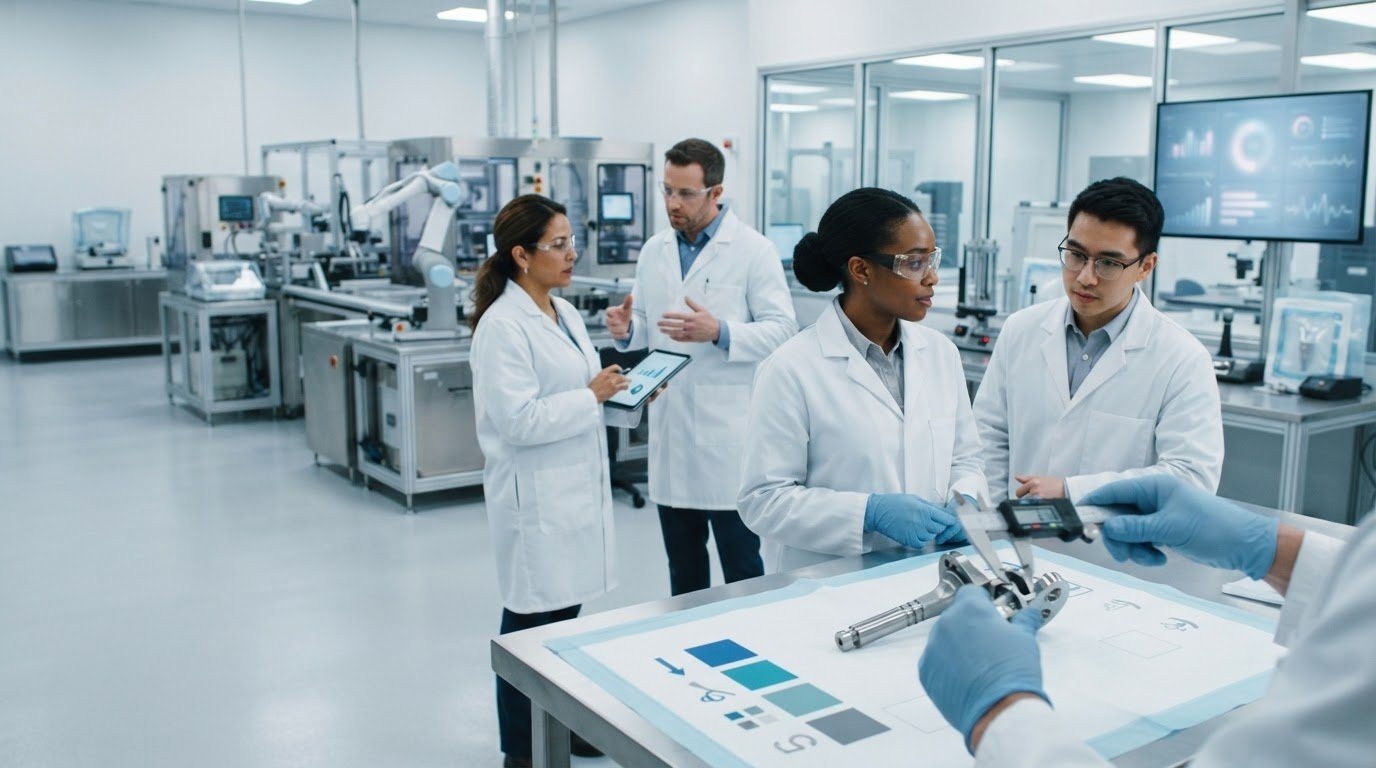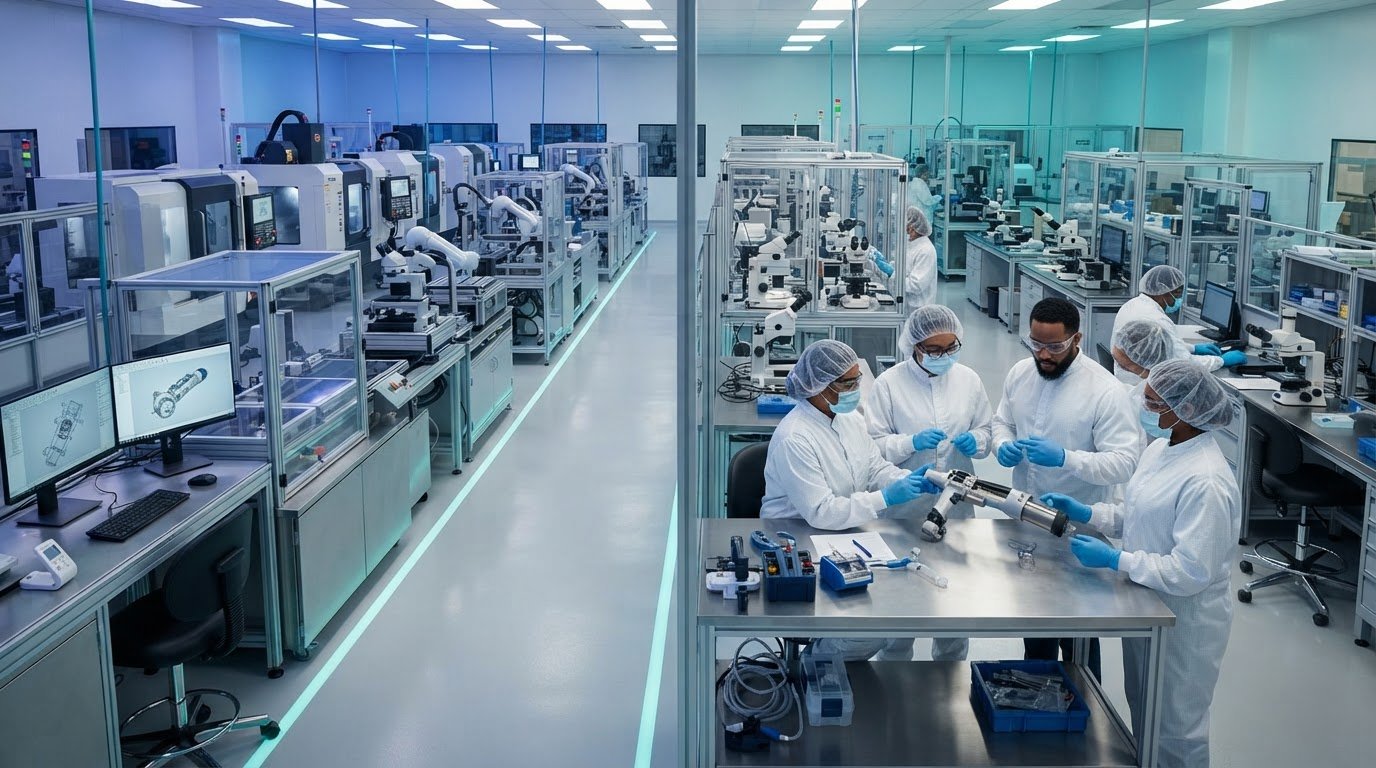

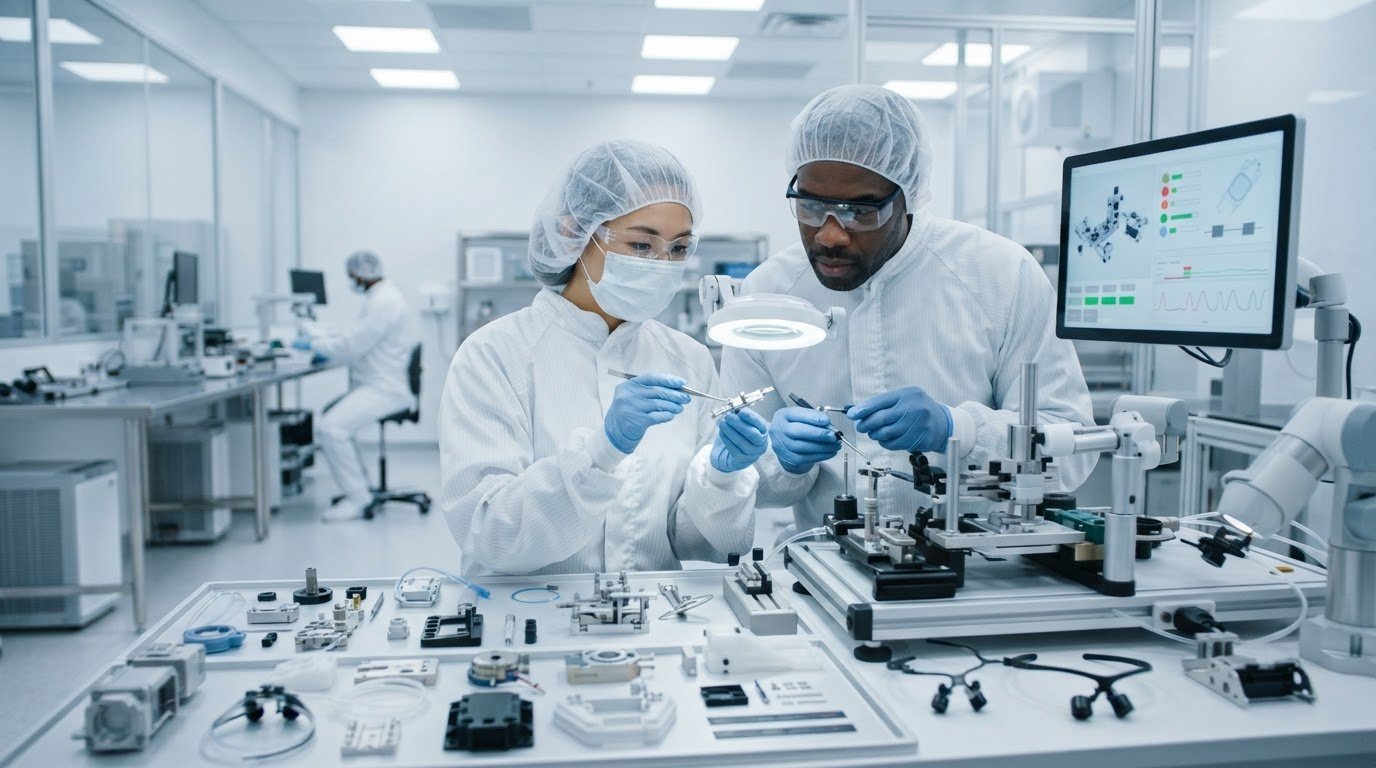
In complex medical device assembly, the greatest risk may lie not in a single component but in the interfaces between components. Precision parts, different materials, and interconnected subassemblies can each meet their individual specifications and still create problems when production begins. Consistent results depend on engineering those interfaces alongside assembly controls and a validation plan.
Reliable assembly takes more than careful integration. Teams need defined inspection criteria, in-process testing, and documented process controls to support repeatable manufacturing within a medical device quality system.
This article explains how to build that path, from design and prototype decisions through process validation and production readiness. It covers the engineering considerations, controls, and testing that help turn a complex design into a controlled assembly process. Fong’s brings more than 40 years of medical device manufacturing experience, Class 8 cleanroom assembly, and IQ/OQ/PQ validation frameworks to this work. Its full-service CDMO capabilities span machining, laser processing, molding, assembly, and testing, connecting development decisions to production execution.
Key Takeaways
- Assess assembly complexity by examining interfaces, tolerances, materials, and feature size, not just the number of components.
- Match manual, semi-automated, or automated assembly to the device’s characteristics and the repeatability the process requires.
- Understand how machining, laser processing, molding, and precision joining contribute at different stages of complex medical device assembly.
- Distinguish design verification from process validation and routine production monitoring when planning a production transfer.
- Use staged readiness gates, from documented requirements through process trials and controlled release, to structure the path to production.
Why Complex Medical Device Assembly Requires More Than Component Joining
Complex medical device assembly is the controlled integration of components, manufacturing processes, process controls, and verification activities into a finished device. It goes beyond joining parts: each interface must meet defined requirements, and the assembled device must be inspected and tested against its specifications. The medical device category covers a broad range of products, so assembly requirements depend on the device’s design and intended use.
Tight tolerances leave less room for variation in positioning or fit. Mixed materials can respond differently to heat, pressure, or joining methods. Small features can be difficult to handle or inspect, while multiple interfaces create more points where dimensions and process steps must align. A change at one stage can affect how a later component fits or functions.
Assembly complexity depends less on the number of parts than on how component interfaces and process steps interact. It also helps to distinguish the activities involved in producing a finished device:
- Component fabrication produces individual parts through processes such as precision machining, laser processing, or molding.
- Subassembly joins selected components into a smaller functional unit.
- Final assembly integrates subassemblies and remaining components into the complete device.
- Inspection and testing assess defined characteristics at appropriate stages. These are verification activities, not assembly steps.
- Packaging prepares the device for its next handling or distribution stage, separately from component joining.
Which device characteristics create assembly complexity?
Examples include endoscopy devices, stents, surgical instruments, and robotic surgical adapters. Miniaturization can make handling and placement more demanding. Material compatibility can influence the choice and sequence of joining processes, while functional interfaces must fit together as intended. A stent’s fine geometry presents different manufacturing considerations from the interfaces of a surgical instrument. Complexity depends on the specific design and manufacturing process, not simply on the device category.
What can go wrong when interfaces are poorly controlled?
A misaligned interface may affect the fit of the next component. Inconsistent joining can create variation between assemblies, while excessive handling or an unsuitable process may damage delicate features. These issues can appear during downstream inspection or testing, when a dimension, fit, or functional check fails to meet its defined acceptance criteria.
The effect can extend beyond the immediate joint. Variation introduced early may require investigation across later steps, complicating process control and production records. Clear interface requirements, suitable handling methods, and inspections at relevant stages make variation easier to identify and manage.
How Engineering Processes Work Together in Complex Device Assembly
Assembly becomes repeatable when engineering choices are translated into a defined sequence of operations, handoffs, and checks. The process plan connects how components are made with how they are positioned, joined, inspected, and tested. Sequencing operations around component interfaces helps control variation before it carries into downstream assembly and testing.
Not every device follows the same route, but a typical workflow moves from prepared components to joining, subassembly, final assembly, and product testing. CNC machining may produce precision features, laser processing may cut or shape components, and injection molding may form parts with defined geometries. Joining methods are selected to suit the materials and interface requirements. The engineering task is to make the steps compatible, rather than select each process in isolation.
How do components move from fabrication into assembly?
Before assembly, incoming components are reviewed against documented requirements, with particular attention to characteristics that affect fit or function. Controlled handoffs preserve identification and status as parts move between fabrication and assembly. Design tolerances and interface requirements guide fixture design, orientation, handling, and process settings. This planning gives operators a defined way to position components and makes critical assembly conditions easier to inspect.
Consider an endoscopy device as an illustration, not a universal production route. A precision-machined feature, molded housing, and laser-processed component may each require a different fabrication method before integration. Engineering teams determine how the parts locate against one another, which joining sequence preserves access to the interfaces, and where a check can detect misalignment before the next operation makes investigation more difficult.
In-process checks belong at points where they can provide useful evidence about the preceding operation or confirm readiness for the next one. Depending on the device, checks may examine position, fit, or a process-specific characteristic. Product testing occurs at a defined stage, often after final assembly, but its methods and acceptance criteria should reflect device requirements. No single sequence or test plan applies to every product.
Where do cleanroom assembly and automated processes fit?
Cleanroom assembly provides environmental control when the device and manufacturing requirements call for it. Fong’s Class 8 cleanroom facilities support assembly of disposable and reusable devices. Automation can also suit specific tasks: robotic handling supports consistent component movement, while smart manufacturing lines use real-time monitoring and in-process testing to provide information about defined operations. The right approach depends on device characteristics, risk profile, and validated requirements.
Choose processes to meet design requirements and produce the evidence needed to control production, rather than defaulting to the most automated option. A manual operation may suit some assembly tasks; another may benefit from dedicated equipment or monitoring. For teams translating design interfaces into a controlled production sequence, Fong’s assembly engineering team connects process planning with manufacturing execution.
How to Evaluate Assembly Approaches for Device Complexity and Production Needs
Choose an assembly approach by matching each operation to the device’s features and the controls needed for consistent results. Manual, semi-automated, and automated methods each have a role. Consider component size, joining precision, production requirements, inspection access, and how process data will be recorded.
Automation should follow process requirements, not serve as an end in itself. A highly automated cell may be unsuitable if it restricts inspection access or cannot accommodate delicate components. A controlled automated task, on the other hand, may reduce variation when consistent positioning or handling is essential. The comparison below is a starting point; actual process selection depends on device design and validated requirements.
| Approach | Potential strengths | Trade-offs and suitable situations |
|---|---|---|
| Manual | Flexible handling and direct operator access. | May suit lower-volume or variable tasks; repeatability depends on clear instructions, training, and appropriate inspection. |
| Semi-automated | Combines operator judgment with equipment-controlled steps. | Requires coordination between manual and machine operations; may suit tasks that need both flexibility and repeatable positioning or joining. |
| Automated | Can support consistent execution of defined, repeatable operations and process monitoring. | Requires suitable equipment, process controls, and validation; may suit stable tasks where production needs justify it. |
Which assembly method fits the device and process?
Start with the operation’s critical characteristics. Small components may need fixtures that control orientation. Precision joining may call for equipment that maintains defined process conditions. Inspection requirements may determine whether operators need direct access during assembly. Throughput matters, but it should not override process capability. For complex medical device assembly, compare each method with documented requirements and the evidence needed to show that the operation remains controlled.
Evaluate connected decisions together. Cleanroom needs depend on the device and process requirements. Joining methods influence fixture design and inspection access. Traceability should capture relevant process information, while packaging requirements can affect how the completed device is handled and protected after testing. A change in one area may require adjustments elsewhere, so plan for the full production flow.
How should engineering and production requirements align?
Design for manufacturability connects device geometry to practical assembly access, fixturing, process control, inspection, and packaging. An early review can identify features that complicate repeatable assembly, such as hard-to-reach interfaces or limited access for verification. Fong’s medical device DFM engineering guide explains how engineering decisions relate to manufacturing execution.
Production planning benefits from a lifecycle view. Fong’s medical device contract manufacturing services connect engineering and manufacturing capabilities across development and production. Aligning product design, process selection, inspection strategy, and packaging requirements helps teams assess assembly choices as one coordinated system.
Which Readiness Gates Help Transfer Complex Assembly Into Production?
Production readiness is demonstrated through evidence, not a handoff date. For complex medical device assembly, teams need to show that design requirements are understood, the selected process is appropriately qualified, and routine controls can identify variation. The evidence depends on the device, its manufacturing process, and its intended markets. A staged review helps identify gaps before controlled production release.
- Document requirements and risks. Establish approved specifications, interface requirements, acceptance criteria, and process risks that need control. These provide the basis for selecting inspections and tests.
- Prepare the process definition. Approve work instructions, equipment requirements, process parameters, inspection methods, and record requirements. Confirm that responsibilities and component handoffs are clear.
- Run process trials. Use planned trials to assess whether equipment, fixtures, instructions, and inspection methods work together under defined conditions. Record results and address gaps before qualification.
- Verify the design and validate the process. Design verification evaluates whether the device meets its specified design requirements. Process validation evaluates whether manufacturing can repeatedly produce output that meets defined requirements, particularly when later inspection alone cannot fully verify the results.
- Approve controlled release and monitor production. Review the required evidence and authorize release through the applicable quality process. Routine production monitoring then uses defined checks, records, and review mechanisms to detect process drift or nonconforming output.
What evidence supports a controlled assembly process?
Evidence may include approved instructions, defined process parameters, equipment records, inspection results, test records, and traceable documentation linking production activity to requirements. Test methods and acceptance criteria should suit the device characteristics and process risks they address. IQ/OQ/PQ frameworks structure equipment and process qualification: installation qualification, operational qualification, and performance qualification. Set the documentation’s depth and content for the particular device and applicable market context, rather than assuming one package fits all.
Design verification, process validation, and routine monitoring answer different questions. Verification asks whether the device design meets its requirements. Validation asks whether the process can produce conforming output under defined conditions. Monitoring checks whether the released process continues to operate within its controls. Fong’s uses IQ/OQ/PQ process validation frameworks as part of its manufacturing capabilities. Its medical device manufacturing compliance perspective covers broader quality-system considerations.
How should teams manage process changes after transfer?
Changes to materials, equipment, fixtures, instructions, or process settings call for documented assessment before implementation. Review potential effects on product requirements, process risks, inspection methods, and existing validation evidence, then determine whether additional qualification or revalidation is appropriate. CAPA supports investigation and correction of identified quality issues, while PFMEA helps teams analyze potential failure modes and prioritize controls. Neither replaces sound process design or effective execution.
Fong’s quality systems include ISO 13485 and IQ/OQ/PQ validation frameworks. Fong’s production-readiness support connects assembly transfer planning with manufacturing controls.
How Fong’s Integrates Complex Medical Device Assembly Capabilities
Fong’s supports medical device development from concept and engineering through assembly and production. Its full-service CDMO model brings process planning and manufacturing capabilities together, helping teams translate product requirements into production operations. With more than 40 years of medical device manufacturing experience, Fong’s works across precision processes, cleanroom assembly, testing, and packaging.
The manufacturing platform includes more than 1,000 production staff and more than 500,000 sq ft of facilities. For complex medical device assembly, that breadth connects capabilities across process stages: precision machining, laser processing, injection molding, full device assembly, product testing, and packaging. Class 8 cleanroom facilities support disposable and reusable device assembly when product and process requirements call for environmental control.
How do integrated capabilities support complex assemblies?
Each process has a role shaped by the component and its interface. Machining can produce precision features, laser processing can support component fabrication, and molding can create formed parts for later integration. Assembly brings these elements together, while testing evaluates defined product characteristics. Fong’s smart manufacturing lines incorporate real-time monitoring, robotic handling, and in-process testing as process controls, not guarantees of a particular outcome.
Fong’s quality systems are ISO 13485 certified, with IQ/OQ/PQ frameworks used for process validation. These provide a structured basis for establishing and documenting process controls, with validation activities planned for the specific operation. Regulatory pathways depend on the product and market. FDA 510(k) clearance and CE marking apply to specific products and should not be assumed to cover every assembly.
What should a project discussion establish first?
A useful technical discussion starts with the information that shapes process choices and production readiness. Device requirements and interface details help engineering and manufacturing teams understand how components must fit and function together. Process constraints and inspection needs clarify which operations and controls are appropriate. Target production requirements provide context for equipment, process planning, and scale-up.
Fong’s uses this project context to align engineering, quality, and manufacturing considerations across development and production. Relevant discussion points include:
- Device requirements, component interfaces, and critical characteristics.
- Existing fabrication or joining processes, along with constraints that affect assembly.
- Inspection, product testing, packaging, and process validation needs.
- Target production requirements and the transition from development activities.
Sharing these details helps frame a practical path from design intent to manufacturing execution. Discuss your complex medical device assembly requirements with Fong’s.
Move Your Assembly Plan Toward Production
The next step for complex medical device assembly is to turn design intent into shared, actionable priorities. Bring engineering, quality, and manufacturing teams together around the decisions that shape the production process: which interfaces need the closest control, what evidence will demonstrate readiness, and how process changes will be assessed throughout the device lifecycle.
A focused project discussion can clarify those priorities before they become assumptions in the manufacturing plan. Device requirements, known process constraints, inspection needs, and production objectives provide a practical starting point for aligning technical decisions with execution. Teams can then define the questions to resolve and the evidence needed to support a controlled transfer.
Fong’s connects engineering considerations with manufacturing planning for medical device teams. Discuss your complex medical device assembly requirements with Fong’s to identify the right next steps for your project.
Frequently Asked Questions
What makes a medical device assembly process different from ordinary product assembly?
Medical device assembly requires controlled processes and records that support product quality, traceability, and applicable regulatory requirements. In complex medical device assembly, a team may need to document which components and process conditions were used for a production lot, then retain inspection or test evidence. Exact controls depend on the product and market. This documented approach helps teams investigate nonconformities and assess whether a change could affect device requirements.
Can complex medical device assembly include both reusable and disposable devices?
Yes. Assembly processes can support both device types, but their production requirements may differ. A reusable surgical instrument, for example, may need design and process considerations related to repeated reprocessing, while a disposable device may require controls specific to its intended single-use configuration and packaging. Device specifications determine the assembly, inspection, and packaging controls. Fong’s Class 8 cleanroom facilities support assembly of both disposable and reusable medical devices.
What does a Class 8 cleanroom classification indicate for device assembly?
Class 8 identifies a defined level of airborne-particle cleanliness in a controlled environment. It describes the room’s particle classification, not the sterility of a device or a guarantee that a product is free from contamination. Cleanroom controls are selected according to product and process requirements, with operating procedures supporting the intended environment. The classification should therefore be considered alongside the assembly activities and applicable monitoring controls.
What do IQ, OQ, and PQ mean in medical device manufacturing?
IQ, OQ, and PQ are stages used to qualify equipment and processes. Installation Qualification (IQ) documents that equipment is installed as specified. Operational Qualification (OQ) evaluates whether it operates across defined conditions. Performance Qualification (PQ) evaluates performance under the planned production process. Together, these activities provide structured evidence about process readiness. Set their scope and acceptance criteria for the equipment, operation, and requirements being qualified.
Does every medical device require FDA 510(k) clearance or CE marking?
No. FDA 510(k) requirements and CE marking depend on the specific device, its classification, intended market, and applicable regulatory pathway. They are not universal requirements for every medical device. Manufacturers determine product-level obligations based on the device’s intended purpose and market scope. A manufacturing partner’s quality systems or experience do not, by themselves, establish that an individual device has a particular clearance or marking.
How are sterilization methods selected for an assembled medical device?
Sterilization selection depends on the device’s materials, design, packaging, and intended processing requirements. The chosen method must be compatible with the assembled product and its packaging, and its suitability needs appropriate validation evidence. Methods used in medical device manufacturing include ethylene oxide, autoclave, and gamma sterilization, but they are not interchangeable defaults. Selection is specific to the product and its documented requirements.
Can assembly processes be changed after production has begun?
Yes, but changes should be assessed and controlled before implementation. A revision to equipment, materials, fixtures, instructions, or process settings may affect product characteristics or existing validation evidence. Teams typically document the change, review associated risks, and determine what verification, qualification, or revalidation is appropriate. CAPA can support investigation and corrective action when an issue arises, while change control helps ensure approved revisions are traceable and communicated.