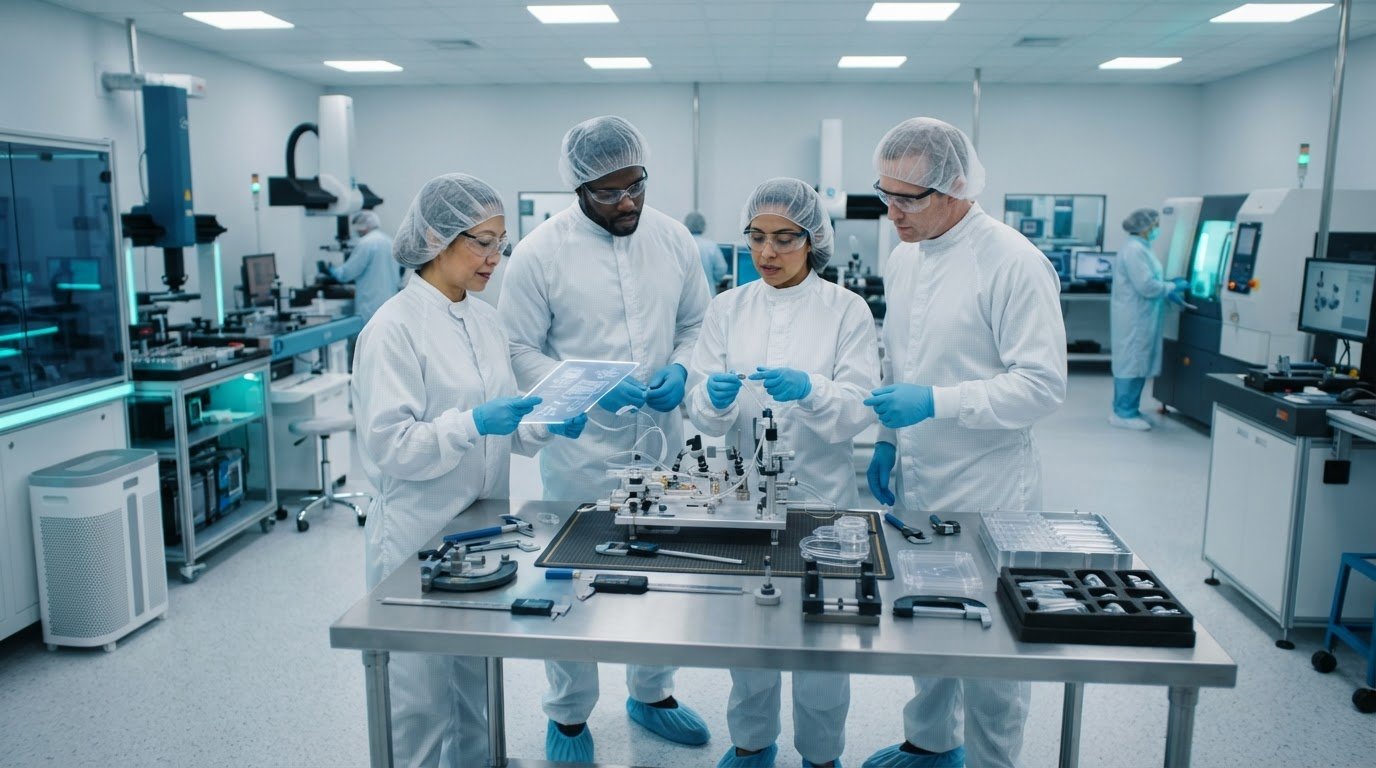

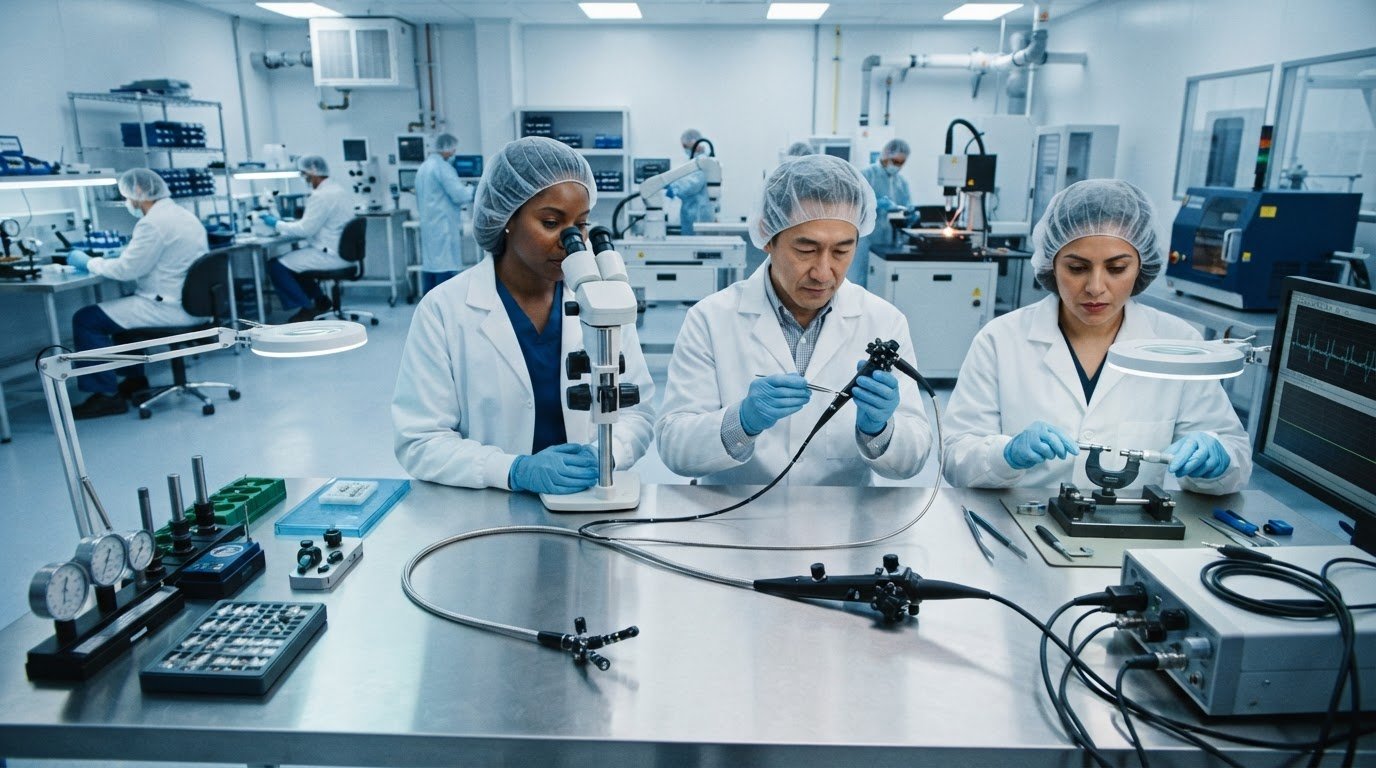
Endoscopic device contract manufacturing can support a product from concept design and prototyping through validation and production. The manufacturing plan should reflect the device’s classification, design requirements, and intended production volume. In the United States, manufacturers of finished medical devices must follow quality system requirements applicable to their devices.
Choosing a manufacturing approach involves more than transferring a design to a production line. Testing, material selection, biocompatibility considerations, and regulatory requirements all shape the path from prototype to production, whether the device is Class I, II, or III.
This guide explains the main stages of development and manufacturing, the role of testing and quality systems, and how production methods may change as volume grows. It also covers factors that influence manufacturing costs and how a CDMO can support complex assembly, validation, and regulatory needs.
Key Takeaways
- Plan inspection and functional testing around the endoscope’s design, intended use, and critical functions so test results inform production decisions.
- Match the production method to volume: laser-cut stainless-steel tubing can suit prototypes and low-volume articulation joints, while stamped and welded assemblies can be more cost-effective at higher volumes.
- Build regulatory and biocompatibility considerations into development, and maintain a quality management system appropriate to the device; the Food and Drug Administration applies this requirement to contract manufacturers that design or manufacture a finished endoscopic device.
- Use the device’s class, design complexity, and production needs to shape the manufacturing plan across Class I, II, and III devices.
- Assess whether development, production, assembly, components, or endoscope refurbishment best addresses the project’s current needs.
Device inspection and functional testing
Inspection should reflect the endoscope’s design, intended use, and assembly sequence. Start by documenting the device configuration and its critical functions. For a flexible endoscope, this may include the insertion section, distal tip, control body, and connections. Record the configuration under test so findings can be traced to the correct design and build.
Next, examine visible features that may affect operation or handling. A defined checklist can cover surface condition, joint alignment, control movement, and component fit. Use consistent viewing conditions and acceptance criteria for each build. If an articulation joint binds or a connection sits unevenly, record its location and condition before adjusting the assembly. This gives engineering a clear basis for review.
Functional testing should assess whether the device performs its intended tasks. Select methods based on the design rather than relying on a generic checklist. For example, move an articulated section through its intended range while observing motion and control response. Image transmission, illumination, fluid pathways, or electrical connections may also need assessment if they are part of the device. Record the procedure, equipment, results, and any deviations.
Engineering laboratories provide a controlled setting for inspection, measurement, and design investigation. A practical sequence is to establish the test configuration, verify the equipment setup, run the procedure, and compare results with documented criteria. If a result falls outside those criteria, retain the sample and records for investigation. Engineering can then determine whether the issue lies with a component, assembly, or test method.
Packaging needs separate evaluation because it can affect device condition during handling and storage. Review the package configuration, protective features, sealing approach, and labeling against defined product requirements. Inspect a packaged endoscope after handling simulations appropriate to its distribution pathway. Record any damage, displaced components, or packaging defects, and link each finding to the relevant build and package configuration.
Repair and refurbishment need a different inspection path from new-device production. First, document the returned endoscope’s condition and identify the affected assembly or function. Complete the repair, repeat relevant functional checks, and record the disposition. This distinguishes repaired units from new builds and supports consistent service records. In complex device assembly, clear work instructions and inspection points can catch fit or connection issues before final testing.
Keep inspection, functional testing, packaging evaluation, and repair records linked through device identification and configuration details. This allows engineering teams to interpret failures in context, refine test methods, and apply validated changes to later builds.
Prototype, pre-production, and high-volume production
Production planning should carry lessons from prototypes into a repeatable manufacturing process. The right approach depends on design maturity, component geometry, and expected volume.
Prototype and Production Tooling
Prototype tooling lets teams evaluate a design before committing to production tooling. For an endoscopic articulation joint, laser-cut stainless-steel tubing may suit prototype and low-volume applications. Assess how the process handles joint geometry, assembly access, and the precision needed for the intended function. Record design changes so later tooling reflects the approved configuration.
Production tooling should match the manufacturing method and the component’s critical features. Compare the approach with part geometry, repeatability requirements, and planned volume. A frequently changing design may suit a flexible prototype method, while a stable design can support tooling for a defined production process. Keep drawings, tooling details, and inspection criteria aligned as the design advances.
Production Volume Stages
Pre-production turns prototype learning into a controlled manufacturing process. Use this stage to refine work instructions, confirm component fit, and identify steps that need closer process control. For example, review an articulation assembly sequence and adjust fixture access before increasing output. Document approved changes so production teams follow the same design and process definition.
At higher volumes, stamped and welded assemblies may be more cost-effective than laser-cut tubing for endoscopic articulation joints. The transition depends on design stability and whether the selected method can produce the assembly consistently. Compare part geometry and assembly requirements before changing processes. The production plan should also account for how components move through fabrication, joining, and final assembly.
Rapid prototyping helps teams evaluate design choices before production decisions become difficult to reverse. Build a prototype to answer a specific engineering question, such as whether a joint profile allows the required movement or adjacent components fit as designed. Review the result, record issues, and update the design record. This focused cycle gives each prototype a clear purpose.
Pre-production should test the proposed process as well as the device design. Map the steps from incoming components through fabrication and assembly. Identify where operators need fixtures, where part orientation matters, and which characteristics require inspection. If a component needs adjustment, update its drawing and related work instructions before building the next batch.
Before selecting a production route, compare the prototype process with the intended high-volume method. Changes in tooling or joining can affect part geometry and assembly steps, so assess the finished configuration rather than assuming the prototype transfers directly. A project team can discuss prototype and production planning when it needs to align design maturity, tooling, and manufacturing stages.
Regulatory and biocompatibility support
Regulatory planning should connect the endoscope’s design, materials, manufacturing steps, and technical evidence. Start with a device record that identifies its intended use, configuration, materials, and production processes. This helps engineering and regulatory teams understand how design decisions affect testing and documentation. For example, assess a change to a patient-contacting material in light of the contact conditions and existing evidence.
Quality systems provide the framework for controlling design and manufacturing records. Contract manufacturers that design or manufacture a finished endoscopic device must maintain a quality management system appropriate to that device, according to the Food and Drug Administration. In practice, controlled procedures connect design inputs, revisions, supplier information, production records, and nonconformity handling. Teams can use those records to trace a finished device back to its approved configuration and manufacturing history.
Biocompatibility considerations start with identifying which materials contact the patient and how the device is used. List each relevant material and its location, then document manufacturing and processing steps that could affect the finished surface. For an endoscope, distinguish materials in the insertion section from components that do not contact the patient. The evidence plan should relate the finished device’s materials and processing to its intended use.
Document and review manufacturing changes. A new material source, joining method, or surface treatment may affect the finished device and its supporting evidence. Record the change, assess its effect on device performance and material exposure, and link any additional evaluation to the revised configuration. This gives regulatory review a clear basis and avoids treating older test records as evidence for an unassessed design.
For a 510(k) submission, contract manufacturing support can help organize technical information about the device, its production, and its testing. Useful inputs include controlled drawings, material records, process descriptions, inspection results, and reports tied to the tested configuration. Keep identifiers consistent across those records. If a test report describes a prototype while the submission describes a revised production design, the difference needs a clear explanation and supporting documentation.
Regulatory support works best when documentation develops alongside engineering, rather than after production decisions are complete. Assign responsibility for reviewing design changes, maintaining records, and addressing gaps in technical evidence. A practical review can trace one component from its material specification through assembly to final documentation. This gives reviewers a coherent account of how the device was designed and manufactured.
Contract manufacturing for Class I, II, and III medical devices
For Class I, II, and III devices, define the manufacturing scope around intended use, design complexity, and production needs. These factors determine the technical evidence, controls, and partner capabilities the project requires.
Manufacturer Selection Criteria
How do I choose an endoscopic device contract manufacturer? Compare its endoscope engineering, production, assembly, and quality-system capabilities with your device’s design and intended use. Then assess whether its processes can support the project’s stage, from development to repeatable production. For a Class I, II, or III device, align responsibilities and records with the specific design and manufacturing scope, rather than relying on a broad service description.
Endoscopic Device Manufacturing Services
Manufacturing services may cover component production, device assembly, process development, and production support. The right mix depends on whether the project involves a complete endoscope, a subsystem, or precision components. Map each manufacturing step to a responsible party, including controls for design revisions, material changes, and production records. This clarifies where engineering decisions are made and how the finished device moves through manufacturing.
Endoscope Manufacturing Specialization
Which U.S. contract manufacturers specialize in endoscopes and endoscopic devices? Look for manufacturers with capabilities in endoscope components, complex assemblies, or endoscope repair and refurbishment. Their specialization should match the project’s specific needs, such as intricate assemblies or reusable instrument components. Review the scope of work and technical responsibilities, not just general medical device experience, to assess the fit.
Ownership and Confidentiality Terms
How are design ownership, intellectual property, and confidentiality handled in contract manufacturing agreements? The agreement should identify background designs, project-specific developments, permitted uses, and access to technical files. It should also define how confidential drawings, specifications, and process records are handled. For example, a revised endoscope component drawing should have a clear owner, revision status, and approved use. These terms reduce ambiguity when engineering changes or production responsibilities shift.
How do U.S. endoscopic device contract manufacturers compare with overseas manufacturers? Compare technical scope, communication and documentation practices, logistics, and support for the project’s production plan. Location alone does not establish a good manufacturing fit. The key question is whether the process, responsibilities, and records meet the device’s needs.
What are the risks of outsourcing endoscopic device manufacturing, and how can they be mitigated? Risks include unclear responsibilities, inconsistent revisions, and gaps between design records and production practice. Define ownership, change control, acceptance criteria, and record access in the agreement, then review those controls at each design or process transition.
What services do endoscopic device contract manufacturers provide?
Service scope can range from a defined production task to coordinated development and manufacturing. A project may need support for one component, a complex assembly, or a complete device. Map the work from design inputs to finished units, then assign each activity to a responsible team. This exposes gaps, such as a design without a production-ready assembly method.
Development services can turn a device concept into engineering outputs for prototyping and production. This may involve refining component geometry, preparing design documentation, and resolving assembly constraints. For example, a working prototype may reveal that a small internal component blocks access during assembly. Engineering can address the issue before finalizing production tooling and work instructions.
Manufacturing services may include precision components, subassemblies, and complex device assembly. The required scope depends on product architecture and the customer’s existing capabilities. A manufacturer handling a subassembly needs clear interface requirements, component specifications, and acceptance criteria. A manufacturer producing a complete device also needs an agreed process for integrating components and maintaining consistent configuration records.
Production support connects approved designs with repeatable manufacturing. It may include process planning, tooling coordination, work instructions, and production documentation. For a device with linked assemblies, teams need to define the build sequence and identify where components are joined. These details help production staff follow the intended configuration and make process changes traceable.
Testing and validation can provide evidence that device functions and defined processes meet established requirements. The specific work depends on the design and the project’s verification plan. A test may evaluate device function after assembly, while process validation examines whether a manufacturing step produces consistent results. Tie each protocol to its purpose, sample configuration, and documented acceptance criteria.
Regulatory support can help organize technical and manufacturing records for a device’s regulatory pathway. Relevant materials may include controlled drawings, process descriptions, test reports, and change records. A complete record set should trace a finished unit to its design revision and production history. Clearly assign regulatory responsibilities between the device company and manufacturing partner.
Some projects also require ongoing endoscope repair and refurbishment rather than new-device production. That work follows a service path: assess the returned instrument, identify affected functions or assemblies, complete the repair, and document its disposition. Separating repair records from new-production records helps teams understand each unit’s history. For support that spans development, assembly, or repair, discuss your endoscopic manufacturing requirements.
Fong’s Engineering & Manufacturing Private Limited: CDMO Services
Fong’s Engineering & Manufacturing Private Limited supports medical device teams that need development, production, or specialized endoscope work. Its CDMO Services cover concept design, prototyping, validation, large-scale production, and regulatory support, including FDA and ISO 13485 compliance. OEM Solutions support complete medical devices manufactured under a client’s brand using ISO 13485 certified processes.
For projects involving specialized parts or integration, Fong’s Micro-precision Components and Complex Device Assembly support component and assembly needs. Endoscope Repair & Refurbishment is for reusable instruments that need repair rather than new-device production. These services offer practical options for coordinated development and manufacturing or a defined endoscope-related need.
Contact Fong’s Engineering & Manufacturing Private Limited to discuss your endoscopic device requirements.
Move Your Endoscope Project Toward Its Next Stage
The next step in endoscopic device contract manufacturing is to define the decision your project needs to make now. Is the priority to advance a design, establish a manufacturing relationship, or maintain reusable equipment? A concise project brief can set out the device’s current stage, completed work, and capabilities needed next. This helps focus an initial discussion on scope and technical priorities.
Fong’s Engineering & Manufacturing Private Limited offers CDMO Services and OEM Solutions for medical device development and manufacturing. Its Endoscope Repair & Refurbishment service supports teams working with reusable instruments rather than new production. Each offering addresses a distinct project objective.
Bring the relevant design context and manufacturing goals into your next conversation. Contact Fong’s Engineering & Manufacturing Private Limited to discuss a suitable next step for your endoscope project. A well-defined scope can help your team move forward with greater clarity and purpose.
Frequently Asked Questions
What are the steps and timelines for developing and manufacturing an endoscopic device?
Development typically moves through design inputs, concept work, prototypes, design refinement, process setup, validation, and production release. Build the schedule around dependencies rather than assuming one overall duration. A prototype revision can affect tooling, while a material change may require additional biocompatibility evaluation. Production release also depends on completed process documentation. A practical schedule identifies each deliverable, its decision owner, and the prerequisites that may affect the next stage.
What FDA regulations and quality system requirements apply to endoscopic device contract manufacturing?
For a finished endoscopic device, contract manufacturers that design or manufacture it must maintain a quality management system appropriate to that device, according to the Food and Drug Administration. Define responsibilities for design records, manufacturing controls, traceability, and regulatory documentation between the device company and manufacturer. FDA 510(k) submission support can involve coordinating technical and manufacturing information, while the applicable pathway and evidence depend on the device and its regulatory status.
What ISO certifications and standards should an endoscopic device manufacturer meet?
ISO 13485 is the quality management standard to assess for medical-device manufacturing. Consider whether the manufacturer’s quality system covers its assigned activities, such as component production, assembly, or validation, and keeps records linked to the device configuration. ISO 13485 does not, by itself, describe every product-specific standard applicable to an endoscope. Those requirements depend on the device’s design and intended use, so address them in its regulatory and engineering plans.