
The long-standing debate of ISO 13485 vs FDA QSR officially ended on February 2, 2026, marking the most significant regulatory shift for the medical device industry in a generation. For decades, manufacturers managed two distinct sets of requirements to maintain global market access. Now, the FDA’s Quality Management System Regulation (QMSR) has harmonized 21 CFR Part 820 with ISO 13485:2016, but this alignment doesn’t mean compliance is automatic. Obtaining a certificate is no longer the finish line; it’s the new baseline for entry into the U.S. market.
You’re likely concerned about the increased level of scrutiny, especially now that the FDA can review internal audit and management records that were previously protected. It’s a complex transition that requires a meticulous refinement of your quality processes to avoid non-compliance during inspections. This guide provides the technical clarity you need to navigate the QMSR Final Rule and build a streamlined QMS that satisfies global regulators. We’ll examine the critical differences that remain and how a disciplined CDMO partner like FSP Group integrates these requirements into a rigorous manufacturing workflow.
Key Takeaways
- Understand how the 2026 QMSR Final Rule officially integrates ISO 13485:2016 into U.S. law and why certification alone is no longer a guarantee of FDA compliance.
- Identify the critical technical differences in ISO 13485 vs FDA QSR regarding risk management and management responsibility to ensure your quality system satisfies both global and domestic standards.
- Learn which specific FDA requirements remain unique under the new harmonization, including stringent controls for labeling, packaging, and Medical Device Reporting (MDR).
- Discover the essential criteria for vetting CDMO partners, focusing on their internal quality culture and the rigor of their process validation frameworks.
- Transition from redundant quality processes to a single, streamlined system that reduces regulatory drag and optimizes the lifecycle management of complex medical devices.
The 2026 Regulatory Landscape: ISO 13485 and the FDA QMSR
The transition from the legacy Quality System Regulation (QSR) to the new Quality Management System Regulation (QMSR) is now complete. As of February 2, 2026, the FDA officially enforces a framework that aligns U.S. domestic requirements with ISO 13485:2016, the international consensus standard for medical device quality management. This shift represents a fundamental pivot in how the agency views compliance. It prioritizes a risk-based approach that has long been the hallmark of global markets. The core objective is clear. The FDA aims to reduce the global regulatory burden by allowing manufacturers to maintain a single quality system that satisfies multiple jurisdictions. When evaluating ISO 13485 vs FDA QSR in this new era, the focus has moved from managing differences to mastering the unified requirements of the QMSR. This alignment isn’t merely an administrative change; it’s a strategic effort to enhance patient safety by focusing on the entire lifecycle of the device.
The End of the Legacy 21 CFR Part 820
The previous iteration of 21 CFR Part 820, established in 1996, served the industry for nearly three decades. While it provided a solid foundation for safety and effectiveness, it lacked the explicit risk management focus found in modern international standards. By moving toward harmonization, the FDA hasn’t just updated a rule; it’s retired the Quality System Inspection Technique (QSIT). In its place, investigators now utilize a modernized inspection process that mirrors the structure of ISO audits. The FDA has “incorporated by reference” the 2016 version of the ISO standard, meaning the text of the standard itself is now part of U.S. law. This doesn’t mean the FDA has relinquished authority. Instead, it’s adopted a more efficient language for ensuring device quality. The historical friction of ISO 13485 vs FDA QSR has been replaced by a more cohesive regulatory logic that benefits both manufacturers and regulators.
Why Harmonization Matters for MedTech CDMOs
For a CDMO like FONG’S (FSP Group), this alignment streamlines the progression from initial prototype to mass production. When a quality management system satisfies both U.S. and international standards through a single set of processes, it eliminates the redundant effort of maintaining parallel documentation. This efficiency is vital for global supply chains. It allows for more agile responses to market demands and faster multi-market product launches. It ensures that complex device assembly and micro-precision components are validated under a framework that regulators in both the U.S. and Europe recognize. You can learn more about how we implement these standards in our analysis of Mastering Medical Device Manufacturing Compliance. This unified approach reduces the regulatory drag that often slows down innovation in high-stakes medical manufacturing, allowing us to bring life-saving technologies to market with greater precision.
ISO 13485 vs FDA QSR: Key Technical Differences
While the Quality Management System Regulation (QMSR) harmonizes the two frameworks, technical nuances remain. The legacy FDA focus was heavily centered on “Safety and Effectiveness” through prescriptive requirements. ISO 13485 uses a “Risk-Based” approach as its structural foundation. This means the intensity of quality controls must be proportional to the risk the device poses. Understanding the nuances of ISO 13485 vs FDA QSR is essential for maintaining a compliant posture in 2026. The FDA now expects manufacturers to demonstrate that risk management is integrated into every phase of the QMS, rather than treated as a separate activity.
Management responsibility under ISO 13485 requires a more explicit commitment to resource provision. It’s not just about oversight; it’s about ensuring that the personnel, infrastructure, and work environment are adequate for the specific device being manufactured. The FDA has historically scrutinized management through the lens of corrective actions, but the harmonized rule places greater emphasis on proactive resource allocation. This ensures that quality isn’t just monitored but is supported by the necessary institutional investment.
Both standards handle Corrective and Preventive Action (CAPA) with high importance. However, ISO 13485 includes a more structured approach to “preventive” actions as part of continuous improvement. The FDA’s legacy QSR often saw CAPA as a reactive tool following a non-conformance. In the 2026 landscape, these distinctions blur. You need a system that is both reactive to failures and proactive in mitigating potential risks before they impact patient safety.
Documentation and Traceability Requirements
ISO 13485 mandates a formal Quality Manual, a requirement the legacy FDA QSR did not explicitly demand. Under the harmonized rule, the concept of the Device Master Record (DMR) has evolved to align with the ISO “Medical Device File.” Manufacturers must maintain documentation that includes device specifications, production process specifications, and quality assurance procedures. The Device History Record (DHR) functions as the primary evidence that a specific production batch was manufactured according to the Device Master Record during high-volume production.
Risk Management and Product Realization
The central role of ISO 14971 cannot be overstated. It provides the methodology for the risk management activities required by ISO 13485. The FDA now views risk management as a foundational element of the entire QMS. This integration is most critical during the design for manufacturability phase. By conducting risk analysis early, you ensure that the manufacturing process itself doesn’t introduce new hazards. To ensure your documentation meets these rigorous standards, you can consult with our regulatory engineering team.
What Remains Unique to the FDA Under QMSR?
Harmonization doesn’t mean identicality. While the FDA’s Quality Management System Regulation (QMSR) adopts the international standard, it preserves specific U.S. statutory requirements that ISO 13485 doesn’t cover. These leftover provisions are mandatory for any device entering the American market. Navigating the nuances of ISO 13485 vs FDA QSR requires a precise understanding of these unique identifiers. The FDA continues to mandate strict adherence to Medical Device Reporting (MDR) under 21 CFR Part 803 and corrections and removals under Part 806. Additionally, Unique Device Identification (UDI) remains a cornerstone of the U.S. regulatory framework under 21 CFR Part 830. Manufacturers must ensure their QMS incorporates these U.S. specific post-market surveillance and tracking requirements to maintain compliance.
Labeling and Packaging for the US Market
Section 820.45 of the QMSR retains specific controls for labeling and packaging that go beyond the general requirements of the international standard. You must provide clear expiration dates and storage instructions that meet U.S. labeling standards. For combination products, the labeling must satisfy both device and drug regulations. At FONG’S, we utilize advanced laser marking and automated packaging systems to ensure permanent, legible, and accurate label application. This technical rigor prevents the mislabeling errors that frequently trigger FDA enforcement actions. Precision in these final stages of manufacturing is just as critical as the engineering of the device itself. It’s about ensuring that the right information reaches the end user without fail.
Record Control and FDA Inspection Access
The most significant change in the 2026 landscape involves record accessibility. Under Section 820.35, the FDA has eliminated the long-standing exception that shielded internal audit and management review records from inspection. Investigators now have the authority to review these documents to verify that a manufacturer’s QMS is functioning as intended. This shift demands a higher level of inspection readiness. It’s no longer enough to have a compliant system on paper; you must prove its effectiveness through transparent, well-documented internal oversight. When comparing ISO 13485 vs FDA QSR, the FDA’s increased access to quality records represents a new era of transparency. Maintaining a meticulous audit trail is the only way to mitigate the risk of non-compliance during a modernized FDA inspection. Every document must serve as evidence of your technical mastery and regulatory discipline.
Strategic Outsourcing: Selecting an ISO 13485 and FDA Compliant Partner
Selecting a CDMO in the post-harmonization era involves more than a simple certificate verification. While the technical gap in ISO 13485 vs FDA QSR has narrowed, the operational execution of these standards remains the true measure of a partner’s capability. You must evaluate a CDMO’s quality culture to ensure they possess a “steady hand” throughout the complex developmental cycle. A robust quality management system must include a proactive CAPA framework and an integrated risk management system that addresses potential failures before they reach the production line. Precision is non-negotiable. This culture of discipline ensures that every micro-precision component and complex device assembly meets the rigorous standards required for global medical device compliance.
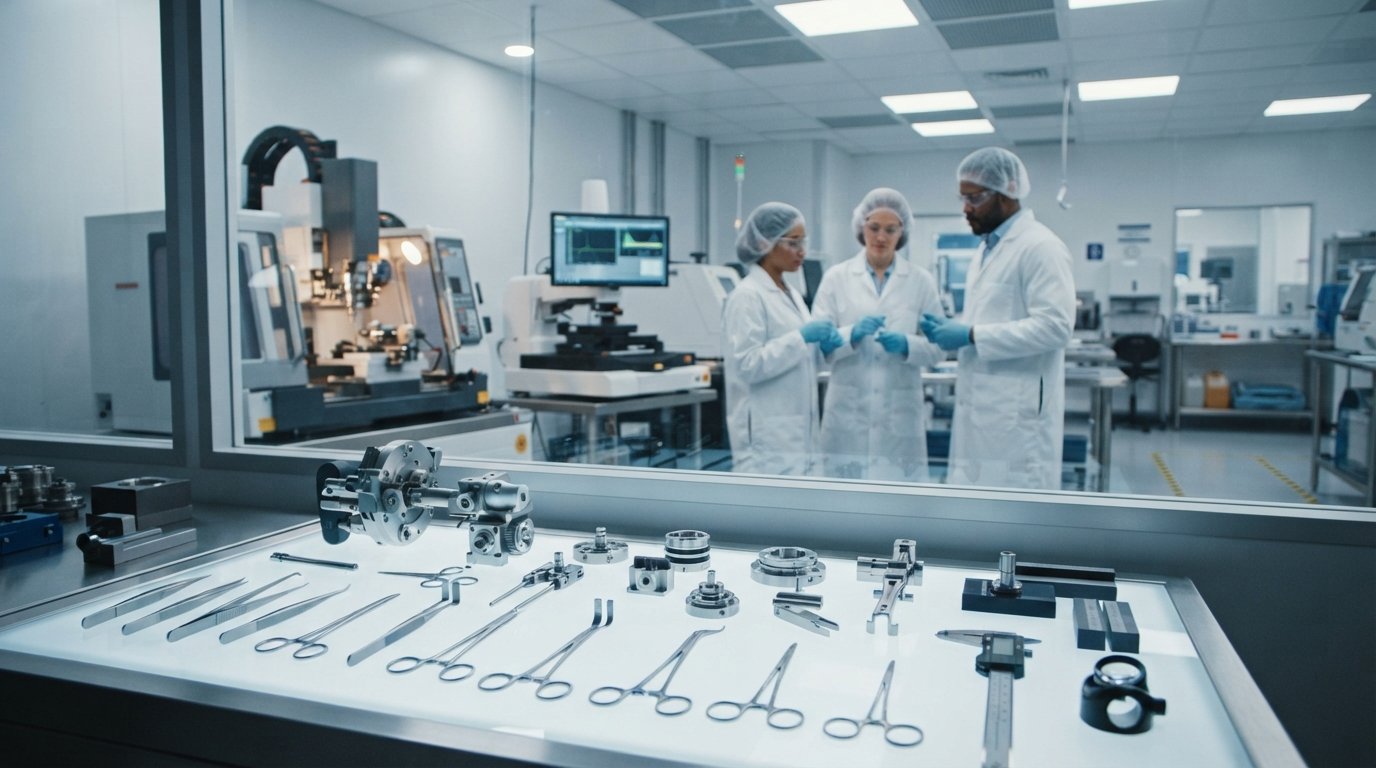
Technical excellence is often demonstrated through environmental controls. Operating within Class 8 cleanroom facilities is essential for maintaining strict bioburden and particulate standards. These controlled environments ensure that environmental risks are mitigated at the source, reflecting a commitment to rigorous validation. A partner that understands the high-stakes nature of medical manufacturing will prioritize these infrastructure investments to protect the integrity of your device lifecycle.
Validating the Manufacturing Process
A CDMO’s Master Validation Plan (MVP) serves as the definitive blueprint for consistency. We utilize the IQ/OQ/PQ (Installation Qualification, Operational Qualification, and Performance Qualification) methodology to ensure every piece of equipment and every process step performs within defined parameters. Smart manufacturing lines and real-time monitoring provide the data-driven evidence required by modern regulators. This transparency is a core component of our Full-Service Medical Device Contract Manufacturing approach. It ensures that every device meets the exact technical outcomes intended by the design. We don’t just follow a process; we validate it at every stage.
Global Footprint and Regulatory Reach
Resilient supply chains require a global perspective and strategic positioning. FONG’S operates with institutional stability from Singapore, with a new manufacturing site opening in Malaysia in Q1 2027 to provide additional scale and regional resilience. For manufacturers focused on the U.S. market, our repair center in Irvine, CA, serves as a critical local touchpoint for FDA-regulated reprocessing and refurbishment. This global reach allows us to leverage deep expertise in FDA 510(k) and CE Mark submissions, guiding your product through complex regulatory pathways. The convergence of ISO 13485 vs FDA QSR standards means your partner’s documentation must be flawless across all sites. We invite you to discuss your manufacturing requirements with our regulatory engineering team to ensure your project remains compliant and on schedule.
FONG’S: Advancing Patient Care Through Technical Excellence
FONG’S (FSP Group) serves as a strategic extension of your engineering and regulatory teams, bridging the gap between theoretical compliance and manufacturing reality. While the harmonization of ISO 13485 vs FDA QSR simplifies the high-level framework, the practical execution of a unified QMS requires a partner that has already integrated these standards into its operational DNA. We provide comprehensive CDMO services that span the entire lifecycle, from initial concept design to full-scale mass production. This end-to-end capability ensures that technical requirements are maintained without compromise during the transition from prototype to patient. Our deep experience with FDA 510(k) cleared products and CE Mark certifications provides the stability needed to navigate global markets with confidence.
Technical excellence is the foundation of our partnership model. We don’t just manufacture components; we refine the processes that make them possible. By positioning FONG’S as a partner that has already integrated QMSR requirements into its manufacturing workflow, we help OEMs reduce regulatory drag and accelerate time-to-market. Our commitment to precision is reflected in our investment in advanced laser processing and micro-precision components, ensuring that every device we assemble meets the exact specifications required for clinical success.
Precision Engineering for Complex Devices
We specialize in the fabrication of micro-precision components for high-stakes applications, including MIS tools, endoscopy devices, and cardiovascular implants. Our advanced manufacturing capabilities allow us to produce intricate components such as robotic surgical adapters and ultrasonic scalpel couplers, where micron-level accuracy is essential for device performance. FONG’S remains steadfast in its commitment to providing best-in-class medical device production through a culture of discipline and precision engineering. This meticulous approach ensures that every component satisfies the most rigorous validation protocols, maintaining the high standards expected by medical professionals worldwide.
Partner with FONG’S for Global Compliance
Our integrated quality system acts as a catalyst for global market entry, reducing the friction often associated with disparate regulatory requirements. By leveraging our Class 8 cleanrooms and our strategic global footprint, you ensure that your devices are manufactured in an environment that prioritizes bioburden control and particulate management. Our repair center in Irvine, CA, provides a local touchpoint for US-regulated device reprocessing, while our expanding capacity in Singapore and Malaysia (opening Q1 2027) offers long-term supply chain resilience. We invite you to collaborate with our R&D and complex device assembly teams to transform your technical designs into compliant, market-ready solutions. For technical inquiries or to discuss your specific manufacturing requirements, please contact Sam Lim at Sam.lim@fongspl.com.sg.
Securing Compliance in the Harmonized Global Market
The convergence of international standards and U.S. law has fundamentally transformed the regulatory landscape. While the transition from ISO 13485 vs FDA QSR to a unified QMSR framework reduces administrative redundancy, it demands a higher level of technical discipline and transparency. Manufacturers must now balance the risk-based methodology of ISO 13485 with the FDA’s specific requirements for labeling, reporting, and record accessibility. Success in this new era depends on a quality management system that’s integrated, validated, and resilient across global jurisdictions.
FONG’S (FSP Group) provides the stability of an ISO 13485 certified manufacturer with a legacy of excellence dating back to 1982. We operate Class 8 cleanroom facilities for complex assembly and maintain a strategic global footprint across Singapore, China, and Malaysia (opening Q1 2027). This infrastructure ensures your devices meet the most rigorous standards of accuracy and compliance. Partner with FONG’S for ISO 13485 and FDA-compliant medical device manufacturing. We’re prepared to navigate these complex regulatory cycles as your trusted technical partner.
Frequently Asked Questions
Does the FDA now accept ISO 13485 certification in place of an inspection?
No, the FDA remains the final authority and will continue to conduct its own inspections of manufacturing facilities. While the QMSR aligns U.S. requirements with the international standard, an ISO certificate doesn’t grant an exemption from FDA oversight. The agency uses a modernized inspection process to verify that a manufacturer’s quality system complies with the incorporated standards and additional U.S. statutory requirements for safety and effectiveness.
What are the biggest changes in the 2026 FDA QMSR Final Rule?
The most significant change is the incorporation of ISO 13485:2016 by reference into U.S. law, replacing the legacy Quality System Regulation. This shift moves the industry toward a framework centered on risk management throughout the device lifecycle. Additionally, the FDA has eliminated the previous exception that shielded internal audit reports and management reviews from investigator scrutiny. These records are now fully accessible during inspections to ensure the system functions as intended.
How does QMSR harmonization affect medical device contract manufacturing?
Harmonization simplifies the global supply chain by allowing a CDMO to maintain one quality system for multiple international markets. This reduces the technical friction of ISO 13485 vs FDA QSR compliance during the transfer from design to mass production. For partners like FONG’S, it means our Class 8 cleanroom processes and advanced laser processing are validated under a single, globally recognized logic, accelerating speed-to-market for our OEM clients.
What specific labeling requirements does the FDA maintain under QMSR?
The FDA preserves specific U.S. statutory controls for labeling and packaging under Section 820.45 that go beyond the international standard. These include mandatory requirements for expiration dates, storage instructions, and Unique Device Identification (UDI) under 21 CFR Part 830. Manufacturers must also ensure labeling for combination products meets both device and drug regulations. We use automated laser marking to ensure these identifiers remain permanent and legible throughout the device lifecycle.
Is ISO 13485:2016 the same as the new FDA Quality Management System Regulation?
No, the QMSR is a broader regulation that incorporates the ISO 13485:2016 standard while adding specific U.S. legal mandates. While the core QMS framework is identical, the FDA maintains its own rules for medical device reporting, corrections, removals, and post-market tracking. Understanding the nuances of ISO 13485 vs FDA QSR is still necessary to ensure that your international quality system also satisfies these specific U.S. statutory requirements.
What records must be available for an FDA inspection after February 2, 2026?
Investigators can now access almost all quality records, including internal audit reports, management reviews, and supplier evaluations. Section 820.35 of the QMSR outlines that manufacturers must produce documentation regarding device specifications, production processes, and quality assurance. This transparency ensures that the FDA can verify a manufacturer’s proactive commitment to risk management and resource provision rather than just reviewing reactive data after a technical non-conformance occurs.
How does a CDMO ensure IQ/OQ/PQ compliance for an OEM?
A CDMO ensures compliance by executing a Master Validation Plan that includes Installation, Operational, and Performance Qualifications. This methodology provides documented evidence that equipment is installed correctly and processes consistently produce parts meeting pre-defined specifications. At FONG’S, we integrate real-time monitoring and smart manufacturing lines to capture validation data continuously. This rigorous approach satisfies both ISO 13485 and FDA expectations for high-precision medical manufacturing and complex device assembly.
Will my existing ISO 13485 QMS need major revisions to meet QMSR?
If your system is already certified to ISO 13485:2016, you likely have the foundational elements, but specific revisions are still necessary. You must integrate U.S. requirements for labeling, Medical Device Reporting (MDR), and Unique Device Identification. You also need to update your inspection readiness protocols to account for the FDA’s new access to internal audit records. Most manufacturers find that a targeted gap analysis is the most effective way to address these remaining differences.