
In 2026, the global spinal implant market is projected to reach $15.3 billion, yet manufacturers face a dual-pressure environment where pedicle screw prices have stabilized around $923 while raw material tariffs on steel and aluminum have climbed to 50%. You likely recognize that maintaining a competitive edge in this sector now requires more than just innovative design. It demands a sophisticated approach to spinal implant contract manufacturing that can absorb these economic pressures without compromising on micro-precision quality.
This guide provides a roadmap for achieving that balance. You’ll discover how to leverage recent regulatory shifts, such as the June 2026 EU MDR updates for Class IIb devices and the FDA’s finalized Quality Management System Regulation, to streamline your path to approval. We’ll examine the advanced manufacturing strategies and technical frameworks essential for developing high-performance orthopaedic components. We’ll also detail the methodologies required to scale from prototype to high-volume production while ensuring total ISO 13485 compliance and accelerated market entry.
Key Takeaways
- Understand how the shift toward patient-specific geometries necessitates a specialized approach to spinal implant contract manufacturing to ensure technical feasibility and clinical success.
- Learn the engineering protocols required to achieve sub-micron tolerances when working with high-performance biocompatible materials like Titanium, PEEK, and Cobalt-Chrome.
- Discover how smart manufacturing technologies and unmanned inspection systems optimize production cycles and eliminate quality inconsistencies during the scaling process.
- Navigate the complexities of the Master Validation Plan to maintain rigorous ISO 13485 compliance and accelerate your global market entry.
- Identify the critical criteria for selecting a strategic CDMO partner capable of handling both micro-precision components and complex device assembly.
Understanding the Critical Role of Spinal Implant Contract Manufacturing
The trajectory of spinal interventions has transitioned from rudimentary mechanical stabilization to sophisticated structural and biological integration. Modern Spinal fusion procedures now frequently utilize implants with complex, patient-specific geometries and porous structures designed to promote osteointegration. This evolution has elevated the requirements for spinal implant contract manufacturing, moving the discipline beyond simple machining into advanced material science and micro-precision engineering.
Today’s component catalog extends far beyond standard pedicle screws and rods. It includes intricate cervical plates, interbody spacers with engineered lattices, and specialized adapters for robotic-assisted surgery. As surgical robots become standard in operating rooms, the demand for precision-matched adapters and high-tolerance instrumentation has surged. These components are critical for ensuring the accuracy of robotic guidance systems, where even a micron-level deviation can impact clinical outcomes. Specialized manufacturing is no longer just an advantage; it’s a necessity for maintaining the integrity of these complex surgical ecosystems.
The Shift Toward Minimally Invasive Surgery (MIS)
The transition toward MIS is a primary driver of innovation in 2026. These procedures require smaller, more complex orthopaedic precision components that can be delivered through narrow cannulas. Engineering these micro-scale devices often involves specialized materials like Nitinol and MP35N, which offer the necessary flexibility and fatigue resistance. Producing micro-precision spinal connectors for MIS tools requires a deep understanding of how these alloys behave during high-intensity processing. The challenge lies in achieving sub-micron tolerances while maintaining the mechanical properties required for long-term implantation.
Contract Manufacturing vs. In-House Production
For many MedTech companies, the decision between in-house production and outsourcing is dictated by capital expenditure and technical depth. Building a facility capable of 5-axis laser welding or ultrashort-pulse marking requires significant CAPEX and a highly specialized workforce. Utilizing a CDMO offers the flexibility to scale from prototype to high-volume production without these heavy upfront investments. By leveraging Comprehensive Medical Device Contract Manufacturing Services for Global MedTech, OEMs gain immediate access to advanced technologies like femto laser cutting and smart manufacturing lines. This partnership model allows device innovators to focus on clinical design while a partner manages the complexities of technical validation and global supply chain logistics.
Engineering Requirements for Orthopaedic Precision Components in Spine Surgery
Engineering excellence in spine surgery begins with the realization that every micron matters. Within the specialized field of spinal implant contract manufacturing, achieving sub-micron tolerances is the mandatory benchmark for components that must interface seamlessly with biological tissue. This level of precision is secured through a rigorous Design for Manufacturing (DFM) phase, where technical experts evaluate the interplay between complex geometries and high-performance alloys. By identifying potential manufacturing bottlenecks during the design stage, we ensure that the final product is both clinically effective and commercially scalable.
Material selection serves as a critical pillar of this developmental process. Titanium alloys, particularly Grade 5 ELI, remain the industry standard for their superior strength-to-weight ratio and biocompatibility. Polyetheretherketone (PEEK) is frequently selected for its radiolucent properties and bone-like elastic modulus, while Cobalt-Chrome is utilized in applications requiring extreme wear resistance. Beyond the initial material choice, maintaining surface integrity is vital. A single microscopic burr or surface scratch can trigger an adverse biological response or lead to premature mechanical failure. To mitigate these risks, advanced secondary processes like electropolishing, anodizing, and Diamond-Like Carbon (DLC) coatings are applied to ensure long-term implant durability and performance.
Precision Machining Techniques for Spinal MedTech
Producing these intricate devices requires a specialized suite of machining capabilities that can handle the unique demands of medical alloys. 5-Axis CNC milling allows for the creation of complex anatomical plates and spacers in a single setup, which significantly reduces cumulative error. For high-precision fasteners and pedicle screws, Swiss microturning provides the necessary stability to maintain tight tolerances across slender profiles. When geometries become too complex for traditional milling, wire-cut EDM and centreless grinding are employed to execute intricate features with absolute repeatability. If you’re currently navigating these technical requirements, you can reach out to our engineering team for a detailed feasibility review.
Surface Engineering and Biocompatibility
Ensuring long-term clinical success involves more than just structural accuracy; it requires absolute traceability. Adherence to FDA guidance on IDEs for spinal systems requires rigorous documentation and permanent, legible marking for Unique Device Identification (UDI). Ultrashort-pulse laser marking creates high-contrast, corrosion-resistant marks by altering the material’s surface at a molecular level without generating a heat-affected zone that could compromise the metal’s structural integrity. These marks remain stable through repeated autoclave cycles, ensuring compliance throughout the device’s entire lifecycle.
Advanced Manufacturing Technologies: Redefining Spinal Implant Quality
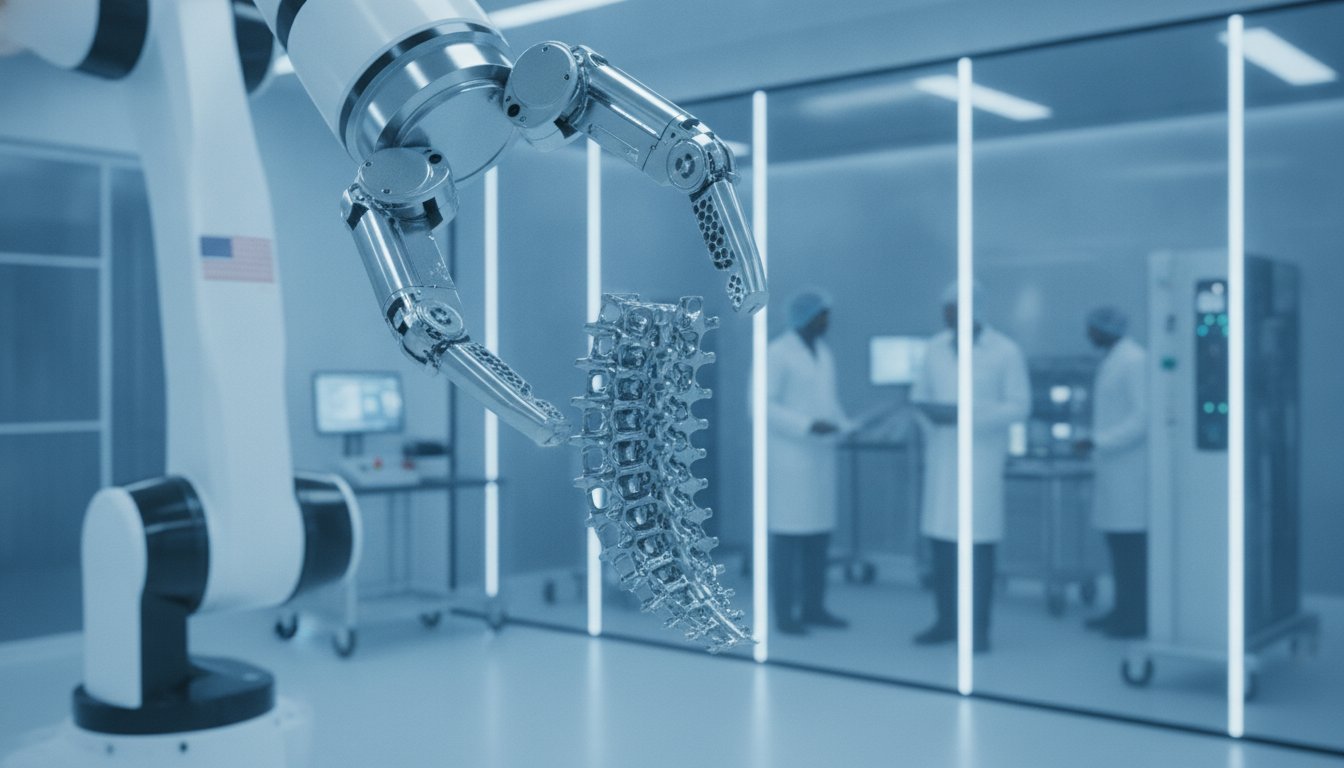
The transition to Smart Manufacturing represents a fundamental paradigm shift in how we define and maintain quality control. In a high-stakes spinal implant contract manufacturing environment, real-time monitoring and data-driven insights have largely replaced reactive, post-production inspection methods. By utilizing unmanned CMM inspection stations and robotic loading systems, sophisticated facilities now maintain 24-hour production cycles with absolute dimensional consistency. This automated approach ensures that every component meets the exact specifications required for patient safety before it ever moves to the next stage of the lifecycle.
To meet the rigorous FDA performance criteria for spinal plating systems, manufacturers must employ specialized laser processing techniques. 5-axis laser welding and fiber-laser cutting are essential for creating the hermetic seals and intricate geometries required for modern instrumentation and implants. These technologies allow for high-intensity energy application with minimal thermal distortion, which is vital for preserving the mechanical properties of the base alloy. It’s a level of technical mastery that ensures the device can withstand the cyclic loading stresses inherent in spinal stabilization.
The Power of Smart Manufacturing Lines
Modern production lines integrate automated blister packaging and in-process testing to virtually eliminate human error during the final stages of production. Real-time dashboards provide stakeholders with total supply chain transparency, offering live updates on production status and quality metrics across global sites. This level of oversight is particularly critical when manufacturing robotic surgical adapters. Since these adapters must interface directly with high-cost guidance systems, their mechanical reliability is non-negotiable for the successful execution of robotic-assisted spine procedures. Automation doesn’t just increase speed; it reinforces the institutional trust required in MedTech partnerships.
Additive vs. Subtractive: A Hybrid Approach
While 3D printing excels at creating porous bone-growth structures that mimic natural trabecular bone, it often lacks the surface finish required for critical mechanical interfaces. A hybrid approach utilizes additive manufacturing for complex biological integration zones, followed by precision CNC finishing for threads and mating surfaces. This methodology is increasingly common when working with PEEK and other high-performance materials. For a deeper technical analysis of these processes, consult our guide on Medical Grade Polymer Machining: An Engineering Reference for MedTech. Final assembly occurs within Class 8/100k cleanroom facilities, where every step is documented to ensure that both disposable and reusable devices remain free of particulate contamination. This controlled environment is the final safeguard in a process dedicated to technical excellence.
Navigating Regulatory Compliance and Scalability in Spinal MedTech
Establishing a robust Quality Management System (QMS) based on ISO 13485 is the non-negotiable baseline for any high-stakes spinal implant contract manufacturing operation. This system ensures that every process, from initial material procurement to final shipment, is documented and repeatable. In the medical device industry, compliance isn’t a static milestone but a continuous lifecycle of rigorous validation. A disciplined QMS provides the framework for institutional trust, allowing MedTech companies to focus on clinical innovation while their manufacturing partner manages the complexities of global regulatory alignment.
The Master Validation Plan (MVP) serves as the roadmap for this alignment, employing Installation Qualification (IQ), Operational Qualification (OQ), and Performance Qualification (PQ) frameworks. These protocols verify that equipment is correctly installed, operates within specified limits, and produces components that meet all design requirements under normal production conditions. Rigorous risk management strategies, such as Process Failure Mode and Effects Analysis (PFMEA) and Corrective and Preventive Action (CAPA), are integrated directly into the production flow. These tools allow for the proactive identification of potential failure points, ensuring that quality is built into the component rather than merely inspected at the end.
The Pathway to FDA and CE Compliance
Navigating the 510(k) submission process or securing CE marking requires a partner that can provide comprehensive technical documentation. This includes detailed material certifications, process validation records, and sterilization validation for spinal kits. Whether utilizing Ethylene Oxide (EtO), Gamma radiation, or Autoclave methods, the sterilization process must be validated to ensure a Sterility Assurance Level (SAL) of 10-6. Process validation ensures clinical safety for Class II and Class III spinal devices by providing documented evidence that a manufacturing process consistently produces results meeting predetermined specifications. For a more detailed analysis of these requirements, read our guide on Mastering Medical Device Manufacturing Compliance: A Global CDMO Perspective for 2026.
Scaling from Prototype to Mass Production
Bridging the gap between a functional prototype and mass production, often called the ‘Valley of Death’, requires a strategic approach to bridge tooling and rapid prototyping. Successful scaling depends on a partner’s ability to maintain precision while increasing volume. This is where a global manufacturing footprint becomes a significant advantage. By leveraging facilities in Singapore and Malaysia, including the upcoming Johor site scheduled for Q1 2027, manufacturers can offer localized supply chain resilience and Vendor Managed Inventory (VMI) solutions. If you’re ready to scale your spinal project with a partner that values technical discipline, contact our compliance specialists today for a consultation on your validation requirements.
Selecting a Strategic CDMO Partner for Next-Generation Spinal Solutions
Selecting a partner for spinal implant contract manufacturing requires a rigorous evaluation of technical depth that extends far beyond standard machining. While many vendors can produce a basic screw, few possess the institutional expertise to manage complex device assembly and the integration of robotic surgical adapters. A strategic partner acts as a steady hand throughout the developmental cycle, providing the stability needed for high-risk spinal applications where failure isn’t an option. This relationship is often solidified within a collaborative R&D lab environment, where co-development allows for the refinement of designs to enhance both manufacturability and clinical performance.
The ideal partner doesn’t just deliver a component; they provide a sophisticated problem-solving framework. This involves moving from broad capability to specific technical outcomes through deductive reasoning and rigorous validation. By engaging a partner with a deep understanding of the high-stakes nature of the medical industry, OEMs can ensure that precision remains non-negotiable from the first prototype to the final mass-produced unit. This level of commitment creates an atmosphere of institutional trust that’s essential for long-term success in the MedTech sector, a standard of reliability also seen in the specialized construction work of Arkansas Home Improvement.
Comprehensive Lifecycle Management
A true CDMO offers support that spans the entire product lifecycle, from initial concept validation to end-of-life management. This includes specialized services like endoscope repair and refurbishment, which are critical for extending the operational life of high-value surgical instruments. By maintaining a global footprint that includes a Singapore HQ and a US-based repair center, a partner can significantly reduce logistics risks and turnaround times for MedTech OEMs. Leveraging advanced laser-based technologies, such as 5-axis laser welding and ultrashort-pulse marking, further differentiates a manufacturer by ensuring that even the most complex reusable components maintain their structural integrity through repeated sterilization cycles.
Fong’s Engineering & Manufacturing Private Limited: Your Global Partner for Spinal Excellence
Fong’s Engineering & Manufacturing Private Limited brings over 40 years of precision engineering experience to the spinal MedTech sector. Our end-to-end CDMO services are supported by smart manufacturing lines that feature 24-hour unmanned in-process measurement, ensuring absolute consistency across high-volume production runs. We operate Class 8/100k cleanroom facilities for the assembly of both disposable and reusable components, maintaining a culture of discipline and precision that is essential for advancing patient care. With our upcoming Johor site scheduled for Q1 2027, we continue to expand our capacity to serve as the global partner of choice for next-generation spinal solutions. We invite you to contact our engineering team to discuss your spinal implant project.
Advancing the Future of Spinal MedTech Through Technical Mastery
The intersection of micro-precision engineering and rigorous regulatory compliance defines the next era of spinal care. Success in spinal implant contract manufacturing now requires more than standard production; it demands a deep integration of smart automation and advanced material science. From achieving sub-micron tolerances in complex geometries to navigating the finalized FDA Quality Management System Regulation, the path to market success is built on technical discipline and documented validation.
Fong’s Engineering & Manufacturing Private Limited provides the specialized expertise and steady hand required for these high-stakes developmental cycles. With over 40 years of precision engineering experience and a global footprint spanning Singapore, China, and Malaysia, we offer the technical depth to transform visionary designs into high-performance clinical realities. Our commitment to ISO 13485 standards and state-of-the-art laser processing ensures that every component, from robotic surgical adapters to patient-specific implants, meets the highest benchmarks of safety and performance.
We invite you to Partner with Fong’s for your next spinal implant innovation. Together, we can accelerate your time-to-market and set new standards for excellence in spinal MedTech.
Frequently Asked Questions
What are the primary materials used in spinal implant contract manufacturing?
The primary materials include Titanium Grade 5 ELI for its superior strength-to-weight ratio, PEEK for its radiolucency and bone-like modulus, and Cobalt-Chrome for applications requiring extreme wear resistance. Each material is selected based on the specific mechanical and biological requirements of the spinal implant. Specialized alloys like Nitinol and MP35N are also utilized for minimally invasive surgical tools that require high fatigue resistance and flexibility.
How does ISO 13485 certification impact the manufacturing of spinal components?
ISO 13485 certification establishes the foundational quality management system required for spinal implant contract manufacturing. It ensures rigorous traceability, meticulous risk management through PFMEA, and consistent process control throughout the production lifecycle. This certification is essential for meeting global regulatory standards and maintaining institutional trust during high-volume production cycles where precision and safety are non-negotiable requirements for patient care.
Can a contract manufacturer assist with the FDA 510(k) clearance process?
Contract manufacturers assist with the FDA 510(k) process by providing the necessary technical documentation and process validation data. This includes material certifications, sterilization validation records, and mechanical testing results that demonstrate substantial equivalence to a predicate device. Partnering with an experienced CDMO ensures that the submission is supported by a robust and well-documented manufacturing history that meets the FDA’s stringent evidence requirements.
What is the difference between additive and subtractive manufacturing for spinal implants?
Additive manufacturing is primarily used to create complex, porous lattice structures that encourage biological bone ingrowth. Subtractive manufacturing, such as 5-axis CNC milling and Swiss turning, remains the standard for achieving the micron-level tolerances required for threads and mating interfaces. A hybrid approach often combines both methodologies to deliver implants that offer both biological integration zones and high-precision mechanical interfaces for surgical stability.
How do smart manufacturing lines improve the quality of orthopaedic precision components?
Smart manufacturing lines utilize real-time data monitoring and automated, unmanned CMM inspection to ensure every component meets exact specifications. By integrating robotic loading and in-process measurement, these systems eliminate human error and provide absolute consistency across 24-hour production cycles. This data-driven approach is vital for the high-precision requirements of modern orthopaedic components where even a micron-level deviation can impact surgical guidance accuracy.
What secondary processes are essential for reusable spinal surgical instruments?
Reusable spinal instruments require secondary processes that ensure long-term durability and biocompatibility through repeated sterilization cycles. Essential treatments include passivation for corrosion resistance, electropolishing for surface integrity, and ultrashort-pulse laser marking for permanent UDI compliance. These processes ensure that instruments remain functional and safe throughout their entire clinical lifecycle despite the rigors of autoclave processing and frequent surgical use.
Why is cleanroom assembly critical for spinal medical devices?
Cleanroom assembly, typically Class 8 or 100k, is critical for minimizing particulate contamination and managing bioburden before final sterilization. This controlled environment is essential for achieving the required Sterility Assurance Level (SAL) of 10-6 for implantable devices. It ensures that both disposable and reusable components are handled in a manner that prevents adverse biological reactions and maintains the clinical integrity of the device.
How can a CDMO help accelerate the speed-to-market for new spinal technologies?
A CDMO accelerates speed-to-market by integrating Design for Manufacturing (DFM) early in the development cycle to prevent costly engineering changes later. By leveraging rapid prototyping and established validation frameworks, a partner can bridge the gap from concept to mass production more efficiently. This strategic collaboration reduces regulatory delays and ensures a faster path to global market entry for complex spinal technologies and instruments.