
A pristine ISO 13485 certificate displayed on a conference room wall tells you almost nothing about what actually happens on the production floor. If you have ever weathered FDA 510(k) review holds or EU MDR submission delays triggered by hidden supplier non-conformances, you already know that checklist-driven evaluations fail to catch process variation. Learning how to audit a potential medical device CDMO requires looking past polished binders and directly interrogating day-to-day engineering execution.
This technical guide shows you how to master prospective partner evaluations across modernized quality management systems, cleanroom controls, and precision fabrication workflows. You will gain a structured auditing framework alongside objective scoring criteria to benchmark competing candidates, verify validation rigor, and safeguard your device lifecycle from day one.
Key Takeaways
- Define targeted audit boundaries based on component risk classification and regulatory submission pathways before reviewing preliminary quality files.
- Master how to audit a potential medical device CDMO across both ISO 13485:2016 and FDA QMSR frameworks to evaluate engineering change controls and CAPA investigation depth.
- Scrutinize shop-floor execution by inspecting multi-axis machining maintenance logs, cleanroom environmental monitoring, and equipment validation data.
- Audit sub-tier vendor controls through certified material test reports, raw material quarantine protocols, and approved vendor qualification records.
- Categorize audit findings systematically into critical, major, and minor non-conformances to establish an objective scoring matrix for candidate selection.
Pre-Audit Preparation: Defining the CDMO Supplier Audit Scope
Thorough preparation dictates the success of any supplier evaluation. Before scheduling facility walkthroughs, technical teams must establish targeted audit boundaries governed by the device’s regulatory classification, intended clinical use, and overall lifecycle complexity. Understanding how to audit a potential medical device CDMO begins with building an empirical scope. This requires requesting foundational quality records, establishing strict non-disclosure agreements to safeguard proprietary tooling files, and crafting an agenda that balances quality system reviews with direct shop-floor surveillance.
Establishing Risk-Based Supplier Classification
Device classification determines supplier oversight intensity. Outsourcing a standard mechanical bracket requires a different verification protocol than contracting an invasive, high-risk assembly. Map out the component’s critical-to-quality (CTQ) dimensions and clinical risk profiles under ISO 14971 guidelines. Class I non-measuring accessories might only demand targeted desktop evaluations. In contrast, Class IIb or Class III components require exhaustive, multi-day on-site audits to assess physical process repeatability, bioburden contamination controls, and secondary operations.
Preliminary Documentation and Desk Audit Checklist
A rigorous desk audit separates qualified manufacturing partners from unprepared candidates before travel begins. Request and analyze the prospective partner’s quality manual, high-level process maps, and corporate organigrams. Scrutinize the registrar accreditation behind their quality certifications, ensuring their scope aligns with the current ISO 13485 standard and encompasses contract manufacturing, cleanroom packaging, and precision assembly.
Prior to visiting the site, audit teams should secure and review a concrete preliminary documentation packet:
- Quality Policy and Management Reviews: Examine executive review summaries to verify that executive leadership actively tracks yield losses, internal non-conformances, and systemic continuous improvements.
- Regulatory History and Inspection Reports: Screen the CDMO’s regulatory track record, specifically analyzing past FDA Form 483 observations, warning letters, or notified body audit non-conformances alongside their formal response letters.
- Equipment and Tooling Lists: Review available machinery registries, checking age, multi-axis machining capabilities, and preventive maintenance records against your product specifications.
- Master Validation Plans (MVP): Ensure the prospective partner operates structured installation, operational, and performance qualification protocols for critical manufacturing equipment.
Mastering how to audit a potential medical device CDMO requires executing this due diligence upfront. Doing so preserves valuable on-site auditing hours for verifying physical equipment, inspecting cleanrooms, and testing real-world operator adherence.
Auditing the Quality Management System: ISO 13485 and FDA QMSR Alignment
A compliant QMS must function as an operational reality on the production line, not just a static software repository. Under the modernized FDA Quality Management System Regulation, U.S. requirements incorporate ISO 13485:2016 by reference into 21 CFR Part 820. This alignment eliminates legacy exemptions under the former Section 820.180(c), meaning FDA investigators now routinely review supplier audit findings, internal evaluations, and management reviews. Learning how to audit a potential medical device CDMO requires examining how these harmonized requirements govern shop-floor documentation, non-conformance material reporting (NCMR), and workforce training records.
Engineering Change Order and DHR Traceability
Audit traceability by selecting a completed Device History Record (DHR) or Medical Device File (MDF) and tracking its production lot backward. Check physical traveler tags and electronic signatures against active revisions in the engineering change order (ECO) database. Discrepancies between approved drawing revisions and active work instructions on the floor expose critical gaps in revision control. Maintaining absolute synchronization between design history files and production floor travelers illustrates the core value of medical device manufacturing compliance across complex assemblies.
CAPA Investigation Depth and Closed-Loop Verification
Superficial audits simply verify that CAPA forms are completed. A thorough technical audit evaluates the engineering depth behind root-cause determinations:
- Root-Cause Analysis: Pull three randomly selected closed CAPAs from the past twelve months. Scrutinize whether investigators relied on rigorous tools, such as Ishikawa diagrams or failure mode simulations, rather than settling on generic operator error.
- Closed-Loop Verification: Review the documented effectiveness checks performed 30 to 90 days post-implementation. Did the CDMO track process drift using statistical process control (SPC) charts, or did they close the file purely on an administrative sign-off?
- NCMR and Complaint Linkages: Cross-reference customer complaints with open NCMR logs. Recurring tooling wear, burr formation, or dimension drift that never escalates to a formal CAPA reveals systemic non-conformance containment failures.
- Operator Qualification: Audit training matrices for operators working on critical workstations. Verify that technicians possess valid certifications for complex assembly processes, laser welding, and automated coordinate measuring machine (CMM) routines.
If you need an experienced partner with proven engineering controls across multi-axis machining and automated testing, consider contacting our engineering team for a technical consultation to discuss your regulatory roadmap.
Shop-Floor Technical Audit: Machining, Cleanrooms, and Process Validation
A technical shop-floor audit is an empirical examination of physical machinery, controlled environments, and metrology labs. Paperwork confirms regulatory intent, but hands-on surveillance validates true manufacturing capability. When evaluating how to audit a potential medical device CDMO, technical teams must transition from conference room binders to the production floor to verify equipment stability, environmental controls, and real-time process capability.
Evaluating Precision Engineering and Secondary Processing
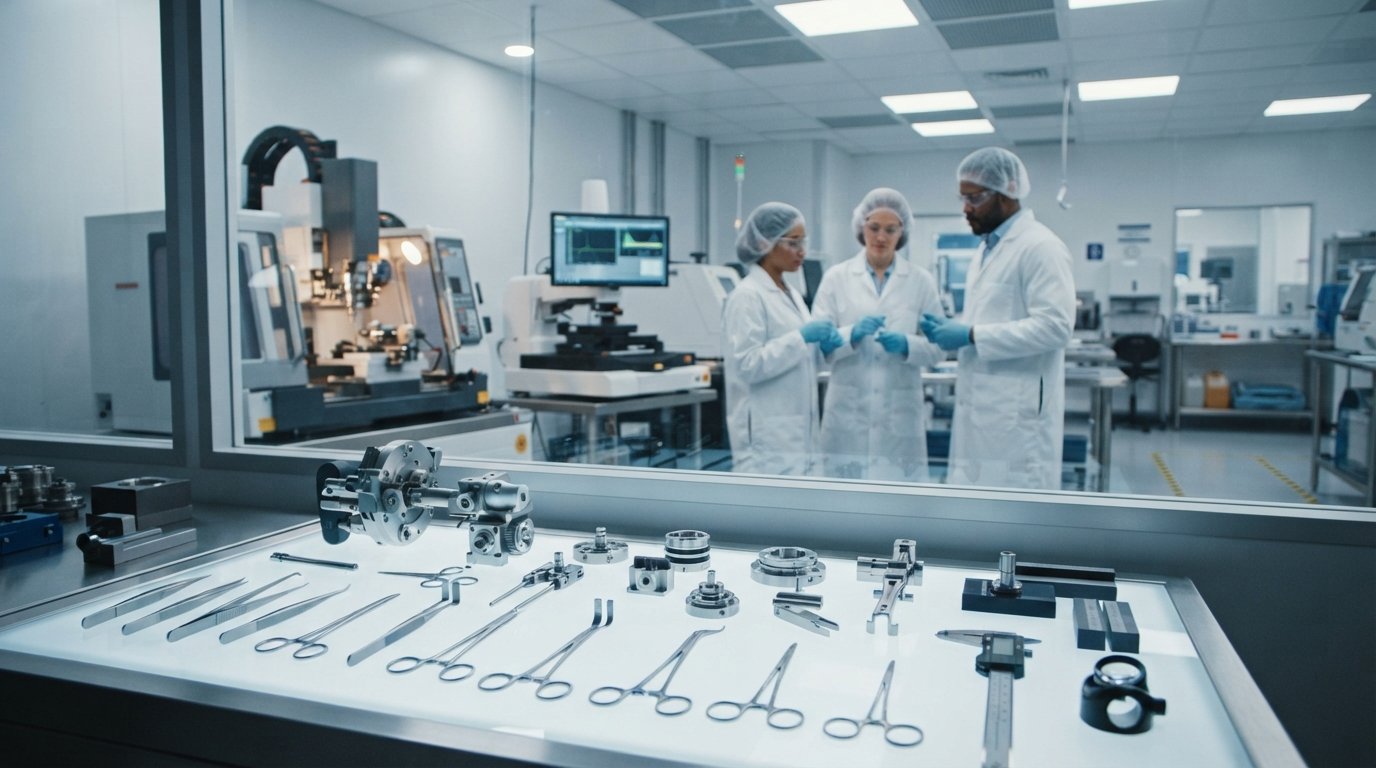
Machine tool precision directly dictates component yield. Inspect calibration records and preventive maintenance schedules across multi-axis CNC milling, wire-EDM, and precision turning equipment. Evaluate controls for secondary processing, such as passivation, electropolishing, and anodizing, to ensure chemical baths maintain validated concentrations. Examine automated laser welding stations for hermetic seal integrity, and review how delicate micro precision medical components undergo burr inspection using high-magnification optical systems and unmanned coordinate measuring machines (CMM).
Cleanroom Environment and Controlled Assembly Inspection
Controlled assembly requires strict contamination mitigation. In Class 8 cleanrooms, inspect continuous environmental monitoring records for airborne particulate counts and routine microbial settling plates. Check pressure differential gauges across gowning airlocks and production suites to confirm positive-pressure cascades that prevent particulate ingress. Review static dissipation protocols, material flow pathways, and sterile packaging validation records, including burst testing and seal-integrity data under ISO 11607.
Process Validation Protocols: IQ, OQ, and PQ Evidence
Validation records reveal whether a CDMO understands its operational boundaries. Review qualification packages against the FDA process validation guidance across all lifecycle stages:
- Operational Qualification (OQ): Verify that engineers challenged upper and lower process parameters, such as thermal thresholds and feed rates, rather than testing nominal parameters alone.
- Performance Qualification (PQ): Ensure sample sizes reflect statistically justified confidence and reliability intervals rather than arbitrary unit counts.
- Automated In-Process Testing: Inspect automated inline testing stations, such as vision systems, high-voltage breakdown testers, or helium leak detectors, to verify that non-conforming units trigger immediate line lockouts.
Rigorous shop-floor surveillance uncovers operational vulnerabilities that standard desktop audits miss entirely, protecting your production schedule from unexpected yield collapses.
Supply Chain Resilience, Raw Material Control, and Sub-Tier Auditing
Sub-tier supplier vulnerabilities represent a frequent source of unmonitored production risk. A CDMO might maintain immaculate internal machining lines, yet still introduce critical defects through poorly vetted raw material stock or unmonitored plating vendors. Understanding how to audit a potential medical device CDMO requires examining their complete supply chain architecture, from raw material receipt to external special-process governance.
Receiving Inspection and Material Verification
Uncontrolled incoming stock compromises entire production runs. During your warehouse walkthrough, inspect raw material staging areas and evaluate quarantine protocols. Confirm that ERP systems enforce strict digital holds that physically prevent unreleased metal rods or polymer pellets from reaching production floors. Review Certified Material Test Reports (CMTR) against international ASTM or ISO material specifications. For critical medical alloys like Nitinol, MP35N, and implant-grade titanium, verify whether the CDMO uses positive material identification methods, such as X-ray fluorescence (XRF) analyzers, to guard against cross-contamination.
Sub-Tier Supplier Oversight and Critical Outsourcing
Secondary contract services require direct regulatory scrutiny under modern compliance frameworks. When evaluating how a CDMO qualifies its Approved Vendor List (AVL), examine the specific criteria applied to high-risk outside processes:
- Sterilization Vendor Oversight: Scrutinize the CDMO’s audit records for external ethylene oxide, gamma radiation, or moist heat sterilization contractors, confirming that bioburden monitoring and cycle validations comply with ISO 11135 and ISO 11137.
- Quality Agreements: Examine legal and quality agreements governing outside secondary processors, such as specialized coating or electropolishing facilities. Ensure these contracts enforce mandatory notification before any process or chemistry change occurs.
- Business Continuity and Dual-Sourcing: Assess how the partner manages raw material buffer stock and multi-site production resilience to withstand supply chain disruptions. CDMOs operating integrated footprints across multiple regions provide vital operational redundancy.
- Non-Conforming Material Disposition: Sample MRB (Material Review Board) records to track how rejected incoming lots are returned, documented, and prevented from re-entering active production inventory.
Aligning raw material discipline with comprehensive contract manufacturing services ensures high component yields across complex product lifecycles. To evaluate how our multi-facility manufacturing platform supports supply chain continuity, schedule a technical audit consultation with our supplier quality engineering team.
Synthesizing Findings: Scoring, Risk Analysis, and Partnership Selection
The closing meeting marks the beginning of objective supplier evaluation. Raw qualitative observations collected during facility surveillance must be converted into actionable risk metrics. Understanding how to audit a potential medical device CDMO requires a balanced scoring model that weighs engineering precision, quality system discipline, and cultural transparency equally. An unaddressed compliance lapse discovered months after transfer compromises both launch schedules and patient safety.
Classifying Audit Findings and Non-Conformances
Objective categorization separates manageable operational gaps from catastrophic regulatory hazards. Triage all findings into three standardized severity levels:
- Critical Non-Conformances: Direct violations that compromise product safety, data integrity, or regulatory compliance. Examples include falsified inspection logs, unvalidated software modifications on production tools, or unauthorized material substitutions. These trigger immediate disqualification.
- Major Non-Conformances: Systemic quality breakdowns that do not immediately produce non-conforming products, such as an uncalibrated coordinate measuring machine or unmonitored cleanroom differential pressures. Mandate a comprehensive root-cause analysis and a corrective action plan within a strict 30-day window.
- Minor Non-Conformances: Isolated administrative oversights, like an incomplete training log signature or a misplaced traveler copy. These require standard corrective measures before commercial production ramp-up.
Pay close attention to organizational attitude during the exit interview. A transparent engineering partner welcomes technical critiques, whereas an evasive team presents ongoing collaboration risks.
Negotiating the Quality Agreement and Long-Term Governance
Never sign a commercial manufacturing contract without finalizing a comprehensive Quality Agreement. This document defines regulatory boundaries, delineating whether the OEM or the CDMO retains specific design history files, regulatory submission ownership, and vigilance reporting responsibilities. Establish strict notification thresholds that legally require the CDMO to obtain written customer approval before modifying tooling, adjusting machining pathways, altering cleanroom layouts, or changing sub-tier suppliers.
Formalize ongoing oversight by establishing regular joint quality reviews, quarterly scorecard updates, and periodic on-site surveillance audits. When evaluating potential manufacturing partners, mastering how to audit a potential medical device CDMO ensures your chosen candidate operates as a reliable extension of your engineering floor. To evaluate technical capabilities and review robust quality documentation firsthand, start by contacting our technical engineering team directly.
Advancing Manufacturing Quality Through Disciplined Technical Audits
Executing a structured evaluation safeguards clinical timelines, product yields, and market authorization milestones. Knowing how to audit a potential medical device CDMO ensures you look past superficial compliance binders to verify real-time process controls, automated metrology, and deep root-cause discipline directly on the production floor. When you audit sub-tier vendor controls and enforce strict quality agreements early, you eliminate hidden operational vulnerabilities before commercial scale-up begins.
With four decades of precision contract development and high-complexity manufacturing experience, Fong’s Engineering & Manufacturing Private Limited operates ISO 13485 certified quality management systems supporting global FDA 510(k) programs. Our fully validated Class 8 cleanrooms and automated in-line inspection systems deliver the repeatable dimensional accuracy that complex medical assemblies demand.
Rigorous supplier auditing isn’t just a regulatory formality; it’s the foundation of long-term commercial reliability. When you hold prospective contract partners to uncompromising engineering benchmarks, you secure your product’s lifecycle and safeguard patient outcomes. Partner with our validated engineering team to establish a transparent, high-precision manufacturing framework for your next device program.
Frequently Asked Questions
How long does a comprehensive on-site medical device CDMO audit typically take?
A comprehensive on-site audit typically takes two to three full business days. The exact duration depends on manufacturing scope, cleanroom classifications, and technical complexity. For standard mechanical fabrication, two days usually suffice to inspect quality systems and basic machine maintenance. For complex assemblies involving Class 8 cleanrooms, automated metrology, and secondary surface finishing, three or more days are necessary to properly witness active production runs, interview line operators, and evaluate validation records.
What is the difference between an ISO 13485 certification audit and a customer supplier audit?
An ISO 13485 registrar audit assesses broad procedural compliance against standard clauses to grant an operational certificate. In contrast, a customer supplier audit interrogates whether the CDMO can repeatedly produce a specific medical component within exact engineering tolerances. When learning how to audit a potential medical device CDMO, OEMs evaluate targeted tooling capabilities, custom cleanroom assembly protocols, and sub-tier material integrity that third-party registrars rarely sample during high-level surveillance audits.
Can a desktop or remote audit replace an on-site CDMO inspection for Class II and III devices?
Desktop audits cannot replace on-site inspections for moderate to high-risk Class II and Class III devices. While remote documentation reviews adequately screen quality manuals, organigrams, and historical certification credentials, they fail to reveal shop-floor process variation. You must walk the physical production floor to observe operator gowning discipline, inspect machine tool maintenance logs, verify differential cleanroom pressures, and evaluate whether active traveler sheets accurately match engineering drawings in real time.
What are the most common critical non-conformances found during CDMO facility audits?
The most frequent critical non-conformances involve unauthorized process changes, unvalidated production equipment, and incomplete traceability records. Auditors often discover engineering adjustments made on CNC machines without approved engineering change orders. Other severe deficiencies include unmonitored particulate spikes within cleanrooms, incomplete installation or operational qualifications for automated inspection lines, and raw material inventory stored in active staging areas without certified material test reports confirming alloy composition.
How should intellectual property and cleanroom access be handled during an on-site audit?
Both parties should execute a detailed non-disclosure agreement before an audit team enters the facility. To protect other clients’ proprietary tooling designs, CDMOs may shroud sensitive work cells or restrict direct photography. Cleanroom access requires auditor compliance with certified gowning protocols, particulate limits, and static dissipation requirements. Understanding how to audit a potential medical device CDMO includes respecting these boundaries while verifying environmental monitoring sensors and automated assembly steps.
What key components must be included in a medical device Quality Agreement after the audit?
A comprehensive Quality Agreement establishes formal regulatory boundaries between the OEM and the manufacturing partner. It must clearly define ownership of Design History Files, Medical Device Files, and complaint handling workflows. The document must mandate formal change notification windows before the CDMO modifies tooling, raw materials, or sub-tier processors. It should also specify batch release authorities, scrap disposal rules, mandatory annual re-audit cadences, and unannounced audit access rights.