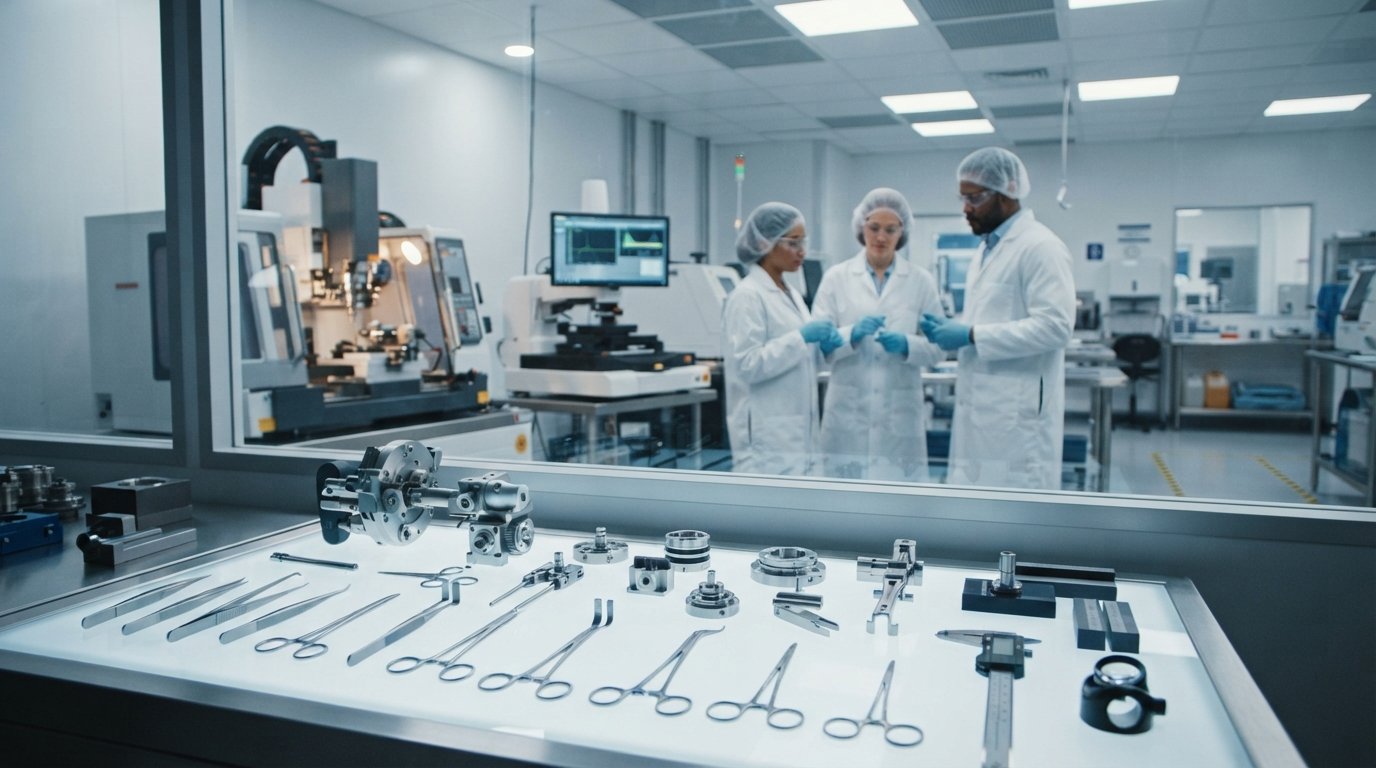


You cannot inspect regulatory compliance into a finished device at final assembly; it must be engineered directly into your supplier’s operational infrastructure. In high-stakes EU MDR medical device contract manufacturing, treating technical documentation as a trailing deliverable invites devastating Notified Body review bottlenecks and audit non-conformances that can paralyze commercial distribution.
You already recognize the mounting friction across the sector: disjointed design transfer files, ambiguous overlaps between the FDA QMSR and European expectations, and the persistent risk that unvalidated processing will compromise market access. The central challenge is clear: how can engineering and regulatory leaders verify that an external partner truly possesses the technical documentation rigor and ISO 13485:2016 controls needed to withstand unannounced Notified Body audits?
This technical guide and audit checklist provides a methodical framework to evaluate contract partners, establish unbroken traceability, and secure seamless technical documentation handover. Ahead, we detail the engineering benchmarks, cleanroom controls, and process validation protocols required to maintain uninterrupted CE marking and safeguard your global supply chain.
Key Takeaways
- Understand how EU MDR 2017/745 shifts regulatory scrutiny directly to critical subcontractors, requiring comprehensive traceability well beyond legacy standards.
- Structure compliant Technical Documentation handovers under Annex II and III to eliminate Notified Body bottlenecks in EU MDR medical device contract manufacturing.
- Implement a five-pillar technical audit framework to evaluate quality management maturity, cleanroom classifications, and end-to-end IQ/OQ/PQ validation.
- Navigate key operational alignments and critical divergences between the FDA Quality Management System Regulation (QMSR) and European regulatory expectations.
- Identify advanced engineering infrastructure, including 5-axis laser processing and micro-precision assembly, that sustains reliable Class II and Class III market delivery.
The Critical Role of Contract Manufacturing Under EU MDR 2017/745
The implementation of Regulation (EU) 2017/745 fundamentally transformed outsourced production relationships for medical device companies worldwide. Under earlier European directives, original equipment manufacturers often treated suppliers as isolated vendors, managing compliance primarily through downstream incoming inspections. Today, EU MDR medical device contract manufacturing demands comprehensive technical traceability across the entire product lifecycle. While legal manufacturers retain ultimate regulatory accountability, European Notified Bodies now apply direct, rigorous oversight to production partners throughout the global supply chain.
Regulatory non-conformances at the supplier tier directly threaten CE mark validity. If a manufacturing partner cannot deliver unbroken batch records, validate processing parameters, or maintain rigorous quality controls, the OEM faces immediate certification delays or product withdrawal from European distribution channels.
Critical Subcontractors and Suppliers Under EU MDR Mandates
Article 10 establishes total lifecycle and supply chain governance mandates for legal device manufacturers. Under this framework, Notified Bodies classify any partner as a critical subcontractor if their operations directly influence device safety, clinical performance, or essential design characteristics. Organizations manufacturing high-risk Class III implants, articulating surgical staplers, or optical assemblies for endoscopic devices fall squarely into this high-scrutiny classification. To evaluate how modern manufacturing networks maintain operational control under these rules, examine these foundational models in medical device manufacturing compliance.
Critical subcontractors must maintain technical files that mirror the manufacturer’s own quality standard. This includes verified material provenance, validated cleanroom operations, and comprehensive risk evaluations aligned with ISO 14971.
Unannounced Audits and Quality Management Responsibilities
Notified Bodies exercise explicit authority to execute unannounced audits directly at contract manufacturing and critical supplier sites. These inspections occur without warning, requiring operational teams to grant immediate physical access to cleanrooms, CNC machining centers, and controlled documentation suites.
Sustaining compliance requires contract partners to operate in an uninterrupted state of audit readiness supported by an accredited ISO 13485:2016 quality management system. Specifically, facilities must be prepared to demonstrate:
- Instant Documentation Retrieval: Immediate access to equipment qualification files, environmental monitoring trends, and calibration logs without operational stalling.
- Process Validation Rigor: Complete Installation Qualification (IQ), Operational Qualification (OQ), and Performance Qualification (PQ) data packages for critical processes like hermetic laser welding and automated assembly.
- Defensible Traceability: Real-time device history records that link raw mill certificates to finished subassemblies and individual Unique Device Identification (UDI) laser marks.
A subcontractor’s failure to satisfy an unannounced Notified Body inspection can instantly trigger suspension of the OEM’s CE mark. Operational rigor at the contract site is therefore an indispensable commercial safeguard.
Technical Documentation and Quality Systems Required for MDR Compliance
Annex II and Annex III of the Medical Device Regulation mandate granular technical substantiation for every manufacturing activity. In high-precision EU MDR medical device contract manufacturing, compliance cannot exist as a detached paperwork exercise. General Safety and Performance Requirements (GSPR) demand physical, verifiable evidence that production processes consistently yield compliant components. Contract partners must generate exhaustive Device Master Records (DMR) that bridge product design with validated production reality.
Device Master Record (DMR) and Technical File Alignment
A compliant technical file requires direct line-of-sight between OEM design specifications and shop-floor manufacturing artifacts. Contract manufacturers must deliver fully realized DMR documentation, including detailed process flows, digital traveler sheets, and work instructions. Bills of Materials (BOM) must document complete compliance with REACH and RoHS standards, proving the absence of hazardous substances. Robust configuration control ensures that every minor tooling revision or cycle tweak initiates a formal Engineering Change Order (ECO). To explore how integrated engineering controls support these requirements, examine our medical device contract manufacturing services.
Rigorous Process Validation: IQ, OQ, and PQ Protocols
European authorities under the EU MDR new regulations framework reject unverified assertions of process stability. Contract partners must substantiate machine capability through structured three-stage validation:
- Installation Qualification (IQ): Verifies that CNC machines, cleanrooms, and automated cells match technical purchase specifications, utility requirements, and software calibration criteria.
- Operational Qualification (OQ): Challenges upper and lower operational boundaries to prove parts remain within tolerance during extreme parameter shifts.
- Performance Qualification (PQ): Confirms multi-lot dimensional repeatability and surface integrity under true commercial production volumes in Class 8 cleanroom environments.
Material Characterization and Biocompatibility Traceability
Biological safety under ISO 10993 depends heavily on chemical management during processing. Residual machining coolants, cutting fluids, or particulate debris can compromise biocompatibility long before final packaging. When processing implant-grade metals like Nitinol or MP35N, facilities must utilize validated ultrasonic cleaning chemistry to prevent cellular toxicity. Every inbound alloy batch must arrive with a Material Test Report (MTR) tracing metallurgical pedigree directly to the original melt lot. If your organization is preparing technical documentation submissions for European review, consult our engineering team to audit your manufacturing file readiness.
EU MDR Contract Manufacturer Audit Checklist: Key Evaluation Pillars
Selecting an outsourced production partner requires an evaluation framework grounded in shop-floor execution rather than passive administrative compliance. In high-reliability EU MDR medical device contract manufacturing, supplier qualification teams must appraise operational risk across five foundational pillars to ensure uninterrupted commercial supply.
When auditing prospective partners, MedTech sourcing and quality executives must systematically interrogate these core disciplines:
- Pillar 1: Quality Management System Maturity: Verify accredited ISO 13485:2016 certification scope, unannounced audit readiness protocols, robust Corrective and Preventive Action (CAPA) closure cycles, and internal audit frequencies.
- Pillar 2: Technical File Integration: Inspect DMR construction, raw material test report archiving, Engineering Change Order (ECO) impact assessments, and configuration control workflows.
- Pillar 3: Process Validation Rigor: Audit retrospective and prospective IQ/OQ/PQ records, automated in-process vision checks, statistical process capability indices (Cpk/Ppk > 1.33), and automated CMM inspection routines.
- Pillar 4: Contamination and Environmental Governance: Examine Class 8 cleanroom microbiological monitoring records, differential pressure logs, and validated sterile barrier packaging systems meeting ISO 11607.
- Pillar 5: Device Traceability and Serialization: Scrutinize lot-level accountability, direct mark durability, and integration with the OEM’s registration architecture.
This technical rigor reflects the expanded regulatory role of the contract manufacturer under modern European directives, where quality agreements must mandate transparent access to process data.
Traceability, UDI Marking, and Serialization Controls
Article 27 mandates indelible Unique Device Identification (UDI) tracking from manufacturing through clinical end-use. Direct part marking must survive repeated chemical reprocessing and steam autoclave cycles without losing machine readability. Standard fiber lasers can induce localized thermal oxidation, which compromises passivation layers on medical-grade stainless steel. Advanced production lines deploy ultrashort-pulse femtosecond lasers to create subsurface, high-contrast Datamatrix codes that resist corrosion. To see how these micro-machining controls prevent structural degradation, review our engineering guide on precision micro components.
Cleanroom Environment and Bioburden Management
Class 8 (100k) cleanroom suites require continuous environmental surveillance to prevent particulate and endotoxin contamination. Facilities must maintain documented continuous monitoring regimes covering non-viable airborne particulate counts, active microbial air sampling, and regular contact plate impressions across work surfaces and operator apparel.
Assembly and primary packaging equipment, including automated heat sealers for Tyvek pouches and blister packs, must undergo rigorous thermal sealing validation per EN ISO 11607-2. Peel-strength testing, dye-penetration leak evaluations, and burst testing verify sterile barrier integrity before secondary packaging.
Harmonizing US FDA Regulations with EU MDR in Contract Manufacturing
Medical device OEMs increasingly structure product launches for simultaneous entry into both North American and European markets. With the FDA’s Quality Management System Regulation (QMSR) taking effect on February 2, 2026, 21 CFR Part 820 now formally aligns with ISO 13485:2016. In EU MDR medical device contract manufacturing, this structural harmonization simplifies high-level quality documentation. Critical operational divides still persist between the United States and the European Union, requiring manufacturing partners to maintain unified production controls capable of satisfying both regulatory regimes without duplicate workflows.
Comparing FDA DHF Requirements Against EU MDR Technical Files
The operational gap between the FDA and European Notified Bodies centers on the documentation lifecycle. While the FDA historically emphasized front-end verification within the Design History File (DHF), EU MDR treats Technical Documentation as a dynamic repository requiring continual maintenance. Manufacturers can’t simply archive manufacturing records after commercial validation.
Subcontractors must feed live manufacturing metrics, yield variances, and non-conformance trending directly into the OEM’s Post-Market Surveillance (PMS) files and Periodic Safety Update Reports (PSUR). Establishing these data loops during early development prevents extensive re-engineering later. Sourcing teams can incorporate cross-border compliance during prototyping by consulting our medical device DFM guidelines.
Risk Management Integration: ISO 14971 Across Jurisdictions
While both jurisdictions reference ISO 14971:2019 for risk management, their practical application differs on the production floor:
- Risk Reduction Thresholds: FDA regulations permit risk-benefit trade-offs based on economic viability (“as low as reasonably practicable”). Conversely, EU MDR mandates reducing manufacturing and design risks “as far as possible” without economic qualification.
- Clinical PFMEA Linking: Process Failure Mode and Effects Analyses (PFMEA) must link shop-floor failure probabilities directly to clinical severity outcomes rather than isolated component defects.
- Automated Mistake-Proofing: To satisfy European requirements for inherent safety, advanced production cells utilize in-line vision systems and unmanned CMM verification to physically prevent out-of-spec components from proceeding to final assembly.
Operating a dual-market supply chain requires manufacturing infrastructure proven across both regulatory authorities. Contact our engineering specialists to review your device technical files and align your multi-market contract manufacturing requirements.
Selecting an End-to-End CDMO Partner for Compliant European Market Access
Navigating supplier qualification under European directives requires an objective, evidence-based roadmap. In high-precision EU MDR medical device contract manufacturing, technical competence can’t be assumed from marketing claims; it requires physical verification across shop-floor machinery, cleanroom disciplines, and legal covenants. MedTech sourcing executives can protect commercial continuity by executing a structured five-step qualification process:
- Credential Verification: Confirm accredited ISO 13485:2016 scope, Class 8 cleanroom certifications, and past Notified Body audit reports.
- Infrastructure Audit: Inspect physical engineering capacity, including 5-axis CNC machining, micro-precision turning, and laser processing systems.
- Validation Review: Evaluate Master Validation Plans (MVP), multi-lot capability data (Cpk/Ppk metrics), and in-line metrology dashboards.
- Contractual Governance: Finalize a binding Quality Technical Agreement covering process freeze parameters and audit access rights.
- Lifecycle Partnership: Engage an established CDMO capable of scaling production while providing ongoing technical documentation support.
Evaluating Advanced Manufacturing and Metrology Infrastructure
Complex assemblies like endoscopic articulation joints, surgical staplers, and orthopedic implants demand sub-micron tolerances. Capable CDMO partners combine 5-axis CNC milling, wire-cut EDM, and Swiss-turn lathe operations with specialized post-processing, including validated electropolishing and hermetic laser welding. Maintaining repeatability across high-volume production runs requires closed-loop inspection. Smart production lines equipped with unmanned coordinate measuring machines (CMM) and multi-camera optical inspection immediately flag microscopic dimensional drift, stopping defective components before cleanroom assembly.
Formalizing Quality Technical Agreements (QTA)
A rigorous Quality Technical Agreement serves as the legal boundary dividing regulatory accountability between the OEM and the manufacturing subcontractor. Under EU MDR, this contract must explicitly delineate technical documentation custody, complaint reporting protocols, and batch release criteria.
Mandatory clauses must enforce immediate notification protocols before a supplier implements any changes to raw material formulations, machine tooling, manufacturing locations, or software controls. The QTA must also contractually guarantee unannounced on-site facility access for both the legal manufacturer and European Notified Bodies. To evaluate our advanced engineering infrastructure and establish audit-ready CDMO services for your pipeline, take the next step by contacting our technical team.
Securing Long-Term Market Access Through Embedded Quality Systems
Sustained European market continuity requires technical discipline embedded directly into your supplier’s operational infrastructure. Meeting the heightened expectations of EU MDR medical device contract manufacturing demands validated process controls, unbroken material traceability, and continuous audit readiness that withstands unannounced Notified Body inspections. By formalizing comprehensive Quality Technical Agreements and integrating DMR documentation early, OEMs can prevent costly delivery halts while maintaining dual-market alignment with FDA QMSR standards.
With over 40 years of precision medical device contract development and manufacturing heritage, Fong’s Engineering & Manufacturing Private Limited provides the technical rigor required for Class II and Class III devices. Our ISO 13485-certified facilities feature Class 8 medical assembly cleanrooms and automated smart production lines equipped with unmanned CMM inspection and 5-axis laser processing. When your commercial pipeline demands absolute regulatory fidelity and micro-precision engineering, our teams stand ready to support your market delivery.
Frequently Asked Questions
What defines a critical subcontractor under EU MDR 2017/745?
Under EU MDR 2017/745, a critical subcontractor is an external organization whose operations directly affect device safety, performance, or essential design characteristics. This classification applies to entities manufacturing high-risk Class IIb and Class III components, providing sterile barrier packaging, or delivering complex subassemblies like endoscopic shafts. When an outsourced partner provides processes that can’t be verified by subsequent inspection alone, Notified Bodies classify them as critical, subjecting their facilities to direct regulatory oversight.
Can Notified Bodies conduct unannounced audits at a contract manufacturing facility?
Yes, Notified Bodies hold the explicit legal authority to execute unannounced on-site audits at critical subcontractor facilities without prior notice. These inspections verify whether shop-floor reality matches the legal manufacturer’s technical documentation. Auditors assess cleanroom controls, machine qualifications, traveler logs, and testing records on active production lines. Contract partners must maintain continuous audit readiness, because refusing immediate facility access or demonstrating systemic record gaps directly jeopardizes the customer’s CE mark validity.
How does EU MDR impact process validation (IQ/OQ/PQ) for contract manufacturers?
EU MDR requires contract manufacturers to provide documented, objective evidence that every critical process consistently yields compliant components. In EU MDR medical device contract manufacturing, retrospective or generic validation packages aren’t acceptable. Subcontractors must execute rigorous Installation Qualification (IQ), challenge operational boundaries during Operational Qualification (OQ), and demonstrate multi-lot statistical capability during Performance Qualification (PQ). These protocols must establish stable capability indices, typically requiring Cpk values exceeding 1.33 under standard production conditions.
What are the direct marking and UDI requirements for outsourced medical components?
Article 27 mandates that reusable instruments and critical components carry direct Unique Device Identification (UDI) marks that remain machine-readable throughout their full clinical lifecycle. For contract facilities, this requires deploying specialized marking equipment, such as ultrashort-pulse femtosecond lasers, to etch high-contrast DataMatrix codes without damaging the passive metal layer. These markings must withstand repeated chemical decontamination, ultrasonic wash cycles, and high-temperature steam autoclave sterilization without corroding or losing optical readability.
How does a Quality Technical Agreement (QTA) function under EU MDR?
A Quality Technical Agreement legally establishes the division of regulatory and operational responsibilities between the legal manufacturer and the contract partner. Under EU MDR, the QTA must enforce strict configuration control, requiring formal OEM notification and approval before altering raw materials, equipment tooling, or sub-tier suppliers. It also governs technical documentation retention schedules, complaint investigation support, and binding clauses granting European Notified Bodies unannounced access rights to the contractor’s facilities.
What is the difference between ISO 13485 certification and full EU MDR compliance for a CDMO?
ISO 13485:2016 certifies an organization’s foundational quality management system, but it doesn’t automatically satisfy European regulatory mandates. Full compliance in EU MDR medical device contract manufacturing demands additional, device-specific controls. These include generating Annex II and III technical documentation, satisfying General Safety and Performance Requirements (GSPR), applying UDI serialization, and feeding shop-floor data into post-market surveillance reports. An ISO certificate confirms system governance, while MDR compliance requires active technical file substantiation.