

The most sophisticated medical device prototype often fails not because of poor engineering, but because the path to scalability was considered too late in the lifecycle. Bridging the gap between a benchtop success and a commercially viable product requires a shift toward integrated medical device development and manufacturing. You likely understand that the pressure to innovate is constantly at odds with the need for rigorous regulatory compliance and global supply chain stability. It’s a high-stakes environment where precision is non-negotiable and every delay impacts patient outcomes.
This guide provides the engineering and regulatory framework required to navigate the complex journey from initial concept to commercial-scale production. By adopting a concurrent engineering approach, you can identify manufacturing bottlenecks before they become costly liabilities. We’ll examine how Smart Manufacturing strategies and a disciplined CDMO partnership can reduce your time-to-market while ensuring absolute adherence to ISO 13485:2016 and FDA standards. From micro-precision components to complex device assembly, you’ll find a clear roadmap for successful device commercialization in 2026.
Key Takeaways
- Understand how transitioning from sequential processes to concurrent engineering reduces technical debt and accelerates your commercialization timeline.
- Learn to integrate Design for Manufacturability (DFM) at the concept stage to bridge the gap between clinical prototypes and mass-producible units.
- Explore the core components of integrated medical device development and manufacturing to ensure a seamless flow between R&D and the production floor.
- Discover how Smart Manufacturing capabilities and real-time data monitoring provide the stability needed to scale production while maintaining ISO 13485:2016 compliance.
Defining Integrated Medical Device Development and Manufacturing
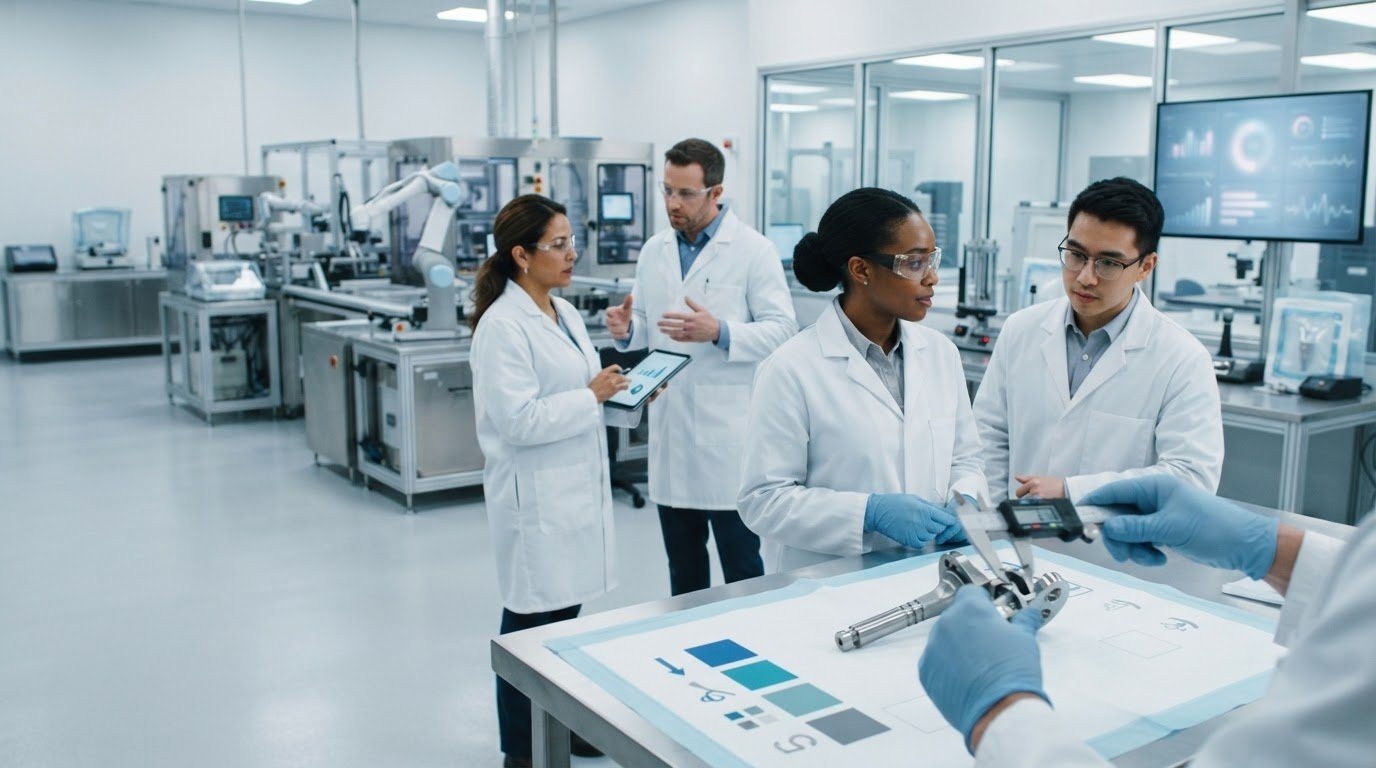
The traditional, linear approach to medtech production is no longer sufficient for the complexities of 2026. In a sequential model, the transition from R&D to the factory floor often reveals unforeseen engineering hurdles that trigger costly redesigns. Moving toward integrated medical device development and manufacturing eliminates these silos by involving manufacturing engineers and regulatory experts at the earliest stages of design. This concurrent methodology ensures that every technical specification is validated for scalability long before the first pilot run begins.
Integrated development is the simultaneous alignment of R&D and production readiness.
This level of cohesion is vital for high-precision instruments such as robotic surgical adapters and intricate stents. These devices demand extreme tolerances and specialized materials that don’t tolerate late-stage adjustments. By integrating design, engineering, and regulatory validation into a single workflow, organizations can ensure that the core components of the device are optimized for mass production without compromising clinical efficacy.
The CDMO Model vs. Traditional OEM Manufacturing
Choosing between a traditional OEM and a Contract Development and Manufacturing Organization (CDMO) determines the stability of your product lifecycle. A traditional OEM typically executes a finished design with little input on the preceding development phases. In contrast, a CDMO provides end-to-end support, acting as a steady hand from the initial concept through to cleanroom assembly and final packaging. With over 40 years of precision engineering experience, a specialized partner manages the technical friction that occurs during design transfer. This institutional trust is essential when adhering to rigorous standards like ISO 13485:2016, where every process must be meticulously documented and validated.
Strategic Benefits of an Integrated Approach
Adopting an integrated framework offers measurable advantages across the Total Product Lifecycle (TPLC). It isn’t just about technical accuracy; it’s about commercial viability. Key benefits include:
- Accelerated Speed-to-Market: Early manufacturing involvement identifies potential production bottlenecks during the design phase, preventing delays during the scale-up process.
- Cost Optimization: Refining the design for manufacturability (DFM) early reduces material waste and minimizes the need for expensive post-launch engineering changes.
- Enhanced Risk Mitigation: Continuous regulatory oversight ensures that compliance isn’t a final hurdle but a foundational element of the development process.
This strategic alignment transforms manufacturing from a back-end service into a core competitive advantage. It allows medical device companies to focus on clinical innovation while their partner ensures the technical execution remains flawless.
Phase 1: Concept Refinement and Design for Manufacturability (DFM)
Translating a clinical requirement into a technical specification is the first critical test of a device’s commercial viability. It’s where abstract ideas meet the physical constraints of mass production. Success at this stage relies on integrated medical device development and manufacturing, a process that ensures every design choice is grounded in production reality. Refining a concept involves more than just functional modeling; it requires a meticulous assessment of how each component will behave during high-volume assembly and long-term clinical use.
Design for Manufacturability (DFM) serves as the bridge between innovation and execution. During this phase, engineers evaluate material selection based on biocompatibility and sterilization stability. Whether a device requires Ethylene Oxide (EtO), autoclaving, or gamma radiation, the material must maintain its structural integrity and chemical properties. For instance, Nitinol stents require precise thermal processing to preserve their shape-memory characteristics, while ultrasonic scalpel couplers demand high-strength alloys capable of enduring extreme vibrational stress. Identifying these requirements early prevents the technical debt that often plagues unintegrated developmental cycles. Teams engaged in medical device development in Singapore will find that applying a structured prototyping checklist at this stage is essential to ensuring every design decision supports a scalable, compliant production pathway.
Engineering for Precision and Scale
Achieving the tight tolerances required for modern medical instruments requires advanced machining capabilities. Utilizing 5-axis CNC milling and auto-lathe technology allows for the creation of complex geometries in a single setup, which reduces cumulative error. A rigorous tolerance stack-up analysis is essential for multi-component assemblies to ensure that individual part variances don’t compromise the final device’s performance. For a deeper technical exploration of these methodologies, consult our Medical Device DFM: Strategic Engineering Guide 2026. These engineering standards are the foundation of a reliable production line.
Advanced Laser Processing in Early Design
Advanced laser processing has transformed how we approach early-stage design for surgical tools and implants. We employ 5-axis laser welding to create hermetic seals in complex surgical instruments, ensuring they remain sterile and functional throughout their lifecycle. Simultaneously, ultrashort-pulse laser marking is used to apply corrosion-resistant, UDI-compliant labels that withstand harsh cleaning protocols. Designers must also account for the delicate geometries of pull rings, marker bands, and hypotubes, ensuring these precision components can be manufactured repeatedly without deformation. If you’re ready to refine your current specifications, you can consult with our engineering team to discuss your project’s specific requirements.
Phase 2: Prototyping, Verification, and Risk Management
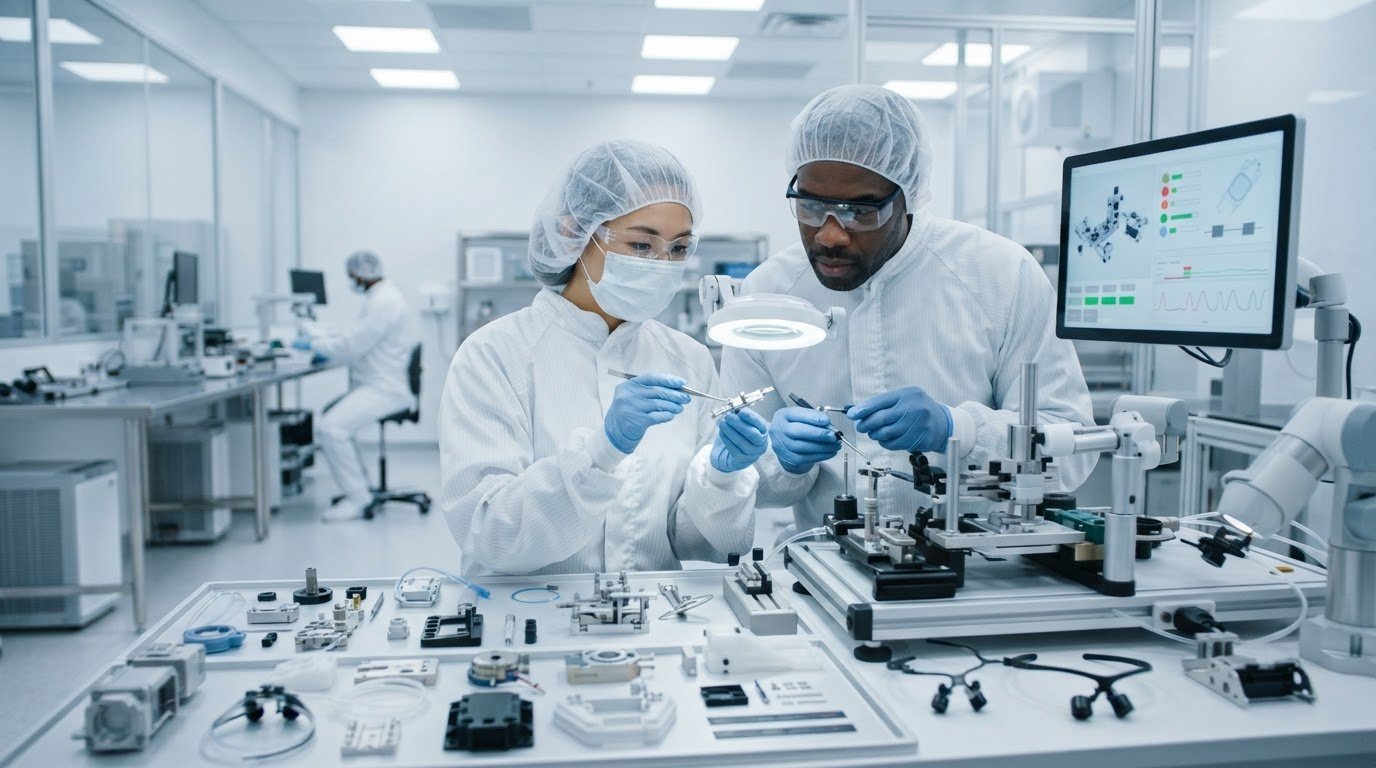
Transitioning from a digital design to a physical prototype marks a critical shift in the product lifecycle. In a model of integrated medical device development and manufacturing, prototyping isn’t just about verifying form; it’s about validating the assembly process itself. We move from functional models to production-equivalent units that utilize the same materials and machining processes intended for final commercialization. This ensures that the data gathered during verification is representative of what will eventually roll off the high-volume production line. Following a structured medical device prototyping services checklist for concept-to-production in 2026 provides the technical milestones needed to keep this transition on track and compliant.
Design verification and design validation are the two essential pillars of this phase. Verification confirms that the device meets every documented technical requirement, such as tensile strength, dimensional accuracy, or electrical output. Validation, however, answers the more fundamental question: does the device fulfill its intended medical use in the hands of the clinician or patient? Both processes require a disciplined approach to documentation to satisfy regulatory auditors and ensure patient safety throughout the device lifecycle. A comprehensive understanding of medical device design verification and validation is essential to ensuring your technical outputs consistently meet design inputs while proving the device satisfies real-world clinical needs.
Rigorous risk management must be woven into every step of this phase. We implement ISO 14971 frameworks and Process Failure Mode and Effects Analysis (PFMEA) to identify potential weaknesses in both the design and the manufacturing process. By anticipating how a component might fail under stress or during assembly, engineers can implement safeguards before the design is finalized. This proactive methodology transforms risk management from a compliance checkbox into a strategic engineering tool.
Micro-Precision Component Validation
Micro-precision components for cardiovascular and orthopedic applications require specialized testing protocols due to their minute scale and high-stakes functionality. Our R&D labs conduct intensive in-process testing, including high-sensitivity voltage testing and leak detection, to ensure the integrity of every individual part. These micro-components often serve as the critical failure points in complex surgical assemblies, demanding a level of scrutiny that standard machining cannot provide. For a detailed look at the engineering behind these parts, see The Science of Micro Precision Medical Components: A Comprehensive Engineering Guide.
Risk Mitigation and CAPA Integration
A robust development cycle relies on identifying failure modes long before the formal design transfer occurs. We integrate Corrective and Preventive Actions (CAPA) into the prototyping phase to address any deviations or technical anomalies immediately. This proactive stance ensures that the final design is hardened against the variables of mass production. Early risk assessment prevents costly post-market failures by identifying and neutralizing technical vulnerabilities during the developmental stage. This methodical verification process provides the institutional trust required for successful, large-scale commercialization.
Phase 3: Design Transfer and Regulatory Compliance
The transition from a controlled R&D environment to a high-volume manufacturing floor is the most critical juncture in the product lifecycle. Design transfer isn’t a single event but a systematic movement of design specifications into production reality. Within an integrated medical device development and manufacturing framework, this process involves the formal handoff of the Device Master Record (DMR). It’s the stage where theoretical engineering is translated into repeatable, validated work instructions that ensure every unit produced is identical to the approved prototype.
2026 marks a pivotal shift in how these transitions are audited. As of February 2, 2026, the FDA has fully implemented the Quality Management System Regulation (QMSR), which harmonizes 21 CFR Part 820 with ISO 13485:2016. This alignment means that a single, robust Quality Management System (QMS) now serves as the backbone for both domestic and international compliance. For manufacturers, this reduces the burden of maintaining dual systems while demanding a higher level of precision in documentation and process control.
Validation frameworks provide the evidence that a manufacturing process is capable of consistently producing safe devices. We utilize a Master Validation Plan (MVP) to oversee the three essential stages of qualification. Installation Qualification (IQ) confirms that equipment is correctly set up; Operational Qualification (OQ) tests the process at its limits; and Performance Qualification (PQ) demonstrates that the process remains stable under normal production conditions. This rigorous validation ensures that the device’s clinical efficacy is never compromised by manufacturing variance.
Regulatory Pathways for Global Market Entry
Securing market access requires more than technical excellence; it demands meticulous documentation for FDA 510(k) clearance or CE Marking under the EU MDR. Managing technical files for Class I, II, and III medical devices involves complex risk assessments and clinical evaluation reports. You can explore these requirements in detail through our guide on Mastering Medical Device Manufacturing Compliance: A Global CDMO Perspective for 2026. These pathways are essential for transforming a local innovation into a global medical solution.
Cleanroom Assembly and Packaging Validation
For sterile devices, the manufacturing environment is as critical as the device itself. Operating within Class 8 (100k) cleanroom environments allows for the assembly of complex instruments while maintaining strict bioburden controls. We coordinate specialized sterilization processes, including EtO, autoclave, and gamma radiation, to suit the specific material needs of the device. Packaging integrity is then validated using Tyvek pouches or blister systems to ensure the sterile barrier remains intact throughout the supply chain. If you’re preparing for design transfer, you can consult with our regulatory experts to ensure your documentation meets 2026 standards.
Phase 4: Scaling to Mass Production with Smart Manufacturing
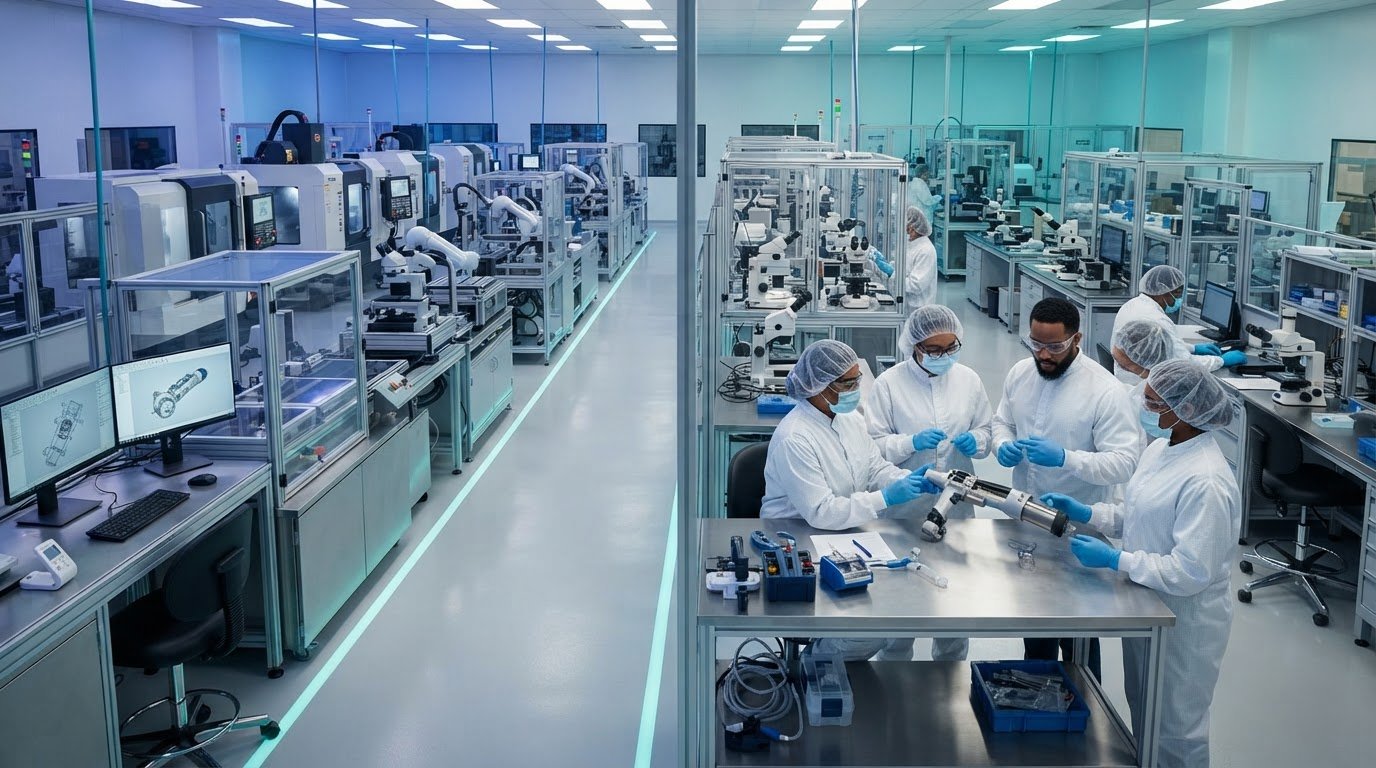
Scaling from pilot runs to high-volume commercial production represents the final validation of a successful integrated medical device development and manufacturing strategy. While earlier phases focus on refining the design and securing regulatory clearance, Phase 4 is about industrializing that design through Smart Manufacturing. This involves deploying production lines equipped with real-time performance dashboards that monitor every critical variable, from cycle times to environmental conditions. By digitizing the factory floor, we ensure that the precision achieved in the lab is maintained across millions of units.
As part of this industrialization, securing reliable process machinery is essential. For those looking to source stainless steel tanks, centrifuges, or separators, famaker.com.au offers high-quality used equipment suitable for diverse industrial applications.
Automation is central to achieving this scale without sacrificing quality. We utilize robotic loading and unloading systems to minimize human intervention in high-precision machining, alongside automated blister packaging lines that ensure sterile integrity. To maintain rigorous standards at scale, we employ unmanned Coordinate Measuring Machine (CMM) inspection. These systems provide 24-hour measurement capabilities, allowing for continuous quality oversight and immediate adjustment of machining parameters if even the slightest deviations are detected. This data-driven approach eliminates the variability that often plagues traditional manual inspection methods.
Global Supply Chain and Logistics Optimization
Managing a global MedTech supply chain requires more than manufacturing capacity; it demands strategic logistics. We utilize Vendor Managed Inventory (VMI) to support global OEMs, ensuring that critical components like cardiac stents and surgical staplers are available exactly when needed. Our strategic footprint, centered at our Singapore HQ and expanding with a new site in Johor, Malaysia, in Q1 2027, provides the geographic resilience necessary to navigate modern supply chain disruptions. This expansion significantly increases our ability to serve as a global partner of choice for complex device assembly and micro-precision components. For teams looking to bridge cultural gaps in these regions through language training, click here.
The Future of Medical Device Manufacturing
The next era of medical device technology will be defined by the seamless integration of advanced engineering and patient-centric care. Maintaining a long-term B2B partnership in this industry requires a deep-seated Quality Culture where precision is an institutional value rather than just a regulatory requirement. As production volumes increase, this culture ensures that every device remains a reliable tool for clinicians and a safe solution for patients. Ready to scale your medical innovation? Consult with our engineering experts today to discuss your path to commercial-scale production.
Advancing the Future of Medical Innovation
Success in the 2026 MedTech landscape demands a shift from fragmented workflows to a unified engineering framework. By prioritizing Design for Manufacturability (DFM) and Smart Manufacturing early in the lifecycle, organizations can avoid the technical debt that often stalls commercialization. This roadmap has demonstrated that integrated medical device development and manufacturing isn’t just an operational choice; it’s a strategic necessity for maintaining precision at scale while adhering to evolving FDA and ISO 13485:2016 standards.
Reliability in this high-stakes industry is built on technical excellence and institutional trust. Whether you’re refining micro-precision components or managing complex device assembly, the stability of your production partner determines your long-term success. With ISO 13485 and FDA 510(k) compliant processes, Class 8 cleanroom assembly, and a global manufacturing footprint across Singapore, China, and Malaysia, we provide the steady hand needed to navigate these complex cycles. Partner with Fong’s for Best-in-Class Medical Device Development. We’re ready to help you bring your life-saving innovations to the global market with absolute confidence.
The demand for high-quality, custom manufacturing extends beyond medical devices into other specialized industries; for example, you can check out PowerSweet Fashion for professional garment production services in China.
Frequently Asked Questions
What is the difference between a medical device CMO and a CDMO?
A CMO focuses strictly on the production of finished designs, whereas a CDMO provides end-to-end support including R&D, engineering, and regulatory validation. Partnering with a CDMO is essential for integrated medical device development and manufacturing because it aligns design intent with production scalability from the earliest stages. This collaborative model reduces technical friction and ensures a smoother transition to mass production.
How does Design for Manufacturability (DFM) reduce medical device costs?
Design for Manufacturability reduces costs by identifying production bottlenecks and material inefficiencies before expensive tooling begins. It minimizes the need for post-launch engineering changes and reduces scrap rates during high-volume runs. By optimizing component geometries for automated assembly, DFM ensures that the device remains commercially viable without compromising its clinical performance or safety standards.
What are the requirements for FDA 510(k) clearance in 2026?
In 2026, 510(k) clearance requires demonstrating substantial equivalence to a legally marketed predicate while adhering to the harmonized Quality Management System Regulation (QMSR). Documentation must emphasize comprehensive risk management and performance data that align with ISO 13485:2016 standards. Manufacturers must provide rigorous evidence of safety and efficacy through validated testing protocols and meticulous technical files.
Why is ISO 13485 certification essential for contract manufacturing?
ISO 13485 certification is essential because it establishes a standardized Quality Management System specifically for the medical device industry. It provides a disciplined framework for risk management, process validation, and full traceability throughout the product lifecycle. For contract manufacturers, this certification serves as a foundation of institutional trust, ensuring that every component meets global regulatory expectations and patient safety requirements.
How do smart manufacturing lines improve medical device quality?
Smart manufacturing lines improve quality by utilizing real-time performance dashboards and automated inspection systems to eliminate human error. These systems provide continuous data on critical process parameters, allowing for immediate intervention if even the slightest deviations occur. Technologies like unmanned CMM inspection ensure that micro-precision is maintained across every unit produced, providing a level of consistency that manual processes cannot achieve.
What happens during the Design Transfer phase of medical device development?
During Design Transfer, the Device Master Record is formally moved from the R&D team to the production unit. This phase involves translating engineering specifications into validated work instructions and establishing the necessary supply chain logistics. It’s a critical juncture in integrated medical device development and manufacturing that ensures the final commercial product perfectly matches the approved and validated design prototype.
Can a CDMO assist with both disposable and reusable surgical instruments?
Yes, a CDMO manages the distinct engineering and material requirements for both disposable and reusable surgical instruments. Disposable tools focus on cost-efficient mass production and sterilization stability, while reusable instruments require durable materials that withstand repeated autoclaving. Specialized partners provide the precision machining, cleanroom assembly, and material expertise needed to ensure both categories meet their specific clinical use cases.
How does the 2026 FDA QMSR update affect current medical device manufacturers?
The 2026 FDA QMSR update harmonizes 21 CFR Part 820 with ISO 13485:2016, creating a unified global regulatory standard for quality systems. Manufacturers must ensure their internal processes reflect these integrated requirements to avoid compliance gaps during FDA inspections. While this change simplifies international market entry, it demands a more meticulous approach to documentation and risk-based decision-making across the total product lifecycle.