
Commercial production rarely follows a single fixed schedule: point of care diagnostic device production typically takes 18 months to several years from prototype to launch. An electrochemical or microfluidic in vitro diagnostic device with established chemistry and a well-defined regulatory pathway can reach production in 18 to 24 months when development is well managed and manufacturing is engaged from the prototype stage. More complex devices, particularly those requiring clinical performance data for regulatory submission, commonly take three years or longer.
That range reflects the work required to move from an initial assessment to a device that can be manufactured consistently, not just the time needed to refine a prototype. The intended test, cartridge design, verification and validation needs, regulatory pathway, and production process all shape the schedule.
This article explains how point-of-care devices, cartridges, and microfluidic assemblies are developed and produced, and why some milestones have greater influence on timing than others. It also examines the transition from pilot builds to commercial production, so you can understand the stages involved and what drives a realistic launch plan.
Key Takeaways
- Plan for a timeline ranging from 18 months to several years; device complexity and regulatory evidence needs can extend development.
- Account for reagent deposition, printing, cutting, lamination, and controlled assembly when mapping the route to scaled manufacturing.
- Cartridge channel design and sealing method influence assembly and the checks needed to verify fluid containment.
- Align component and material choices with the assay, sensing method, and intended production process.
- Build quality management and production controls into development so pilot manufacturing can transition toward commercial scale.
How point-of-care diagnostic devices are made?
Manufacturing starts by translating the assay and its intended use into a device design, process plan, and production controls. For disposable tests, the plan must integrate the instrument, consumable, reagents, packaging, and regulatory evidence.
In-House and Contract Manufacturing
In-house manufacturing uses a company’s own people, equipment, and facilities. Contract manufacturing assigns defined production work to an external partner. This choice affects control over process knowledge, investment in equipment, and access to specialized capabilities.
Internal production can suit teams with established equipment and staff for processes such as reagent deposition or cartridge assembly. Contract manufacturing can bring those capabilities into development earlier, including process engineering for a disposable test. Compare the options by mapping required processes, target volumes, quality responsibilities, and the ability to scale without redesigning the production line.
Facilities, Partners, and Consumables
A suitable facility matches its controlled work areas, equipment, and inspection methods to the device’s materials and assay. A manufacturing partner or CDMO can coordinate design transfer, process development, and production planning for both the instrument and disposable consumable.
Consumable production may combine roll-to-roll printing, precision cutting, automated lamination, and controlled reagent deposition. For example, printed assay layers and laminated fluid paths must align so the sample follows the intended test sequence. Facility capabilities also need to support component handling, assembly, packaging, and documented inspection. Packaging and distribution plans should reflect the device’s storage and transport needs. Sterilization depends on whether the design and intended use require a sterile product.
Requirements, Quality, and Validation
Regulatory classification shapes the submission pathway and evidence needed for a U.S. diagnostic device. According to the U.S. Food and Drug Administration, most point-of-care diagnostics in the United States require a 510(k) premarket notification, while higher-risk devices may require a PMA submission.
Point-of-care in vitro diagnostic devices are subject to ISO 13485 quality management system requirements, according to the International Organization for Standardization. The same organization states that ISO 15197 applies to blood glucose monitoring systems as a product-specific performance standard. Quality management and validation therefore connect documented design decisions with process controls, inspection criteria, and evidence that the finished device meets its intended requirements.
Production Costs and Quality Risks
Development and production costs depend on assay complexity, tooling, material selection, validation work, production volume, and the capabilities required for assembly. A project price depends on the case and is given after a quote request; these factors shape the estimate. The main production risks include variation in reagent placement, inconsistent lamination, contamination, and assembly errors that disrupt test performance.
Controls should target these failure points through process monitoring, defined acceptance criteria, and inspection of critical assemblies. For example, a fluid-path defect in a cartridge can prevent sample movement and compromise the result. In the United States, point-of-care testing is used in settings such as primary care, emergency departments, rural clinics, patient homes, and mobile screening units. Assess market size in relation to these settings and the intended test applications.
IVD cartridge and microfluidic assembly
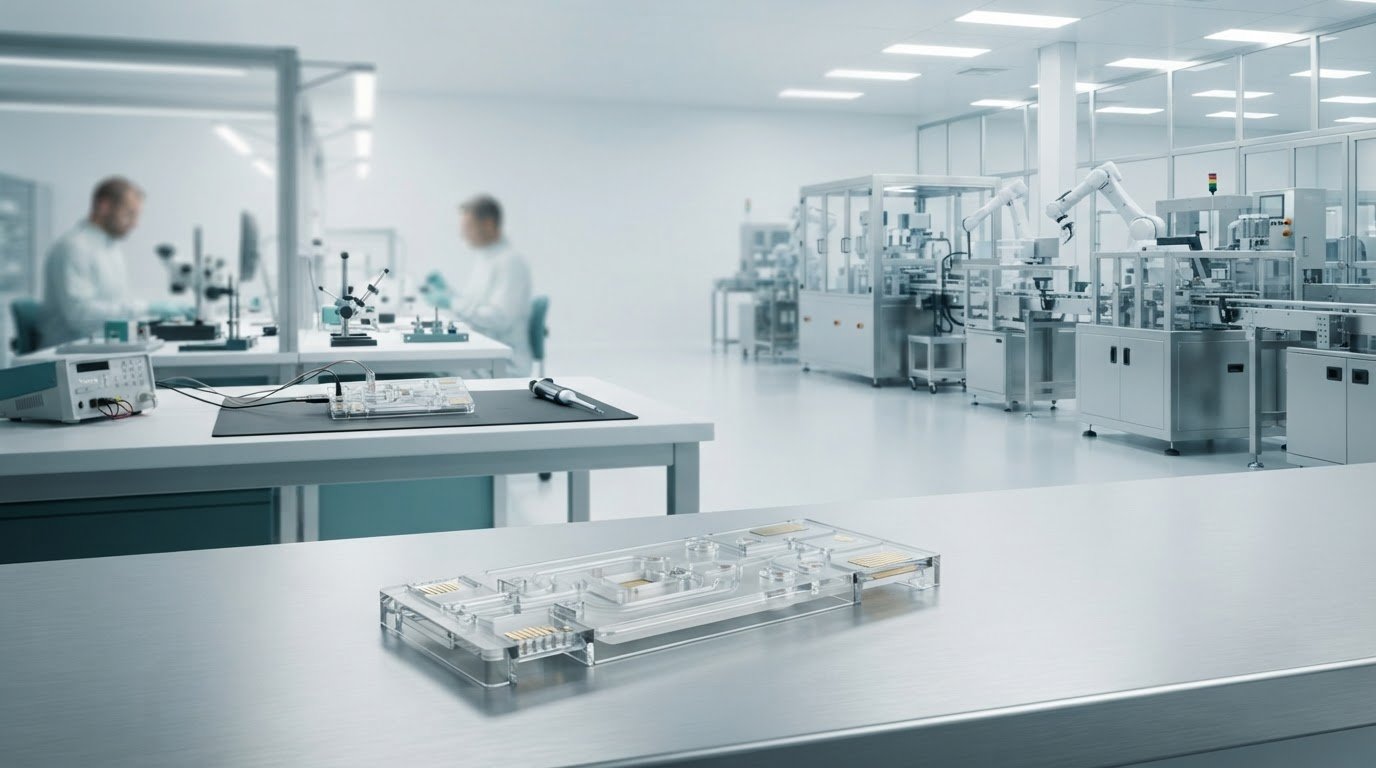
An IVD cartridge or cassette holds the sample and assay materials while controlling their movement through a test. Microfluidic channels guide small, precisely defined fluid volumes through engineered pathways, supporting multistep reactions in a compact format. The assembly must align these pathways with wells, reagent zones, vents, and the instrument interface. A mismatch can interrupt flow or prevent the assay from reaching its readout stage.
During development, engineers translate the assay sequence into channel geometry and assembly requirements. A cartridge with eight wells, for example, needs defined connections between wells and channels so each fluid reaches its intended reaction area. The design must also account for sample entry, reagent release, air displacement, and waste containment. These features affect both manufacturability and test operation. Microfluidic expertise helps connect assay behavior with material selection, tolerances, and assembly methods.
Assembly commonly brings together a molded or formed substrate, fluidic layers, and a cover or sealing film. The production sequence may include component preparation, alignment, bonding, and inspection. Precision matters at each interface: a shifted layer can narrow a channel, while an incomplete bond can create leakage or unwanted fluid transfer. Testing should therefore assess the assembled cartridge’s flow path and sealing function, not only its appearance. Where a sealing method requires it, production may include 100% testing of the sealing function.
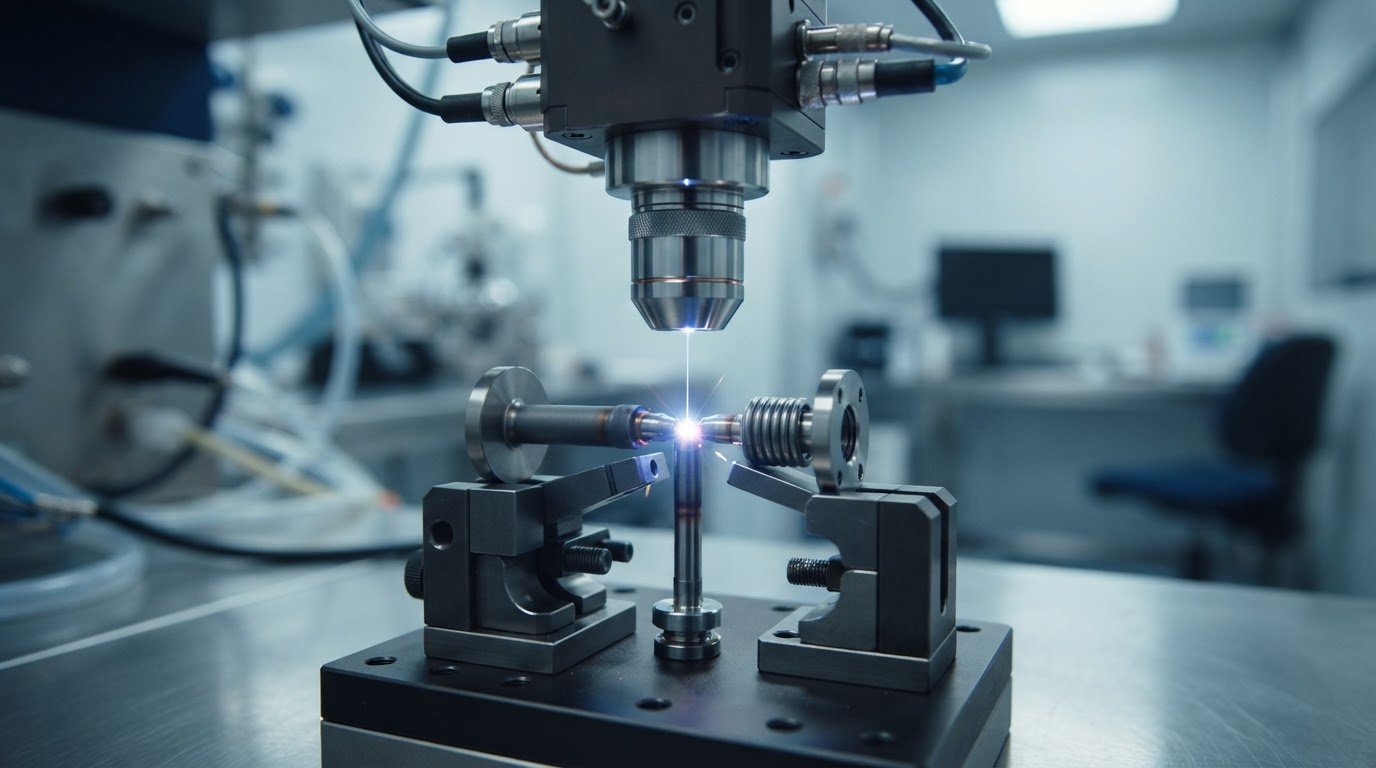
Channel sealing methods include pressure-sensitive adhesives, UV-cured glue, selective laser soldering, and multi-shot molding. Each method forms a barrier differently, so selection depends on cartridge geometry, material compatibility, assay requirements, and the assembly process. Adhesives can join layered channel structures, UV-cured glue bonds selected areas, laser soldering applies energy selectively, and multi-shot molding integrates features during molding. The chosen method must preserve channel dimensions and prevent fluid escape or cross-flow.
- Pressure-sensitive adhesive: bonds prepared layers, with alignment and adhesion affecting channel integrity.
- UV-cured glue: joins selected surfaces, requiring controlled placement and curing.
- Selective laser soldering: directs bonding energy to defined locations in the cartridge.
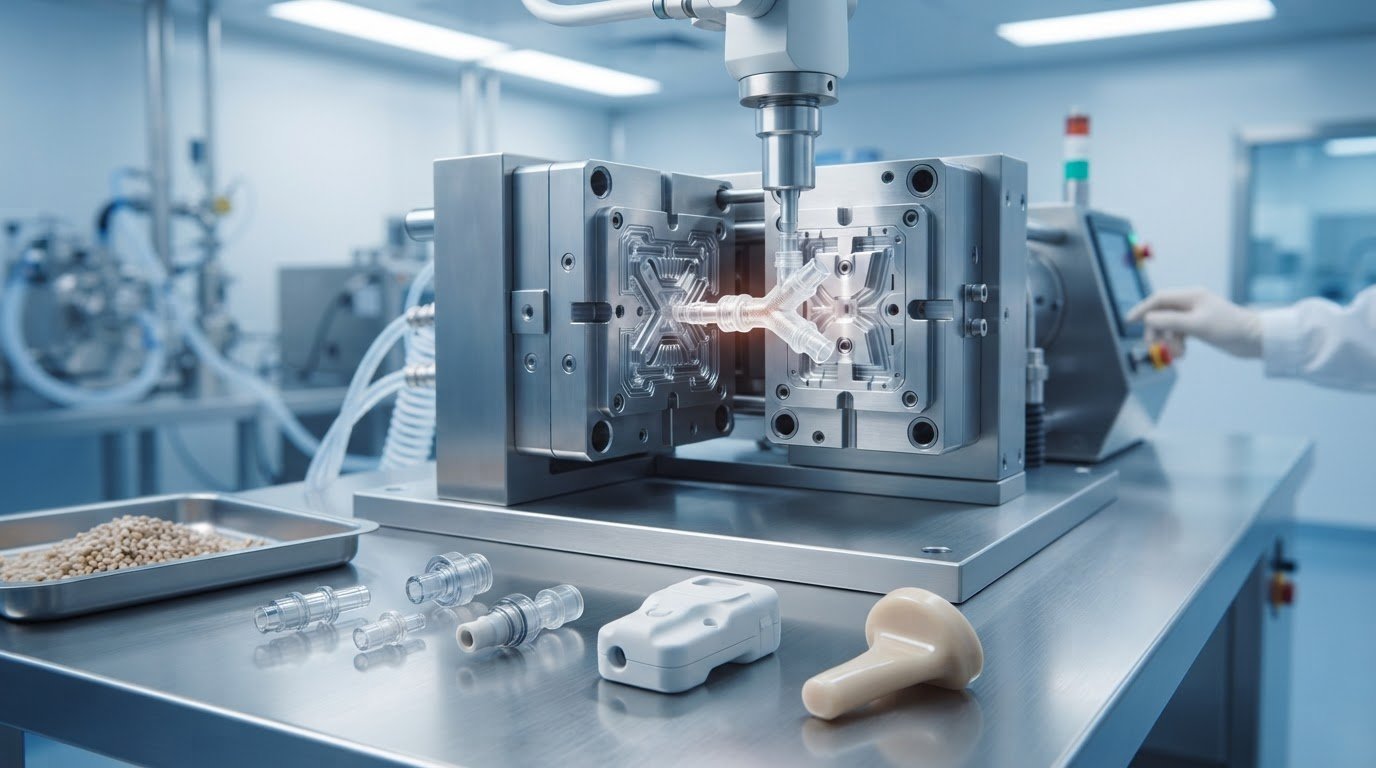
- Multi-shot molding: forms connected features through successive molding steps.
Pilot builds reveal how a design behaves during repeat assembly and testing. Engineers can use those results to refine fixtures, bonding parameters, and inspection criteria before increasing production. Complex device assembly connects cartridge components with instrument interfaces, while micro-precision components support controlled alignment and fit. To discuss the assembly requirements for a microfluidic project, share your cartridge assembly requirements.
Device components and materials
A point-of-care medical device integrates a substrate, sensing element, reagent or chemistry layer, microfluidic structure, and readout mechanism. Each component has a defined role, but the interfaces between them determine whether the complete test works as intended. During design, teams map the sample and signal paths, then select materials and assembly methods to suit those requirements. A substrate change can affect channel formation, sensor placement, and how the instrument reads the result.
The substrate supports the diagnostic elements and establishes the device’s physical structure. A disposable cartridge may use medical-quality resin, which can reduce its overall carbon footprint. The material must also suit the cartridge’s fluid pathways and assembly process. Designers consider how the substrate holds the sensing element and reagent layer, and how those parts stay aligned during manufacturing. These decisions influence component fit, repeatable assembly, and production-volume planning.
The sensing element converts a biological interaction into a measurable output. For electrochemical sensing, printed electrodes may use carbon, silver, or gold, selected according to the analyte and detection method. The electrodes must meet the assay’s functional requirements and fit the device’s electrical interface. In a lateral flow assay, antibody-antigen binding produces a colorimetric readout visible to the naked eye. This uses an optical signal rather than an electrode-based measurement.
- Substrate: provides the base for the diagnostic structure and supports component alignment.
- Sensing element: detects the target through a selected electrochemical or optical approach.
- Reagent layer: contains the assay chemistry needed for the intended reaction.
- Microfluidic structure: directs sample and reagents through defined channels.
- Readout mechanism: presents the result through a visible color change or instrument signal.
Component integration is a design activity, not simply a final assembly step. The microfluidic structure, for example, must position the sample relative to the sensing area, while the readout mechanism must detect the resulting signal. Manufacturing teams translate these relationships into placement requirements and assembly controls. Complex device assembly brings separate components together while preserving their intended alignment and function.
Connectivity adds another interface to the device architecture. Pre-qualified connectivity modules can support modular point-of-care solutions and potential upgrades. Design teams can account for the module’s physical and electrical connections alongside the assay and readout. This separates connectivity choices from core diagnostic components while keeping interfaces defined for integration. The selected configuration still needs to match the intended device design.
Material and component decisions should be resolved together. The selected electrode, resin, or reagent layer affects how the device is assembled and how its output is produced. During design transfer, teams link each component specification to its assembly position and functional role. This component-level view helps preserve the intended device architecture as manufacturing moves from individual builds to repeatable production.
Prototype-to-production timelines
The prototype-to-commercial-production timeline for a point-of-care diagnostic device typically ranges from 18 months to several years. An electrochemical or microfluidic in vitro diagnostic device with established chemistry and a well-defined regulatory pathway can reach production in 18 to 24 months when development is well managed and a manufacturing partner is engaged from the prototype stage. More complex devices, or devices requiring clinical performance data for regulatory submission, commonly take three years or longer.
These ranges reflect different development requirements, not a universal schedule. An initial concept must become a defined product, a controlled manufacturing process, and evidence supporting its intended use. Each stage can reveal design or process changes that affect later work. For example, a revised assay may require updates to cartridge design, verification plans, and manufacturing documentation. Planning these dependencies early helps teams identify which activities can proceed in parallel and which rely on earlier results.
Build a practical timeline around linked milestones rather than a single launch date. The sequence below shows how work commonly progresses from concept toward commercial production:
- Assessment and concept: define the patient need, intended test, assay approach, and product requirements.
- Prototype development: evaluate the assay, device architecture, and critical interfaces using representative builds.
- Design refinement: address observed performance issues and convert design choices into controlled specifications.
- Process development: establish assembly, inspection, and production methods that can be repeated.
- Verification and validation: generate evidence that the design and processes meet their defined requirements.
- Production transfer: align documentation, materials, equipment, and personnel for routine manufacturing.
The regulatory pathway and clinical evidence needs can become critical-path activities. A device with established chemistry and a clearly defined submission route may involve less development uncertainty. A novel assay or a device requiring clinical performance data adds evidence planning and review work. These requirements influence when design decisions must be fixed and production processes can be finalized.
Involving manufacturing teams from the prototype stage can reveal production constraints before design transfer. A partner can assess whether component tolerances, assembly steps, and inspection methods support repeatable output. This early input matters for micro-precision components, where fit and alignment can affect the finished device. Late process changes may require new builds and additional testing, extending the path to launch.
Use the timeline as a planning model, then track progress against completed evidence and controlled processes. Moving from a functional prototype to commercial production, for example, takes more than increasing build volume: the team must demonstrate a reproducible process and maintain the required records. A reliable schedule connects each milestone to its technical outputs, regulatory needs, and manufacturing dependencies.
Scaling from pilot to commercial production
A pilot build tests whether the defined design and manufacturing process can produce consistent devices beyond prototype conditions. Commercial production then requires controlled materials, repeatable assembly, documented inspections, and capacity suited to demand. In the United States, point-of-care in vitro diagnostic devices are subject to FDA 21 CFR Part 820.
Scaling begins by comparing pilot methods with the intended production format. Teams review each operation, from incoming component inspection to final device testing, and identify steps that rely on manual adjustment. An operator aligning components by eye, for example, may need a fixture or defined inspection method to achieve repeatable assembly. Any process change must preserve the device’s specified performance and documentation.
Manufacturing controls need to grow with production. ISO 13485 requires documented design controls, supplier management, risk management processes, and traceability throughout production. These records connect a finished device to its materials, suppliers, process instructions, inspections, and release decisions. When a component or supplier changes, documented review helps determine whether further evaluation or process updates are needed.
A scale-up plan can organize readiness around practical workstreams:
- Process transfer: translate approved design outputs into controlled manufacturing instructions.
- Supplier readiness: align component specifications, incoming checks, and change communication.
- Equipment and fixtures: define operating parameters and maintenance requirements for each assembly step.
- Inspection and testing: set acceptance criteria for components, assemblies, and finished devices.
- Production records: maintain traceability through material use, process steps, and release.
Custom manufacturing arrangements can support a device’s specific assembly sequence, but responsibilities must remain clear between the product owner and production teams. A controlled handoff identifies who maintains drawings, approves changes, manages supplier records, and reviews nonconforming output. This clarity helps prevent differences between the pilot process and routine production instructions.
Commercial readiness also depends on how the production line responds to variation. A rising defect pattern in a molded component, for instance, may call for a supplier investigation, tighter incoming inspection, or revised process controls. Teams should use production data to distinguish isolated errors from recurring causes, then document corrective actions and verify their effect. This makes process improvement part of ongoing manufacturing, not a one-time pilot activity.
For complex diagnostic devices, assembly planning connects components, instructions, inspection points, and traceability into one controlled workflow. Discuss your production scale-up requirements to align assembly needs with a manufacturing plan.
Fong’s Engineering & Manufacturing Private Limited: CDMO Services
Fong’s Engineering & Manufacturing Private Limited supports medical device teams moving from concept design and prototyping through validation and large-scale production. Its CDMO Services and OEM Solutions connect development work with manufacturing, including regulatory support for FDA and ISO 13485 compliance.
For point-of-care projects, coordinated production planning is a useful next step when assay and device requirements need to come together. Micro-precision Components and Complex Device Assembly support projects where component accuracy and integrated assembly are central to the device. The right engagement depends on the project’s development stage, design requirements, and manufacturing needs.
To discuss a medical device development or manufacturing project, contact Fong’s Engineering & Manufacturing Private Limited or visit fongspl.com.sg.
Set the next production decision in motion
Start by defining what the device must achieve and what is needed to move it forward. Bring together the assay requirements, device design status, intended production format, and regulatory pathway. This gives engineering and manufacturing teams a shared basis for evaluating open decisions, defining responsibilities, and aligning development work with the planned production process.
Point of care diagnostic device production depends on coordinated decisions across the assay, device, and manufacturing process. Fong’s Engineering & Manufacturing Private Limited offers CDMO Services and OEM Solutions for medical device projects. Its offerings also include Endoscope Repair & Refurbishment, addressing a distinct need for reusable instruments.
A clear project discussion can establish which technical questions need attention first and how manufacturing involvement fits the development stage. Contact Fong’s Engineering & Manufacturing Private Limited to discuss your project and its next production decisions. A well-defined starting point can help your team move forward with greater clarity and purpose.
Frequently Asked Questions
How long does it take to go from assessment to commercial production?
Assessment to commercial production typically takes 18 months to several years. An electrochemical or microfluidic IVD with established chemistry and a well-defined regulatory pathway can reach production in 18 to 24 months when development is well managed and manufacturing is involved from the prototype stage. More complex devices, especially those requiring clinical performance data for submission, commonly take three years or longer. Assay maturity and evidence needs strongly affect planning.
How long does it take to go from prototype to production for a POC device?
Prototype-to-production timing typically ranges from 18 months to several years. A prototype is only one milestone: the team must also refine the design, demonstrate performance, establish repeatable manufacturing processes, and prepare regulatory evidence. For example, a change to assay chemistry after prototype testing may affect the cartridge and require additional evaluation. Early manufacturing input can expose production constraints before design transfer and help teams plan around them.
What is the point-of-care diagnostic device production process?
The process moves from defining intended use and assay requirements to designing, testing, validating, and manufacturing the device. Teams translate the diagnostic concept into specifications for the instrument, consumable, and readout. They then assess whether the assembled system performs as intended and whether production can consistently meet defined requirements. A test using a disposable cartridge, for example, must work as an integrated system, not simply as a working instrument paired with an unverified consumable.
What are the key components and technologies used in point-of-care diagnostic devices?
Common components include a substrate, sensing element, reagent or chemistry layer, microfluidic structure, and readout mechanism. The technology depends on the assay: lateral flow tests use antibody-antigen binding with a visible colorimetric readout, while electrochemical sensors measure current or voltage changes at a functionalized electrode. Printed electrodes may use carbon, silver, or gold. The analyte and detection method guide these choices, while connectivity modules can support modular device designs.
What equipment and facility requirements are needed to manufacture point-of-care diagnostic devices?
Facilities need capabilities that match the device’s materials and assembly sequence. Production may require roll-to-roll printing, precision cutting, automated lamination, and controlled reagent deposition. Inspection and testing methods must also evaluate the assembled product’s critical functions, such as fluid movement or sealing. The facility’s quality system supports documented processes and traceability. ISO 13485 quality management system requirements apply to point-of-care in vitro diagnostic devices, according to the International Organization for Standardization.
What are the steps for scaling point-of-care diagnostic device production?
Scale-up connects the pilot process to controlled routine manufacturing. Start by documenting pilot methods and identifying operations that rely on manual adjustment. Then align component specifications, supplier controls, equipment settings, inspection criteria, and production records. Use manufacturing data to identify recurring defects and investigate their causes. Repeated cartridge sealing failures, for example, may require process review and corrective action before output increases. Documented design controls, risk management, supplier management, and traceability support this transition.