

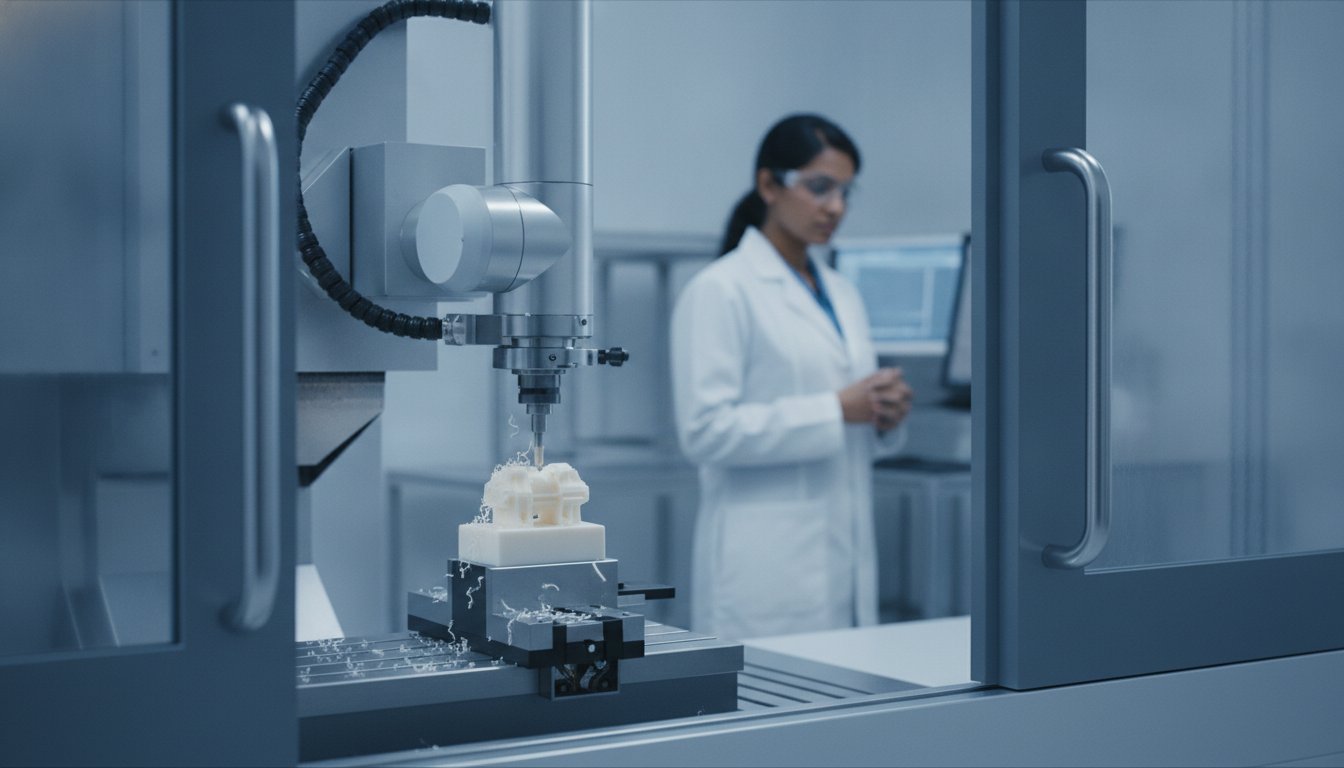
Could a subtle thermal shift during a CNC cycle be the difference between a successful 510(k) submission and a costly regulatory delay? For engineers developing next-generation implants and surgical tools, the answer’s often found in the nuances of material integrity. As the global medical polymers market grows to an estimated $27.1 billion in 2026, the technical demands placed on medical grade polymer machining have transitioned from simple part fabrication to a complex exercise in risk management. You recognize that maintaining tight tolerances in flexible materials while preventing polymer degradation is a significant hurdle in the developmental lifecycle.
This reference provides a comprehensive framework for addressing these challenges through precise DFM strategies and advanced CNC techniques. We’ll examine the mechanical properties of PEEK, the implications of the ISO 10993-1:2025 update, and the documentation required to satisfy the FDA’s harmonized Quality Management System Regulation. By the end of this guide, you’ll have a clear roadmap for selecting materials and machining partners that align with the highest standards of clinical safety and engineering excellence. We’ll move from material fundamentals to the rigorous validation protocols that define high-performance medical manufacturing.
Key Takeaways
- Identify the critical selection criteria for high-performance thermoplastics like PEEK, focusing on biocompatibility and the ability to withstand rigorous sterilization cycles.
- Discover how advanced medical grade polymer machining techniques, such as 5-axis milling and Swiss-style turning, achieve the tight tolerances required for complex surgical geometries.
- Establish a robust quality assurance framework by utilizing IQ/OQ/PQ validation protocols to ensure long-term process stability and ISO 13485 compliance.
- Optimize the transition from R&D prototyping to mass production by leveraging a CDMO partnership that integrates global manufacturing sites with Class 8 cleanroom assembly.
Fundamentals of Medical Grade Polymer Machining
Medical grade polymer machining is the precision subtractive manufacturing of biocompatible thermoplastics into intricate components for clinical applications. This process is distinct from general industrial machining because it prioritizes the preservation of the material’s molecular integrity. For engineers, it’s a critical bridge between initial R&D and full-scale production. It allows for the refinement of device geometries without the immediate capital expenditure of injection moulding tools.
The shift from metals to polymers in MedTech is driven by functional necessity. High-performance polymers offer radiolucency, which is essential for clear imaging during surgical procedures. They also provide a modulus of elasticity that closely mimics human bone, reducing the risk of stress shielding in orthopedic implants. While materials like Medical Grade Silicone are frequently used for flexible seals and gaskets, rigid thermoplastics require advanced CNC techniques to achieve the structural stability needed for robotic surgery adapters and endoscopic tools.
Machining vs. Injection Moulding: When to Choose Subtractive
Subtractive manufacturing is the superior choice when tolerances must be held within microns. Injection moulding introduces variables such as material shrinkage and non-uniform cooling rates that can compromise dimensional accuracy. Medical grade polymer machining eliminates the need for draft angles. This allows engineers to design parts with vertical walls and complex internal features that are impossible to mould without expensive side-actions. For production runs of 50 to 5,000 units, machining is often more cost-effective. It bypasses the high costs and lengthy lead times of steel tool fabrication, enabling a faster response to clinical feedback.
The Importance of Stock Shape Quality
The reliability of a finished medical component depends on the quality of the raw stock. High-quality extrusion processes ensure that rods and plates are free from internal voids or inclusions that could lead to part failure. Machining centers must also manage internal stresses within the polymer. If a material isn’t properly annealed, it may warp as material is removed, leading to dimensional instability. Rigorous traceability is a non-negotiable requirement. Every batch of raw polymer must be documented with a certificate of compliance to ensure the material’s chemical composition and mechanical properties are consistent with the original design specifications.
Material Selection: High-Performance Polymers for MedTech
Selecting the right material is a fundamental engineering decision that dictates the clinical success of a medical device. For high-performance applications, medical grade polymer machining requires polymers that meet rigorous standards for biocompatibility, chemical resistance, and structural stability. PEEK (Polyetheretherketone) remains the industry benchmark for long-term implants and reusable surgical instruments. Its modulus of elasticity closely matches human bone, and it maintains structural integrity even under extreme thermal stress. Engineers working in adjacent disciplines, such as spinal implant contract manufacturing, rely on these same material properties to develop high-performance pedicle screws and interbody fusion devices.
While PEEK is the gold standard, materials like Ultem (PEI) and Radel (PPSU) offer excellent performance for diagnostic equipment where cost-efficiency is a factor. Radel, in particular, is valued for its transparency and high impact strength. For advanced applications, carbon-fiber reinforced polymers provide the stiffness of metal with the benefits of plastic, while bioabsorbable materials like PLLA are used for temporary fixation devices that the body eventually resorbs without surgical intervention.
Sterilisation Compatibility and Material Stability
Medical components must endure aggressive cleaning protocols without losing their mechanical properties. Evaluating how a polymer reacts to Autoclave, EtO, and Gamma radiation is vital. Repeated steam sterilization can lead to hydrolysis or micro-cracking in lesser materials. This stability is especially critical during reusable endoscope refurbishment, where components must survive hundreds of cycles without degrading. Choosing a material that resists oxidation and thermal breakdown ensures the device remains safe for patient use over its entire lifecycle.
Engineering Properties of Medical Thermoplastics
High-performance polymers are increasingly capable of replacing stainless steel in structural applications. This transition requires a deep understanding of tensile strength and thermal stability. During medical grade polymer machining, the material must remain dimensionally stable despite the heat generated by high-speed CNC milling. Polymers with low thermal expansion coefficients prevent warping during the fabrication of micro-precision components. Additionally, these materials must offer total resistance to hospital-grade disinfectants and bodily fluids to prevent environmental stress cracking.
The intersection of material science and precision engineering is where clinical reliability is born. If you’re currently evaluating high-performance thermoplastics for a new device design, you can consult with our engineering team to ensure your material selection aligns with manufacturing realities and regulatory requirements.
Advanced CNC Techniques for Complex Polymer Geometries
Advanced machining of medical thermoplastics requires a departure from traditional metalworking logic. While 5-axis CNC milling enables the fabrication of intricate surgical stapler components and robotic adapters in a single setup, Swiss-style turning is indispensable for small-diameter polymer pins and connectors. These high-precision techniques minimize manual handling and reduce the risk of particulate contamination. By utilizing multi-axis platforms, we maintain the geometric integrity of the part while ensuring that complex internal features are executed with repeatable accuracy.
Thermal management is the primary challenge in medical grade polymer machining. Unlike metals, polymers don’t dissipate heat through the chip; instead, the thermal energy remains concentrated in the tool and the workpiece. We utilize specialized tooling geometries with high-positive rake angles to ensure clean shearing rather than rubbing. This precision is vital for achieving the ultra-smooth surface finishes required for clinical safety. A rough or smeared surface can harbor biological contaminants or trigger adverse tissue reactions, making tool selection a critical factor in biocompatibility.
Design for Manufacturability (DFM) in Polymer Machining
Design for Manufacturability (DFM) is the bridge between a theoretical CAD model and a validated medical component. Engineers should optimize wall thicknesses to prevent material deflection during the cutting cycle and use generous corner radii to enhance structural stability. Reducing the number of tool changes through intelligent part design directly impacts production efficiency. By integrating these principles during the early development phases, DFM will play a decisive role in reducing the total cost of ownership for complex medical devices by 2026.
Smart Manufacturing and Real-Time Monitoring
Smart manufacturing technologies have transformed the consistency of high-volume polymer fabrication. Integrating robotic loading systems allows for 24/7 unmanned production, ensuring that global MedTech demands are met without sacrificing precision. Real-time dashboards monitor tool wear and dimensional drift, allowing for proactive adjustments before a component falls out of tolerance. This level of digital control is essential for producing micro precision medical components, where unmanned CMM inspection provides a continuous stream of validation data to maintain rigorous quality standards.
Quality Assurance and Regulatory Validation
Validation isn’t a post-production checklist; it’s the foundation of medical grade polymer machining. Regulatory bodies like the FDA require technical evidence that a manufacturing process remains stable across its entire lifecycle. ISO 13485 compliance provides the structural framework for this quality culture, ensuring that every decision, from tool selection to coolant chemistry, is documented and repeatable. PFMEA (Process Failure Mode and Effects Analysis) allows engineers to anticipate polymer-specific risks. We look for failure modes like thermal degradation or microscopic burrs that could compromise biocompatibility before they ever reach the assembly floor.
The high-stakes nature of MedTech manufacturing means that precision must be “built in” through a disciplined validation cycle. This approach moves beyond simple dimensional checks and focuses on the long-term reliability of the component in a clinical setting. By maintaining a quiet confidence in our technical mastery, we ensure that every machined part meets the rigorous standards of global regulatory environments.
Validation of Machining Processes
The IQ/OQ/PQ framework is the industry standard for verifying process stability. Installation Qualification (IQ) confirms that the CNC equipment and ancillary systems are correctly installed and calibrated specifically for polymer runs. Operational Qualification (OQ) follows, where we define the “operating window” by testing the extremes of feed rates and spindle speeds. This rigorous testing ensures that even if minor environmental fluctuations occur, the part remains within the validated specification. Finally, Performance Qualification (PQ) demonstrates that the process produces consistent results over long-term mass production, proving that the initial precision is a repeatable technical outcome.
Post-Machining Inspection and Traceability
Measuring flexible medical polymers requires specialized equipment to avoid material deflection during inspection. We utilize non-contact measurement systems, such as high-resolution optical CMMs and laser scanners, to verify intricate features without the risk of physical contact. This data is integrated into a comprehensive lot-level traceability system. We track every component back to the original raw resin batch and specific extrusion lot. This level of transparency is essential for adhering to medical device manufacturing compliance standards in a global marketplace.
Final assembly and packaging are conducted in Class 8 (100k) cleanroom environments to mitigate the risk of particulate contamination. This controlled environment is where machined components are integrated into complex device assemblies under strict bioburden controls. Our global partnership model ensures that these standards are maintained across all manufacturing sites. If you’re ready to transition your device from a prototype to a fully validated production line, speak with our validation engineers to establish a robust quality plan for your project.
Scaling from Prototype to Mass Production with a CDMO Partner
The journey from a functional R&D prototype to a commercially viable medical device is a transition fraught with regulatory and operational risks. While initial prototypes demonstrate feasibility, mass production requires a manufacturing process that’s both scalable and strictly validated. Partnering with a medical device contract manufacturing expert ensures that the precision achieved during the developmental phase is maintained across thousands of units. This scalability is particularly critical for medical grade polymer machining, where material consistency and process stability must be defended through rigorous data.
End-to-End Lifecycle Support
True CDMO partnership extends far beyond the machining center. It involves managing the entire lifecycle of a component to accelerate speed-to-market. We integrate secondary processes such as laser welding and hermetic sealing within a controlled environment to maintain device integrity. Our focus on smart manufacturing, including 24-hour unmanned in-process measurement, reduces reliance on manual labor and lowers the total cost of ownership. These automated smart lines ensure that every part, regardless of volume, adheres to the same meticulous standards established during the IQ/OQ/PQ phase.
Selecting the Right Partner for 2026 and Beyond
As we move into 2026, the criteria for selecting a manufacturing partner have evolved. Technical capability is now inseparable from regulatory history and financial stability. A “steady hand” in the developmental cycle is one that views the relationship as a long-term partnership rather than a transactional vendor arrangement. This mindset is essential for navigating the complex regulatory landscapes of the FDA and CE Mark. We remain committed to technical evidence and adherence to global standards, providing the institutional trust required for high-stakes medical innovation. Ready to scale your next polymer innovation? Contact Fong’s Engineering & Manufacturing Private Limited for expert CDMO support.
Mastering the Future of Medical Device Fabrication
Achieving excellence in medical grade polymer machining requires a meticulous balance of material science, precision engineering, and regulatory discipline. The transition from a complex PEEK prototype to a validated, mass-produced component depends on a robust IQ/OQ/PQ framework and advanced 5-axis CNC capabilities. Maintaining material integrity while meeting tight tolerances isn’t just a technical requirement; it’s a fundamental commitment to patient safety and clinical reliability.
Fong’s Engineering provides the institutional trust and technical mastery needed to navigate these high-stakes developmental cycles. With ISO 13485 and FDA 510(k) certified processes, we leverage smart manufacturing and a global footprint across Singapore, China, and Malaysia to ensure your device reaches the market with absolute consistency. We invite you to Partner with Fong’s for Precision Medical Polymer Machining and transform your next MedTech innovation into a clinical reality. We’re ready to support your most ambitious engineering goals.
Frequently Asked Questions
What are the most common polymers used in medical grade machining?
PEEK, Ultem (PEI), Radel (PPSU), and medical-grade Polycarbonate are the most prevalent materials in precision fabrication. These thermoplastics are selected for their inherent biocompatibility and mechanical stability under stress. PEEK is frequently utilized for load-bearing implants; Radel and Ultem are common in surgical trial components and diagnostic equipment. Each material requires specific machining parameters to preserve its molecular integrity and ensure long-term clinical safety.
How does machining compare to injection moulding for medical devices?
Machining offers tighter tolerances and the ability to create complex geometries without the draft angles required for injection moulding. It’s the preferred method for low-to-mid volume production and the bridge-to-production phase. While injection moulding is more cost-effective for high-volume runs, machining maintains superior dimensional accuracy for critical components like robotic surgical adapters. It also bypasses the significant capital expenditure and lead times associated with steel tool fabrication.
What is the importance of ISO 13485 in polymer machining?
ISO 13485 establishes the quality management system necessary for ensuring every step of the medical grade polymer machining process is documented and repeatable. It provides the technical evidence required for global regulatory submissions and FDA compliance. This certification confirms that the manufacturer adheres to the rigorous standards necessary for patient safety and risk management. It ensures that every component is traceable from the raw resin batch to the final packaged device.
Can medical grade polymers be sterilised repeatedly without losing properties?
High-performance polymers such as PEEK and Radel are specifically engineered to withstand repeated autoclave, EtO, and gamma sterilization cycles. Their molecular structures resist hydrolysis and thermal breakdown during high-temperature steam exposure. This durability is essential for reusable surgical instruments and endoscope components that must maintain structural integrity over hundreds of clinical uses. Selecting a material with high thermal stability prevents the dimensional drift that can occur during repeated reprocessing.
What tolerances can be achieved with CNC machining for plastics?
Precision CNC machining can achieve tolerances as tight as +/- 0.01mm, depending on the polymer’s thermal stability and the part’s geometry. Achieving these specifications requires specialized tooling geometries and temperature-controlled environments to manage the material’s high coefficient of thermal expansion. Proper annealing of the stock material is also vital to prevent internal stress relief and warping during the subtractive process. This level of precision is necessary for micro-precision connectors and pins.
How do you ensure biocompatibility during the machining process?
Biocompatibility is maintained by using certified medical-grade resins and strictly controlling the manufacturing environment to prevent cross-contamination. We utilize specific lubricants and cleaning agents that don’t leave cytotoxic residues on the part surface. Every tool and fixture is managed to ensure no industrial contaminants are introduced. Final cleaning and inspection in a Class 8 cleanroom ensures the components are free from particulates and biological contaminants before they reach the patient.
What is the typical lead time for a validated polymer component production run?
Lead times for a validated production run typically span 8 to 12 weeks, depending on the complexity of the validation protocols required. This timeline accounts for raw material procurement, the execution of IQ/OQ/PQ frameworks, and final quality inspections. For established processes running on our smart manufacturing lines, lead times can be optimized through automated scheduling and 24/7 unmanned production cycles. This ensures a steady and predictable supply for global MedTech firms.
Does Fong’s provide cleanroom assembly for machined polymer parts?
Yes, we provide Class 8 (100k) cleanroom facilities for the assembly of complex medical devices and medical grade polymer machining components. This controlled environment is critical for mitigating bioburden risks during the integration of endoscopic tools, surgical staplers, and robotic adapters. Our end-to-end service includes secondary processes like laser welding and hermetic sealing within these sterile zones. This integrated approach ensures that the precision achieved during machining is preserved throughout the final assembly.