
A resin’s medical-grade label is only the starting point. Medical grade polymer injection molding shapes selected thermoplastics into repeatable device components by heating the material, injecting it into a mold, and allowing it to cool. The right material and process depend on the component’s intended use, required performance, and contact with the body; the U.S. Food and Drug Administration classifies medical devices into three risk classes.
That makes precision just as important as polymer selection. The material must suit the device’s mechanical demands and sterilization method, while mold design and process control help ensure consistent dimensions and function. This article explains medical grade polymer injection molding, where molded components are used, and what makes a plastic suitable for medical applications. It also compares common material choices and shows how their properties influence usability, precision, and manufacturing decisions.
Key Takeaways
- Understand how injection molding turns selected polymers into repeatable medical components, and why material behavior and mold design both influence the result.
- See how applications such as instrument housings, tubing, and orthopedic components call for different combinations of strength, flexibility, and chemical resistance.
- Evaluate medical-grade plastics by their intended use, biocompatibility, mechanical demands, and compatibility with the device’s sterilization method.
- FDA Quality System Regulations, identified by the U.S. Food and Drug Administration as 21 CFR part 820, have many parallels with ISO 13485.
- Learn how precision tooling, process control, and material selection work together to support consistent dimensions and practical device usability.
What Is Medical Injection Molding?
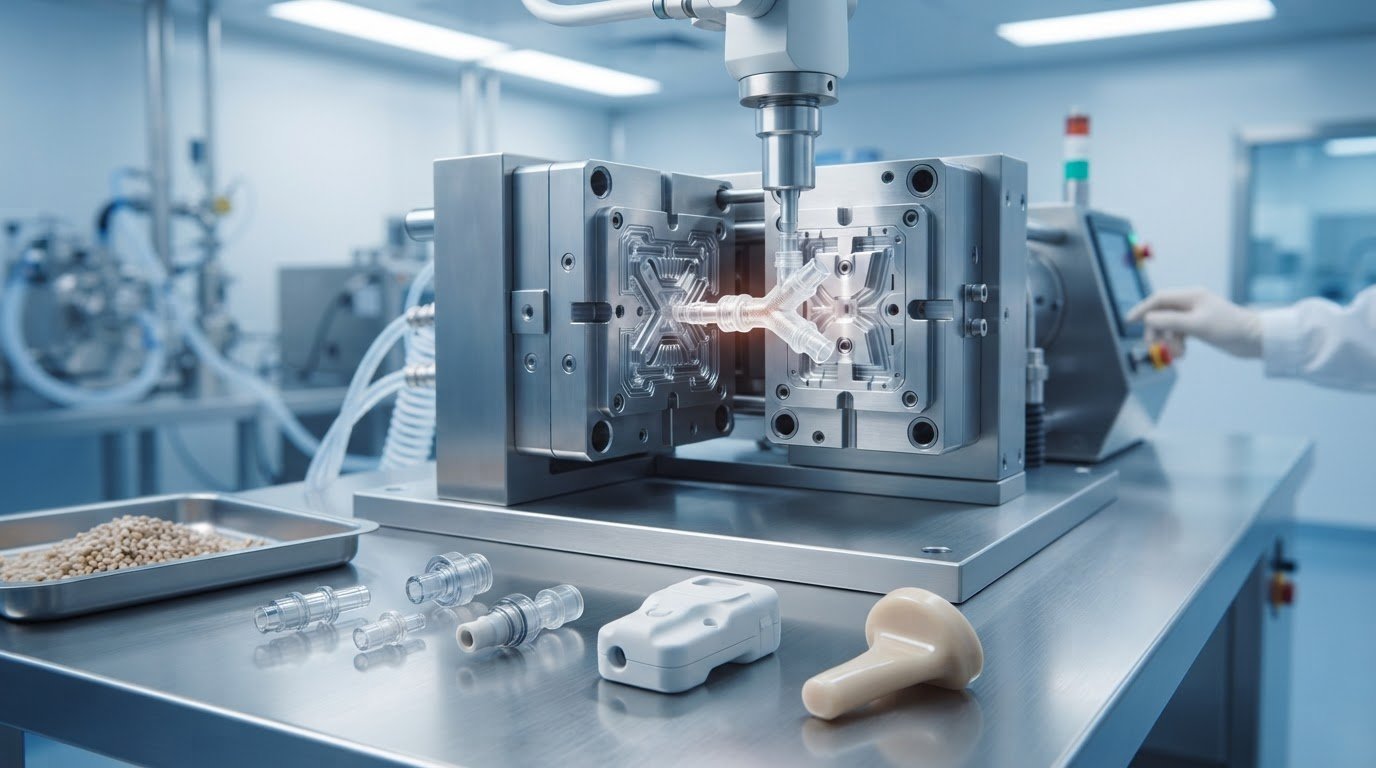
Medical injection molding forms polymer components by injecting softened resin into a shaped mold, then cooling the part. Medical grade polymer injection molding applies this process to devices whose material, production controls, and documentation must suit their intended use.
Medical Resin Biocompatibility
Biocompatibility describes a material’s ability to interact with biological systems without causing adverse reactions. It matters because a resin must be assessed in relation to a device’s intended contact with tissue, fluids, or the body. ISO 10993 provides a framework for biological evaluation and consists of 23 parts or subsections.
Resin documentation should identify the specific grade and connect its evidence to the component’s intended use, contact, and sterilization conditions. This traceability helps distinguish materials that may look similar but have different documented properties. USP Class VI is also cited as a biocompatibility standard for medical environments, but it does not replace evaluating a resin for its intended application.
Medical and Standard Injection Molding
Both medical and standard plastic injection molding use molds to shape polymer, but medical production emphasizes documented materials, process consistency, and traceability. These controls matter because a component’s intended use determines its performance and biological considerations. Thermoplastics can be melted and reformed without permanent alteration, making them suitable for molded medical components.
In medical grade polymer injection molding, material selection is tied to a device’s expected contact, function, and sterilization method. The U.S. Food and Drug Administration classifies medical devices into three risk classes, from Class I, the lowest-risk category, to Class III, the highest. This classification helps frame device risk but does not establish resin suitability by itself.
Requirements and Process Validation
ISO 13485 is a quality management system standard for organizations producing medical-grade products, according to the International Organization for Standardization. The U.S. Food and Drug Administration identifies its Quality System Regulations as 21 CFR part 820 and says they have many parallels with ISO 13485.
Process validation documents whether defined production conditions can consistently produce parts that meet requirements. Manufacturers establish process parameters, evaluate parts against specifications, and retain records linking material lots, production conditions, and inspection results. Validation also addresses changes to resin, tooling, or settings, as each can affect component performance. These records make production repeatable and reviewable.
Costs, Lead Times, and Quality Controls
Tooling and production costs depend on mold complexity, resin choice, cavity design, validation needs, and production volume. Lead times reflect design readiness, tooling development, material sourcing, and validation work. Minimum order quantities are influenced by production setup, mold configuration, and the manufacturing plan.
Common molding risks include short shots, flash, warpage, and dimensional variation. Controls include reviewing mold design, monitoring temperature and pressure, inspecting components, and documenting corrective actions. These checks help identify defects before parts enter assembly or device production. Defined acceptance criteria also link inspection results to each component’s required fit and function.
Medical device applications for injection molding
Injection molding supports medical components ranging from fluid-handling parts to durable instrument housings. The application determines which polymer properties matter most, including stiffness, flexibility, moisture resistance, and wear performance.
Common Plastics and Their Applications
Common medical plastics serve different functions, so matching polymer behavior to the device helps preserve fit and usability. High-density polyethylene is rigid and moisture-resistant, and is used for solid pharmaceutical products; low-density polyethylene is flexible and translucent, making it suitable for squeezable bottles and tubing. Ultrahigh molecular weight polyethylene’s wear resistance supports its use in orthopedic implants.
Polyethylene is also used in prosthetics, medical packaging, tubing, and disposable devices, where chemical resistance and durability are useful. Polycarbonate is used in surgical instrument housings, blood oxygenators, and IV components. ABS suits equipment housings and handheld devices, while polypropylene is used for syringes, containers, and surgical instruments. Polystyrene includes clear, rigid grades and impact-modified grades for packaging inserts and selected diagnostic or laboratory components. The choice depends on the part’s function, not just its appearance.
Injection molding can produce complex shapes and integrate features that might otherwise require separate components. Examples include endoscope housings, single-use instrument handles, pacemaker and defibrillator housings and leads, dental abutments, and orthopedic bone plates and screws. Each application places different demands on the plastic: a handle needs a usable grip, while a housing must protect enclosed device elements and maintain its designed geometry.
For fluid-contact applications, consider the material’s chemical behavior and expected exposure alongside its mechanical properties. Low-density polyethylene’s flexibility suits tubing, while rigid high-density polyethylene serves different packaging and pharmaceutical functions. Ultrahigh molecular weight polyethylene is selected for orthopedic use partly because resistance to wear matters under repeated movement. These differences show why one polymer cannot suit every patient-facing application equally well.
Material Trade-Offs
Material trade-offs are the compromises among strength, flexibility, durability, and process suitability that shape a component’s performance. Rigid plastic can support a stable housing, while a flexible grade may better suit tubing or a squeeze container. Choosing for one property alone can undermine another requirement, so engineers consider the component’s geometry, use, and interaction with neighboring parts.
Polyethylene illustrates this range: its variants cover flexible tubing, rigid pharmaceutical containers, and wear-resistant orthopedic components. Polystyrene’s clarity can aid visibility, while its rigidity may not suit a part that must flex. Molded parts also need to fit their assembly interfaces and preserve the device’s intended function. For assemblies involving molded components, planning medical device assembly requirements alongside material selection can help align part design and integration.
What Makes a Plastic “Medical Grade”?
Material suitability depends on the device’s intended use and the conditions its molded components must withstand. Sterilization compatibility and chemical resistance are central considerations because processing can affect a part’s appearance, dimensions, or function.
Sterilization Compatibility
Sterilization compatibility describes a polymer’s ability to tolerate a specified sterilization method while retaining the properties required for its application. A resin suitable for one method may not suit another. Medical-grade resins can be designed for gamma irradiation, ethylene oxide (EtO), or steam autoclaving, but compatibility must match the device’s planned processing.
PEEK is compatible with autoclave, gamma, EtO, and steam sterilization. Thermoplastic elastomers may be compatible with EtO and gamma, while autoclave tolerance depends on the type. These differences make the exact resin grade important: a broad material-family name alone does not establish performance for a molded component.
Gamma radiation works well with polycarbonate and PEEK, though it may discolor some materials. Autoclaving exposes components to high temperatures, so PEEK and PSU are examples of plastics used when heat resistance matters. Ethylene oxide gas is generally compatible with most plastics. These differences affect material choices for clear housings, flexible seals, and reusable instruments.
Evaluate the finished part, not just the resin data. Sterilization can affect color, surface appearance, dimensions, and mechanical behavior. For example, a transparent polycarbonate component may need assessment after gamma exposure, while a reusable part intended for autoclaving needs a polymer suited to repeated heat exposure. Let the intended method inform material and design decisions early.
Chemical Resistance and Operating Conditions
Chemical resistance is a material’s ability to retain required performance when exposed to chemicals used during device operation, cleaning, or sterilization. A polymer may tolerate one process but respond differently to another. Consider the chemical agents and operating conditions together when selecting a resin for a molded medical component.
Ethylene oxide is generally compatible with most plastics, but that broad compatibility does not establish suitability for every device. Gamma radiation may discolor some materials, and autoclaving requires sufficient temperature resistance. PEEK’s compatibility with autoclave, gamma, EtO, and steam methods offers different processing options from a thermoplastic elastomer, whose autoclave tolerance depends on its type.
Match the actual resin grade to the device’s exposure conditions. Consider the sterilization method, cleaning agents, expected contact, and the component’s required function. A seal must retain its intended flexibility; a housing must preserve fit and protection. Testing these properties after relevant processing helps determine whether the molded part continues to meet its design requirements.
Compatibility is not a generic label. Document the resin grade, sterilization method, and relevant operating exposures together, then evaluate the finished component under those conditions. This makes material choices more specific and helps prevent a polymer selected for chemical resistance from being treated as automatically suitable for every sterilization process.
Aesthetics, usability, and material selection
Design for manufacturability takes a part from requirements through moldable geometry, prototype evaluation, validation, and production. In the United States, assess a molder’s medical-device experience, material controls, engineering input, and ability to document consistent manufacturing.
Common Medical Molding Materials
Common medical molding materials include polycarbonate, PEEK, polypropylene, and thermoplastic elastomers; each supports different mechanical and usability demands. Medical-grade polycarbonate has a tensile strength of approximately 70 MPa and a glass transition temperature of 147°C. Its use in medical devices and surgical equipment makes it a candidate where a rigid component is needed.
PEEK has a tensile strength of approximately 90-100 MPa, a modulus of elasticity of approximately 3.6 GPa, and a melt temperature of approximately 343°C. Those properties support demanding applications, but processing conditions and component requirements still shape the choice. Medical TPEs can reach 600% elongation at break, which can suit flexible parts.
Polypropylene is used for syringe barrels, labware, and diagnostic devices. Its melt flow index typically ranges from 12-25 g/10min, a processing property that informs how resin fills mold features. Material choice also affects appearance and handling: a component’s texture, color, flexibility, and dimensional fit can influence how clinicians use it.
A “medical grade” label alone does not establish that a plastic is BPA-free. Specify appearance and performance requirements separately, then align them with the resin grade and intended application.
Material Sourcing and Engineering Support
Material sourcing links a device’s requirements to a resin grade with relevant technical documentation and processing guidance. Engineering support translates that choice into manufacturable geometry by considering wall transitions, flow paths, dimensional targets, and assembly interfaces. For example, a thin grip and a rigid housing may require different polymer behavior, even within the same device.
Early engineering review can identify conflicts between appearance, mechanical demands, and molding behavior before tooling is finalized. Resin availability and consistency also matter to production planning; material records should preserve the identity of the grade used for molded parts. This links design decisions with manufacturing and inspection requirements.
Material efficiency starts with part geometry and mold layout. Reducing unnecessary wall thickness, avoiding excess material in nonfunctional areas, and designing effective runners can reduce resin use and molding waste. Multi-cavity tooling can produce multiple parts per cycle, so balanced filling and consistent cavities help limit rejected components.
Material Selection and Testing
A practical selection workflow starts by defining the component’s function, mechanical demands, appearance, and dimensional interfaces. Then compare candidate grades with those requirements and the intended sterilization process. Finally, review moldability and produce samples for evaluation before committing to production tooling.
Test the finished molded component, not just the resin properties. Assess fit, function, surface appearance, and dimensions against design requirements, and evaluate the part after relevant sterilization. If a clear polycarbonate housing or flexible TPE feature changes appearance or performance, use that finding to refine the material or design before production validation.
Precision injection molding
Precision molding coordinates mold design, material flow, and process conditions to produce parts within defined requirements. In medical production, dimensional accuracy must go hand in hand with surface quality, durability, and reliable assembly.
The mold establishes the part’s geometry, while the molding process determines how consistently that geometry is reproduced. Medical molds for Class II and III device manufacturing may require tolerances of ±0.01 mm or better. That level of control makes design details consequential: wall transitions, gates, vents, and cooling paths can influence filling, shrinkage, and the final dimensions.
Thin-wall injection molding typically produces medical components with wall thicknesses below 1 mm. Such designs can reduce material use and create compact components, but they demand careful management of material flow and process conditions. Temperature and pressure are among the parameters monitored during manufacturing because variation can affect the molded part’s shape and consistency.
Multi-cavity tooling produces multiple parts during each molding cycle. It can support higher-volume production, but cavity balance matters: uneven filling can create differences between parts from the same mold. Tooling and mold design therefore need to account for both the component’s geometry and repeatability across cavities. Medical molds commonly use 420 stainless or H13 tooling, with SPI A2 or A3 surface finishes.
Precision does not always come from molding alone. Combining injection molding with finish-machining can add complex features that molding may not achieve by itself. This can be useful when a molded body needs a refined interface or feature with tighter dimensional control. Insert molding offers another design option: embedding an insert during molding to support customization or simplify assembly of multiple components.
These methods serve different needs. A straightforward housing may be made directly in a mold, while a component with detailed interfaces may need finish-machining. Insert molding can integrate elements into one part, but the mold design must accommodate their placement. Choose the approach according to the part’s function, material, geometry, and assembly requirements.
For a precision-focused design, define critical dimensions and functional interfaces before finalizing the mold. Then align mold design, process monitoring, and inspection criteria with those requirements. This provides a clearer basis for evaluating parts and maintaining consistent production. It also helps engineering teams distinguish essential tolerances from dimensions that do not affect fit or function.
When molded parts require precise interfaces or integration with other components, discuss your micro-precision component requirements as part of the device design process.
Fong’s Engineering & Manufacturing Private Limited: CDMO Services
Fong’s Engineering & Manufacturing Private Limited supports medical device teams through CDMO Services and OEM Solutions, connecting development work with manufacturing needs. Turn to its CDMO capabilities when a project needs support across concept design, prototyping, validation, large-scale production, or regulatory support, including FDA and ISO 13485 compliance.
For projects focused on precise device components or integrated products, Micro-precision Components and Complex Device Assembly can address relevant engineering and production needs. Endoscope Repair & Refurbishment serves a different purpose: maintaining reusable endoscopes and surgical instruments through repair and refurbishment. These offerings support distinct stages and requirements, rather than replacing material selection, mold design, or process validation.
Contact Fong’s Engineering & Manufacturing Private Limited or visit fongspl.com.sg to discuss your medical device project.
Move Your Device Design Toward Production
The next step is to turn material and performance priorities into a clear manufacturing brief. Define the component’s intended function, essential dimensions, appearance, sterilization method, and assembly interfaces. This gives engineering discussions a practical foundation and helps teams assess design decisions against production needs.
Medical grade polymer injection molding works best when material selection and component design are developed together. Fong’s Engineering & Manufacturing Private Limited supports medical device programs through CDMO Services and OEM Solutions, while Endoscope Repair & Refurbishment addresses the distinct needs of reusable equipment. Choose the discussion that fits your project stage, from developing a device concept to refining production requirements.
Bring your component requirements and project objectives into the next conversation. Contact Fong’s Engineering & Manufacturing Private Limited to discuss a practical path forward for your medical device program. A focused technical discussion can help translate design intent into informed manufacturing decisions.
Frequently Asked Questions
What Are The Factors Influencing Material Processability (Moldability)?
Moldability depends on resin flow, moisture, part geometry, and the temperature and pressure settings used during production. Pellet drying must follow time and temperature conditions specific to the material. For example, polycarbonate requires pre-drying at 120°C for 4-6 hours to prevent hydrolytic degradation. PEEK also needs high processing temperatures, with barrel temperatures of 360-400°C and mold temperatures of 160-200°C.
What Types of Devices and Components are Typically Injection Molded?
Injection molding is used for components in diagnostic, cardiovascular, orthopedic, dental, and surgical devices. Examples include suture anchors, dental abutments, pacemaker and defibrillator housings and leads, and single-use instrument handles. A component’s role shapes its design priorities: a housing needs to protect internal elements, while an anchor or instrument feature must function as part of a larger device assembly.
What materials are used in medical devices?
Medical devices use polymers selected for the component’s intended role, such as silicone for flexible parts and PEEK for demanding device applications. Other options include polysulfone, Radel® PPSU, and certain grades of Ultem® PEI. Some plastics, including these materials, are suitable for contact with internal bodily fluids and tissue for up to 24 hours. Intended contact and use guide the material choice.
Why Material Choice Matters?
Material choice affects how a component performs in its device, including how it handles mechanical loads, chemical exposure, and sterilization. It also shapes usability: a flexible catheter tip has different requirements from a rigid protective housing. Consider how the part connects with adjacent components, since dimensional fit and material behavior can affect assembly. Evaluate a candidate resin against the component’s function and operating conditions.
What is medical-grade polymer injection molding?
Medical grade polymer injection molding forms polymer resin into medical-device components using a designed mold. Resin selection, tooling, and controlled processing work together to produce parts with defined geometry and function. Once the mold is created, the method can produce thousands or even millions of identical parts. It suits projects that require repeatable molded components at production scale.
Which polymers are commonly used for medical injection molding?
Common choices include polypropylene, polycarbonate, polyethylene, PEEK, ABS, and thermoplastic elastomers. The appropriate option depends on the part: ABS is used for equipment housings and handheld devices, while TPEs suit flexible features such as seals and grips. ABS has a heat deflection temperature of approximately 95°C. These examples show why resin properties should be matched to component demands rather than selected by name alone.
What are the cleanroom requirements for medical-grade injection molding?
Cleanroom selection depends on the contamination control needed during production and the device’s manufacturing requirements. ISO 14644 defines cleanroom classes from Class 1 to Class 9; medical device designs can call for an ISO 14644 Class 7 or Class 8 cleanroom to limit contamination. The required controls should align with the component’s production environment, handling, and downstream assembly rather than being treated as a resin property.