
Key medical device manufacturing automation trends include AI-assisted visual inspection, connected process monitoring, collaborative robotics, and integrated assembly systems. These technologies can help detect defects, improve process consistency, and increase throughput while allowing employees to focus on tasks that require judgment. Automation works best when it supports product quality and process control, rather than being treated as a standalone equipment purchase.
That focus matters: manufacturers need dependable records, repeatable processes, and production capacity that can adapt to changing demand. This article explains how inspection systems can detect defects, how connected data can inform process decisions, and where automated assembly can reduce repetitive handling. It also covers how to prioritize automation under labor constraints, including why process mapping, validation, and flexibility belong in the plan from the start. The result is a practical guide to assessing how automation can strengthen quality and consistency across medical device production.
Key Takeaways
- Use AI vision inspection to identify defects consistently, and assess whether inspection methods suit the size and characteristics of the components being produced.
- Deploy collaborative robots for repetitive handling and packaging tasks so employees can focus on quality assurance and work that requires judgment.
- Connect production and quality data to improve process visibility, traceability, and timely decision-making.
- Plan automation across the full assembly process, including equipment integration, product changes, and validation needs.
- Prioritize processes where automation can strengthen quality and throughput while supporting workforce capacity and future production needs.
AI-powered visual inspection and process optimization
AI-powered visual inspection can identify defects as medical devices move through production. A vision system captures images, then artificial intelligence compares product features with defined acceptance criteria. For example, it can flag a misplaced component, surface flaw, or inconsistent seal for review. This supports repeatable checks and helps teams focus on exceptions instead of manually examining every image.
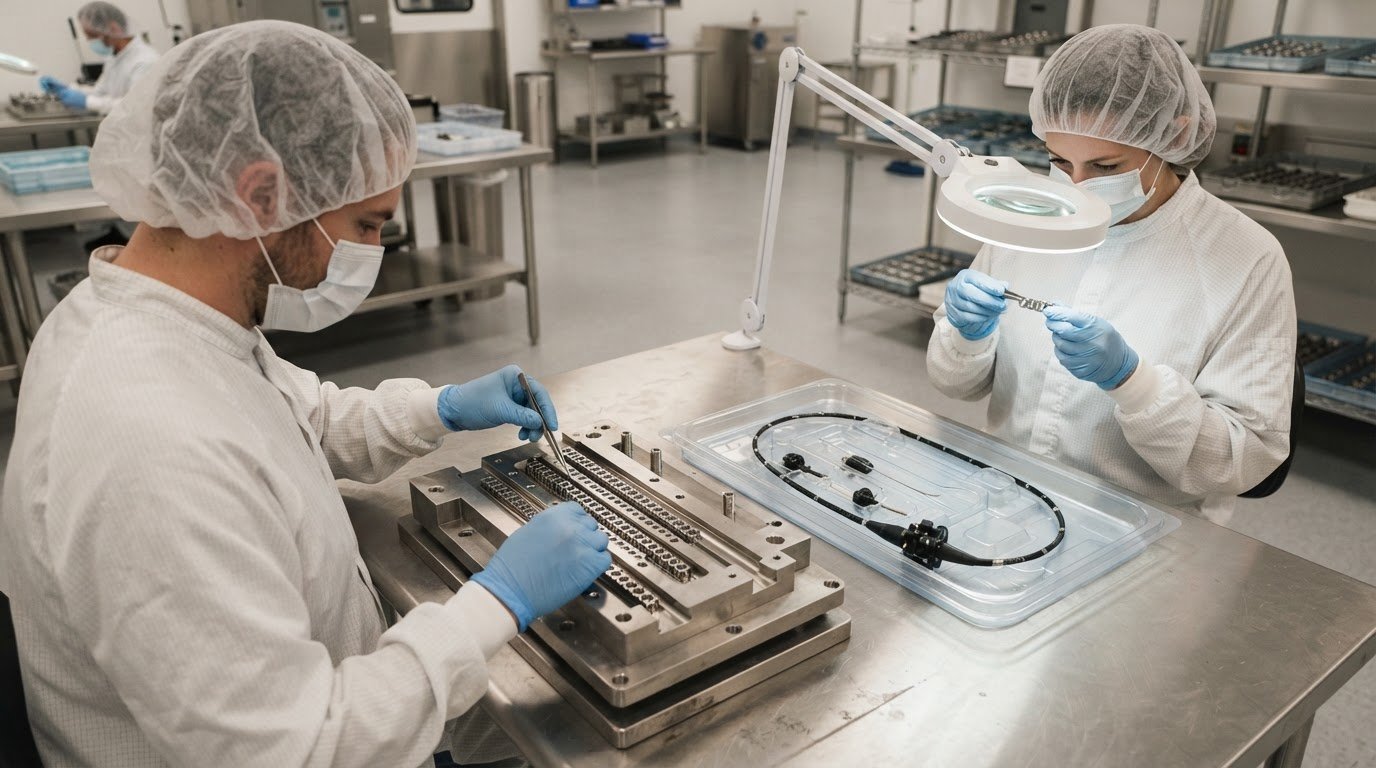
Inspection equipment should match the component and defect being assessed. Standard cameras can check visible features, while smaller parts may require computational imaging. Laser profilometry measures surface profiles, and focus stacking combines images captured at different focal depths. These methods can reveal details a single image may miss. As device components become smaller, choosing suitable optics, lighting, and image-processing methods is central to reliable detection.
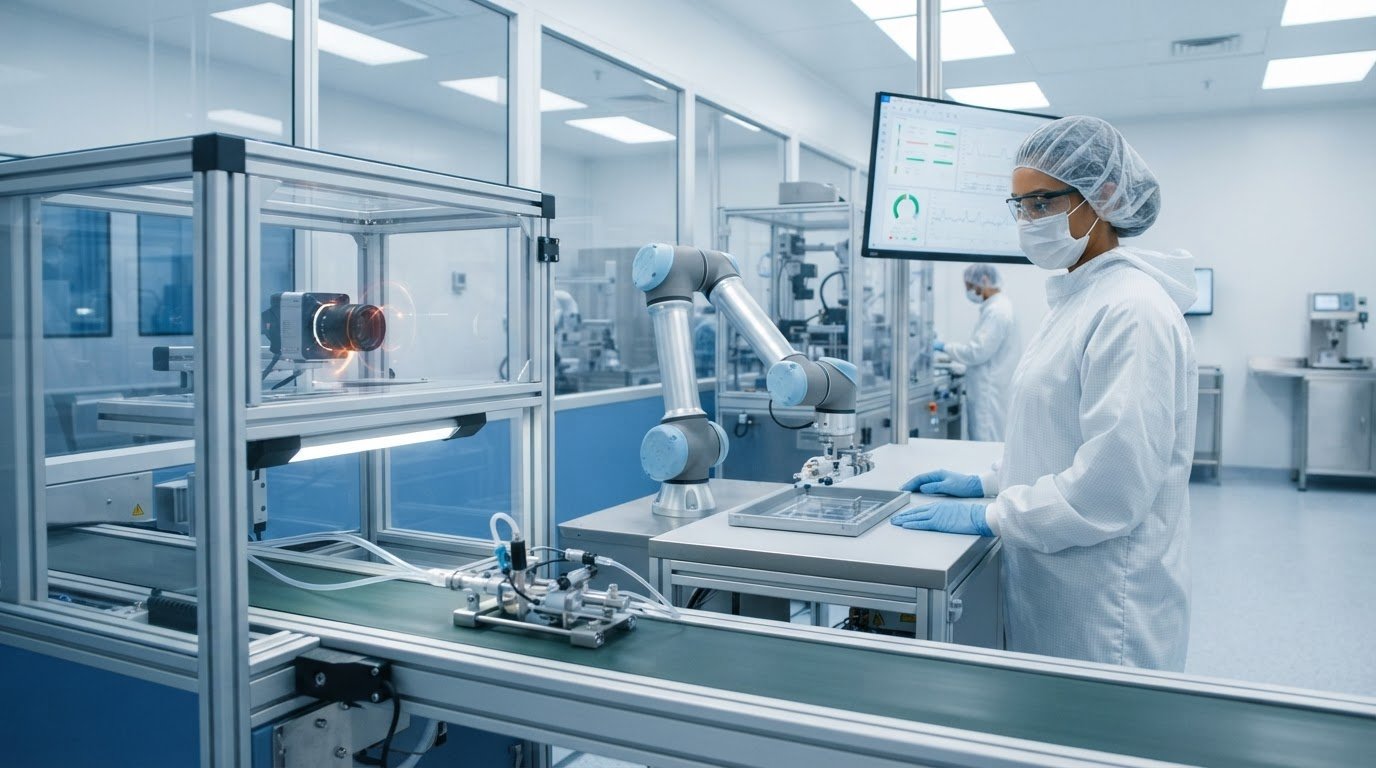
An in-line vision system can inspect 100% of products on a moving conveyor belt. That coverage can help manufacturers identify defects close to the process step that created them. A practical workflow sends each image to the inspection system, records its result, and routes flagged units for review. The system should connect inspection outcomes to the relevant production record, so teams can investigate recurring defects and trace decisions.
AI can also analyze manufacturing data beyond images. By comparing quality outcomes with equipment settings and environmental conditions, a system can surface patterns linked to process variation. Engineers can use those insights to investigate changes in temperature, machine speed, or another controlled parameter. The goal is not to let a model make unreviewed production decisions, but to help teams identify when process review may be useful.
Collaborative robots can support inspection by presenting components consistently to a camera or handling repetitive packaging steps. For example, a robot can load trays and lids into a tabletop heat-sealing machine, initiate heating, and remove sealed packages. Repeatable handling can make image capture or seal checks more consistent. Employees can then focus on quality assurance, reviewing exceptions, and decisions that require process knowledge.
Semi-autonomous aids can bring inspection into daily work instructions. At a work center, software can display a task, prompt an in-line quality check, track workflow, and report exceptions. A clear sequence helps employees record results as work happens instead of reconstructing events later. Linking those records with sensor readings and inspection results can also reveal delays or recurring defects across production steps.
Before implementation, define the feature to inspect, the acceptable range, and the response to a failed check. Test the system with representative parts and known defect examples, then document how images, sensor readings, and operator decisions are captured. In regulated manufacturing, assess vision systems, inspections, sensors, process controls, and data collection against traceability and validation needs, including IQ/OQ/PQ. This makes inspection part of a controlled process, rather than adding a camera without a defined quality purpose.
What are some of the biggest trends you’re seeing in medical device manufacturing automation today?
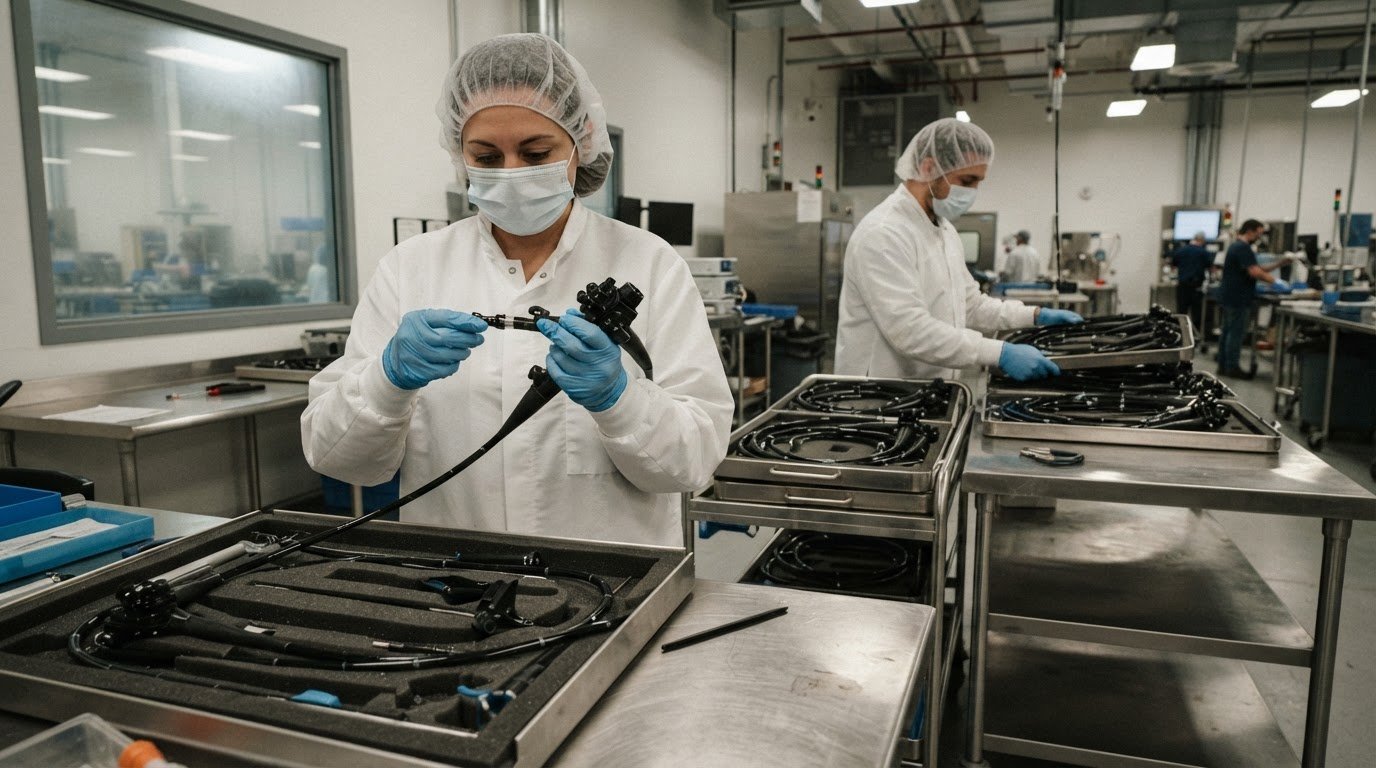
A clear shift is toward robotic systems that support employees rather than remove them from production. Collaborative robots handle repetitive tasks, while people manage changeovers, exceptions, and quality decisions. Manufacturers also combine robots with vision systems to increase capacity utilization while keeping labor headcount relatively flat. The practical goal is a more consistent production flow, with employees focused on tasks that need judgment.
Component handling is a useful starting point. A robotic arm can load a device part into a machine fixture, hold it during processing, then unload it for the next operation. Adaptive grippers can accommodate different component shapes, while force sensors help detect contact during delicate handling. These tools can reduce manual transfers and support repeatable placement. The cell still needs clear controls for misaligned parts, interrupted cycles, and operator access.
Collaborative robots can also assist with assembly, pick-and-place, and quality-control tasks. A robot may position a small component for a camera, while a vision system checks its orientation before the next assembly step. If inspection flags an exception, the process can pause for employee review. This division of work combines robotic repeatability with human assessment, rather than treating automation as a substitute for manufacturing expertise.
Automation requirements vary by device type. Sterile devices place particular emphasis on controlled handling during assembly and packaging. Implantables can require careful positioning and inspection of small, precision features. Single-use devices may benefit from repeatable assembly and packaging across recurring production runs. In each case, the device’s materials, geometry, process sequence, and inspection criteria determine which robotic tasks are suitable.
Practical applications include robots loading and unloading components from machine fixtures, and robotic systems supporting assembly, inspection, or pick-and-place work. These applications can reduce manual material handling and help manufacturers increase capacity utilization while maintaining relatively flat headcount. They describe possible operational outcomes, not a universal performance figure: results depend on how well the task, tooling, vision, and process controls fit together.
For a useful assessment, map the task before selecting equipment. Identify where employees repeat the same transfer, where a component needs stable positioning, and where a vision check can detect a defined defect. Then test the gripper, sensor response, and exception handling with representative parts. A successful cell should fit the production sequence and allow employees to intervene safely when conditions fall outside the planned cycle.
Manufacturers evaluating precision components or complex assembly can discuss how robotic handling fits their production requirements through a manufacturing project discussion.
Industry 4.0, IoT monitoring, and AI-driven quality control
Among medical device manufacturing automation trends, connected monitoring stands out because it links sensors, production equipment, and software. For example, a sensor reading from an assembly station can be associated with the production record for a finished device. Teams can view process conditions alongside inspection outcomes, then investigate whether a machine setting changed when a quality issue appeared.
AI-driven analysis can identify patterns in process data and present insights through dashboards. Engineers can review key performance indicators alongside sensor readings and inspection results, then investigate recurring deviations. Robotic assembly, quality-control, and pick-and-place systems can also produce records linked to specific process steps. Time-stamped device history records support traceability, while exception reporting directs attention to a failed inspection or interrupted cycle.
In the United States, the FDA’s Quality Management System Regulation (QMSR) took full effect in February 2026 and aligns U.S. medical-device quality expectations with ISO 13485:2016. For medtech manufacturers, automated quality control should support controlled processes and accessible records. ISO 13485 is relevant to medical-device manufacturing compliance, so teams should connect inspection results, process controls, and production documentation to their quality system.
To validate automated processes under FDA requirements, define the system’s intended use, document requirements, and test installation, operation, and performance. IQ/OQ/PQ provides a structure for those validation stages. GAMP 5 can help teams apply a risk-based approach to computerized systems, linking testing depth to system use and process risk. Retain evidence of test execution, deviations, resolutions, and approval decisions.
Connected monitoring also needs defined responses. Teams can specify which sensor conditions trigger review, who assesses an alert, and how the decision enters the production record. Where 5G connectivity and edge computing are used, sensor feedback can support near-immediate production adjustments. The control strategy should identify permitted adjustments and record their effects on quality. These medical device manufacturing automation trends make it important to keep data-driven changes traceable across production.
Automated assembly systems and equipment integration
Digital twins let manufacturers simulate production processes, test hardware and software, and plan layouts before making physical changes. Manufacturing execution systems (MES) connect production steps with work orders and process records. Predictive maintenance uses equipment condition data to identify developing issues and plan maintenance before a failure disrupts production.
Integration matters across the complete assembly line. An automated system can coordinate conveyors, part calibration, robotic handling, sorting, and serialization. For example, a production cell can feed components to an assembly station, capture process data, then pass completed units to packaging. Reviewing the whole sequence helps reveal handoff problems that a standalone machine purchase might leave unresolved.
A digital thread links information across design, production, quality, and suppliers. According to the National Institute of Standards and Technology, its digital thread initiative helps define a technical roadmap for connecting these information sources. In practice, teams can use linked records to trace a design change through tooling, process instructions, inspection plans, and supplier information. This connection supports informed engineering decisions throughout development and production.
Modular production cells let manufacturers reconfigure equipment for different products or process needs. A cell may combine pick-and-place equipment, inspection, and packaging, then be adjusted when tooling or product requirements change. Before choosing a system, assess whether it can accommodate new SKUs, process changes, and increased production requirements without replacing the entire line. Flexible integration can help manufacturers respond to product changes.
Agentic systems can be considered for bounded administrative tasks, such as organizing work instructions, summarizing workflow status, or routing exception reports. Keep people responsible for approvals and decisions that affect production records or product disposition. Define the system’s permitted actions, data access, and review process before deployment. For example, an automated alert can flag a missing record for an employee to resolve, rather than changing the record without review.
Connected factories also face cybersecurity and data-integrity risks. Unauthorized access, altered records, or inconsistent system data can undermine production visibility and traceability. Separate system permissions, preserve audit trails, and control how changes move between equipment and manufacturing software. These measures help teams detect unexpected edits and establish which record represents the approved production history.
Assess integration through a defined sequence: map the production flow, identify the systems and records each step needs, then test representative product changes and equipment exceptions. Include analytics for equipment performance and review whether maintenance alerts correspond to actual operating conditions. For support planning around complex device assembly requirements, align equipment integration with the product, process, and production objectives.
Throughput, consistency, and labor constraints
Automation planning should start with a production constraint, not a machine purchase. Map the steps that limit output, such as repeated material transfers, changeovers, or tasks that rely on a small pool of trained employees. Then compare demand with available labor and equipment capacity. This helps teams target processes where automation can improve throughput and consistency while leaving room for future production needs.
Capacity utilization is one reason manufacturers are adding robotic and vision systems. These technologies can increase equipment use while keeping labor headcount relatively flat. A practical labor plan identifies which tasks need continuous attention and which follow a repeatable sequence. For example, an automated cell may perform a recurring transfer while employees oversee exceptions, coordinate changeovers, and maintain production records.
Labor shortages strengthen the case for selective automation, but they don’t remove the need for skilled human roles. The ARM Institute projects more than two million unfilled roles across the broader U.S. manufacturing sector by 2030. Medical device operations still need employees who can interpret process information, handle unusual conditions, and support quality decisions. Training should therefore prepare staff to operate, monitor, and troubleshoot automated equipment.
Automation can reduce some labor costs by taking over repetitive work, but labor is only one part of the operating picture. Wages were expected to account for 20.6% of revenue in the medical device manufacturing industry in 2018. That historical figure illustrates why workforce planning matters, while current project decisions should focus on the specific task, required oversight, equipment integration, and process controls.
Advanced automation can enable 24/7 three-shift operation while reducing gowning cycles and contamination risk. This capacity can help a facility respond toward sustained demand without relying on every production step to be manually staffed around the clock. The operating plan still needs to define shift handoffs, response procedures, maintenance responsibilities, and employee oversight so each production period follows the same controlled process.
To assess a proposed project, document the current workflow, identify a bottleneck, and compare it with the intended automated sequence. Track whether the change improves output consistency, equipment use, or employee allocation, then review the results against production needs. This evidence helps distinguish a useful automation investment from equipment that adds complexity without addressing a real constraint.
For support assessing complex production requirements, discuss your manufacturing project and the assembly processes you aim to improve.
Fong’s Engineering & Manufacturing Private Limited: CDMO Services
Fong’s Engineering & Manufacturing Private Limited supports medical device projects through CDMO Services, from concept design and prototyping to validation and large-scale production. Its regulatory support includes FDA and ISO 13485 compliance, connecting development needs with manufacturing execution. Turn to this support when a device project needs coordinated development and production, or when scaling requires an experienced manufacturing partner.
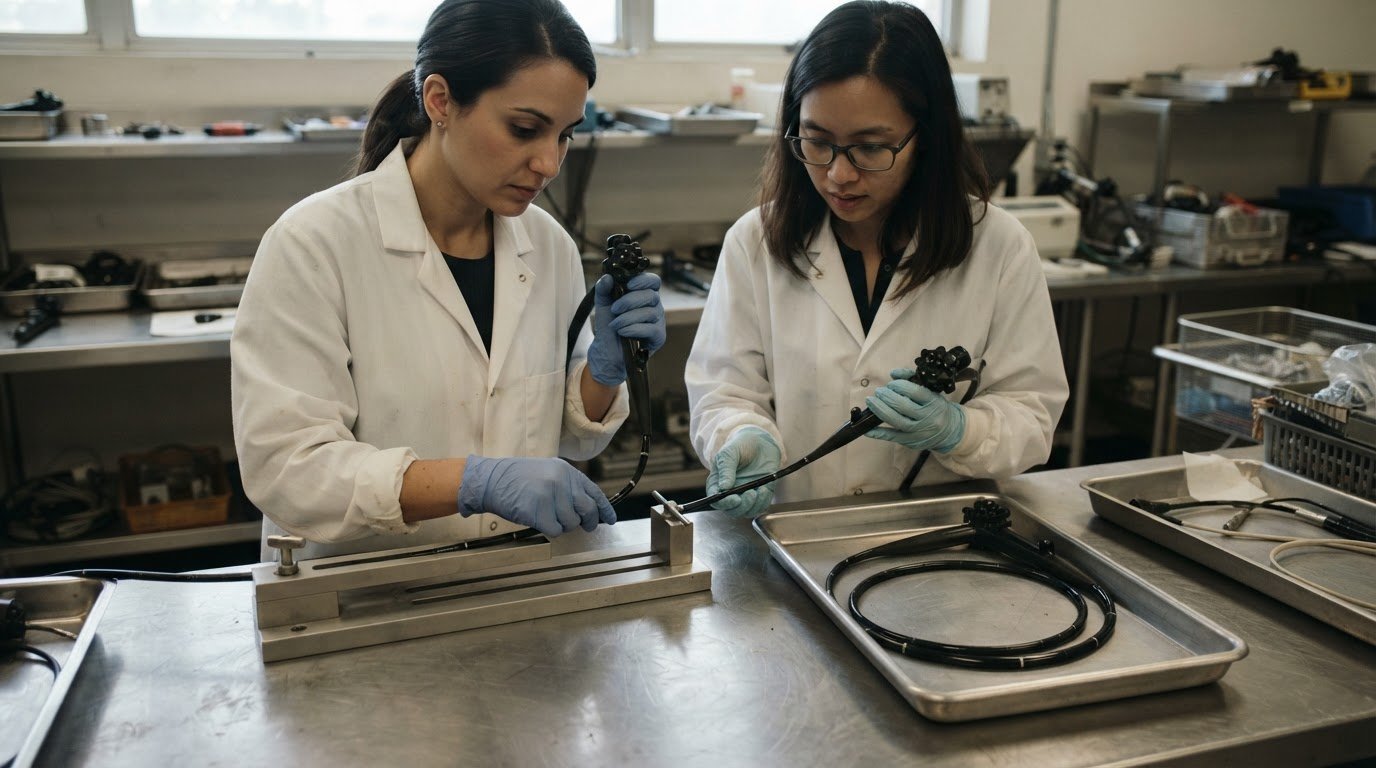
OEM Solutions cover complete medical devices manufactured under a client’s brand using ISO 13485 certified processes. The company also offers Complex Device Assembly, Micro-precision Components, and Endoscope Repair & Refurbishment. These capabilities can address distinct needs, from precision components and device assembly to reusable instrument refurbishment.
To discuss your medical device manufacturing requirements, contact Fong’s Engineering & Manufacturing Private Limited or visit fongspl.com.sg.
Turn automation priorities into a defined project
Choose the next automation initiative by linking a production constraint to a clear quality objective. The most useful medical device manufacturing automation trends are those that fit the device, process controls, workforce, and planned production changes. Start with a defined task, document current conditions, and specify what evidence will show whether the revised process performs as intended.
A feasibility study or proof of concept can help teams assess a high-risk task before wider implementation. Use it to examine equipment integration, employee oversight, process records, and exception handling together. A clearly scoped evaluation gives engineering, quality, and operations teams a shared basis for deciding what to adopt and how to assess whether it supports the project’s needs.
Fong’s Engineering & Manufacturing Private Limited can discuss how its medical device manufacturing capabilities align with your project requirements. Contact Fong’s Engineering & Manufacturing Private Limited to discuss a considered next step for your manufacturing project.
Frequently Asked Questions
What is the dominant operational trend you’re seeing among medical device companies?
A major operational shift is combining robotic and vision-system automation to increase capacity utilization while keeping labor headcount relatively flat. Manufacturers are targeting repeatable production tasks, then using employee expertise for supervision and exceptions. For example, a team can automate a recurring equipment-loading task and reassign operators to process monitoring or quality review. The focus is selective automation that addresses a defined production constraint, rather than automating every step.
What should OEMs look for in an automation partner?
An effective automation partnership starts with understanding the device, manufacturing process, operating challenges, and longer-term production goals. Integration work should account for product changes, tooling, data collection, validation, and employee workflows. Ongoing planning matters too: training, service, spare parts, troubleshooting, and technical support after installation all affect system performance over its lifecycle. These considerations connect equipment selection with sustained manufacturing operations, rather than treating installation as the project’s final step.
What are the top automation trends in medical device manufacturing in 2025-2026?
Key trends include AI-assisted inspection, connected sensor monitoring, collaborative robotics, and integrated assembly systems. Manufacturers also use production data from ERP and MES software to support operational decisions. Digital twins can help teams simulate process layouts and test production changes before implementation. Together, these developments point toward automation designed around traceability, process visibility, and flexible production, rather than isolated equipment performing a single task.
How are AI and machine vision used for medical device inspection and quality control?
Machine vision captures images of components or products, while AI systems analyze those images for defined defects or deviations. An in-line system can inspect 100% of products on a moving conveyor belt. For small components, computational imaging methods such as laser profilometry or focus stacking can help capture features that standard imaging may not resolve. Inspection results can be linked to production records, giving quality teams information to investigate recurring process patterns.
How are robotics and collaborative robots used in medical device assembly and packaging?
Robots support repetitive tasks such as loading components into fixtures, moving parts between assembly stages, and handling packaging. Collaborative robots can work alongside employees, who remain available for process oversight and exception handling. For example, a robot can repeatedly present a part to an assembly station while an employee checks a flagged unit or manages a changeover. This division of work can improve repeatability without removing human judgment from production.
What are the costs and ROI of automating a medical device manufacturing line?
Costs depend on the process being automated, equipment and tooling requirements, integration with existing systems, validation work, and workforce training. Assess ROI by comparing project inputs with measurable operational outcomes, such as throughput, scrap, rework, equipment utilization, and labor allocation. Establish baseline performance before implementation, then monitor the same measures after commissioning. This approach shows whether automation addresses the production constraint it was intended to solve.
What FDA and ISO 13485 requirements apply to automated medical device manufacturing?
The FDA’s Quality Management System Regulation (QMSR) took full effect in February 2026 and aligns U.S. medical-device quality expectations with ISO 13485:2016. Automated processes should have documented requirements, controlled records, and evidence that the equipment performs as intended. IQ/OQ/PQ provides a framework for documenting installation, operation, and performance testing. Manufacturers should connect system outputs, inspection records, and process changes to their quality management activities.
How does automation affect labor needs, skills, and workforce training in medical manufacturing?
Automation can shift employees from repetitive handling toward equipment oversight, quality review, troubleshooting, and exception management. Training should match each role: operators need to understand routine cycles and safe interventions, while technical staff need to interpret alarms and investigate process variation. Workforce planning should also account for changeovers and maintenance. The goal is to align employee skills with the tasks that remain essential as production systems become more automated.