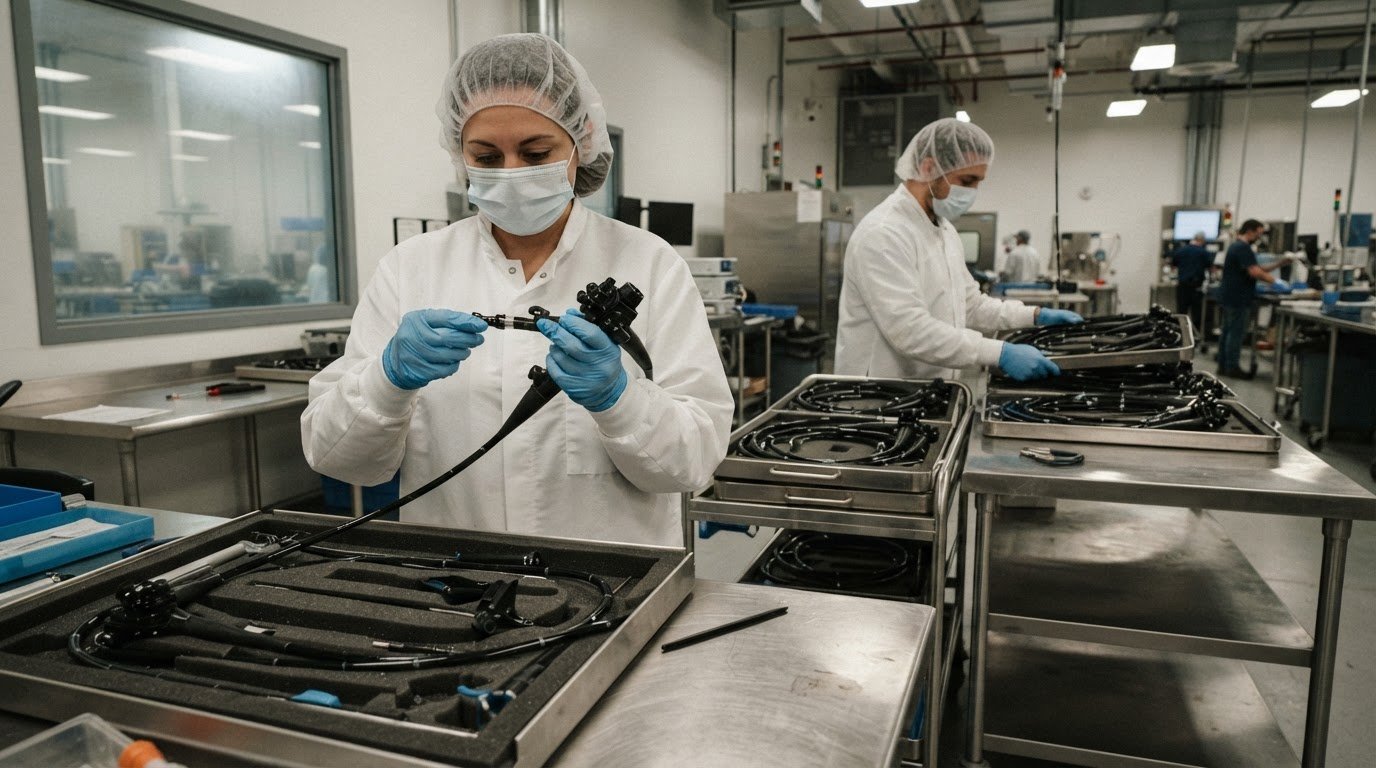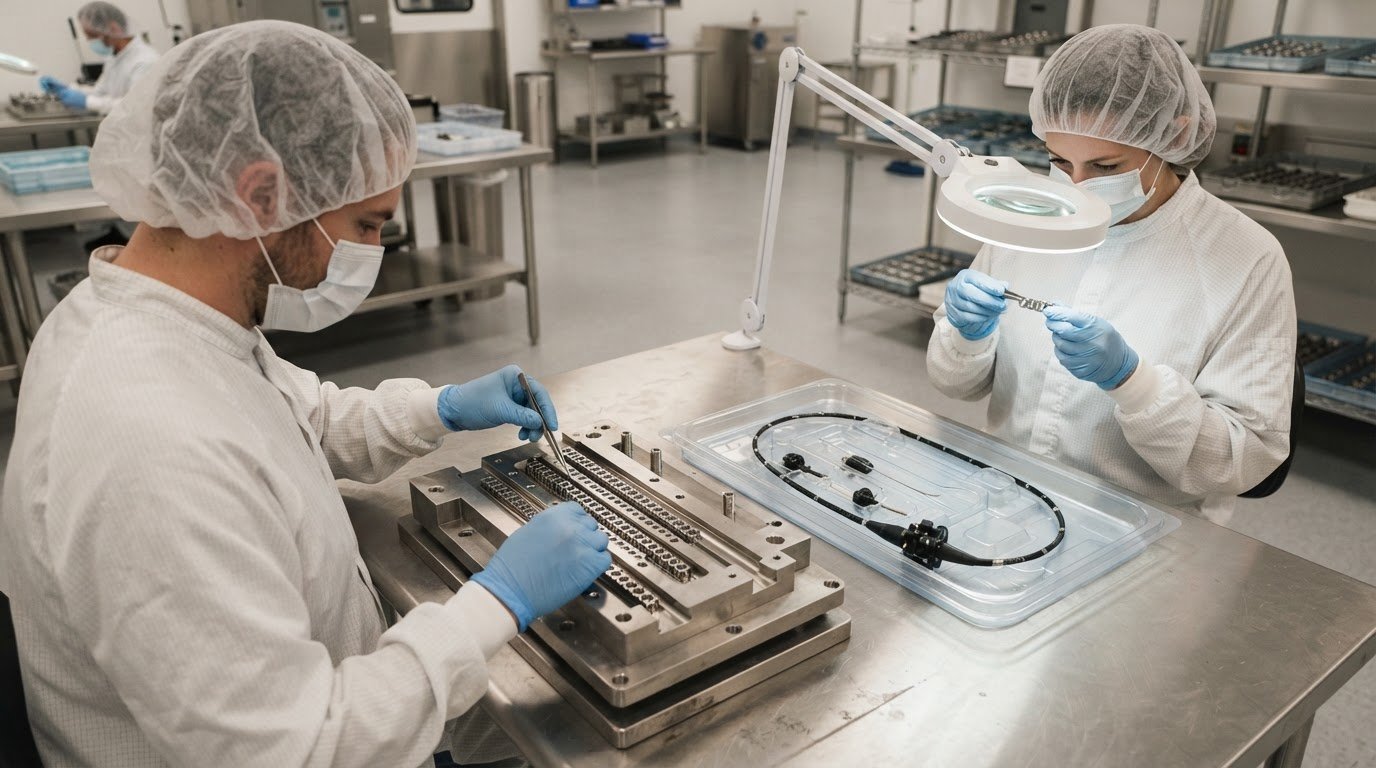
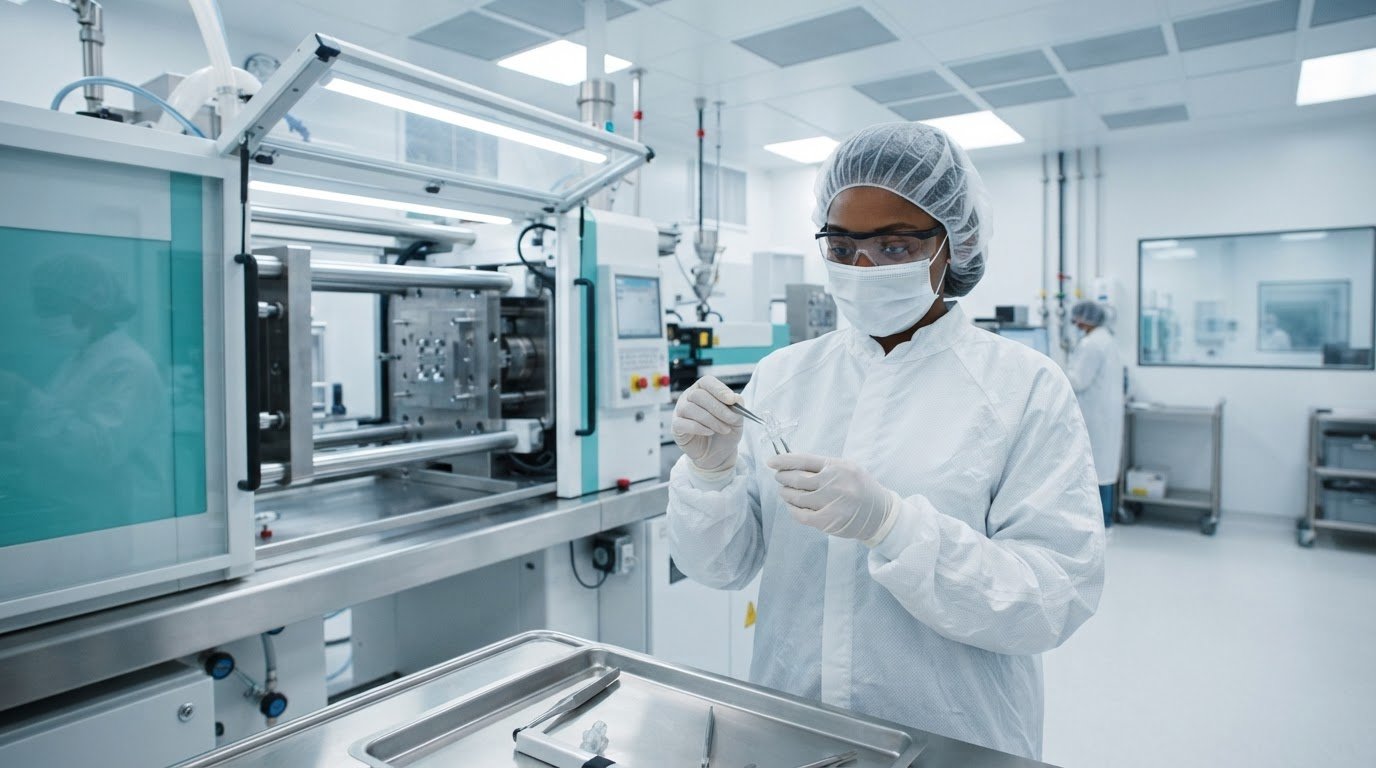
The mold isn’t the only part of medical molding that needs control. Cleanroom injection molding for medical devices combines the standard injection molding process with measures that limit airborne particles and other contamination risks during production. Most plastic cleanroom injection molding takes place in ISO Class 7 or ISO Class 8 rooms, with the appropriate classification depending on the cleanliness requirements of the part and process.
It’s reasonable to focus on the molded component, but the production environment matters too. Room classification, air conditions, equipment, materials, and handling all contribute to contamination control. This article explains cleanroom molding, how ISO classifications relate to medical-device production, and which room conditions influence the process. It also outlines when cleanroom molding may be relevant and how manufacturing and quality systems support a device from development through production.
Key Takeaways
- Distinguish the molding process from the cleanroom controls that manage contamination during production.
- Use particle concentration limits to understand what ISO 7 and ISO 8 classifications mean for a manufacturing environment.
- Assess how airflow, pressure, humidity, cleaning, and handling work together to maintain controlled room conditions.
- Relate the device’s production needs and contamination risks to the cleanroom environment and quality controls required.
- See how development, validation, and production fit into a broader medical-device manufacturing approach.
What is Cleanroom Injection Molding?
Cleanroom injection molding forms plastic components in a controlled environment designed to limit airborne particles. For medical devices, the molding process and room controls work together to manage contamination while meeting design and production requirements. Cleanroom injection molding for medical devices involves more than selecting a molding machine: the material path, equipment, operators, and records also shape production controls.
Particle Control in Cleanrooms
A cleanroom limits airborne particles through filtered air, managed access, and procedures that reduce particle generation. This matters because particles may settle on exposed materials, tooling, or molded surfaces. Room classification sets limits on airborne particle concentration, while gowning and controlled movement help prevent people and materials from introducing contaminants.
Compared with conventional molding, cleanroom molding adds environmental controls around the same basic forming process. It differs from other medical-device manufacturing methods, which may use different equipment and production controls depending on the component. For example, a molded housing can be produced in a controlled room, then moved to separate assembly operations with defined handling requirements.
Traceability and Quality Control
Material traceability links incoming resin and production records to parts made from each material lot. Records can connect material receipt, machine settings, inspection findings, and finished-part identification. This information matters when a process deviation requires teams to determine which production outputs may be affected.
Quality control compares molded components with defined acceptance criteria, including applicable dimensions, appearance, and functional requirements. For example, inspection records for a connector housing can document measurements against its approved design limits. In cleanroom injection molding for medical devices, linking these records helps teams evaluate production consistency and assess the effects of process changes.
Quality and Safety Controls
Quality and safety controls combine approved processes, equipment checks, operator procedures, and inspection records. In the United States, FDA Quality System Regulations are referred to as 21 CFR part 820, according to the Electronic Code of Federal Regulations. Documented controls connect manufacturing decisions with production quality and support review of process records.
IQ, OQ, and PQ mean installation, operational, and performance qualification. IQ documents equipment installation; OQ evaluates operation across defined settings; PQ assesses repeatable performance under production conditions. Qualification evidence should relate to process requirements and acceptance criteria, helping teams determine whether production is operating as intended.
Materials and Resins
Medical-device molding uses selected thermoplastics and silicone materials, with the choice depending on the component’s function, design, and processing needs. A rigid housing and a flexible seal, for example, can require different materials. The resin must suit both the part and its manufacturing process.
When selecting a material, teams assess geometry, required strength or flexibility, and intended use. Resin identity and lot records link approved inputs to production output. Material selection must also align with the validated process and device design requirements, keeping decisions traceable.
Cleanroom environments and contamination control
Molds, machines, and operators are controlled through cleaning, defined handling procedures, and restricted movement between production areas. These measures address contamination introduced by equipment, materials, and people at different stages of molding.
Cleanroom Environments
A cleanroom combines filtered air, controlled access, and operating procedures to limit contamination around production. Particles can enter through people, equipment, packaging, or materials, even when molding equipment is functioning correctly. For example, a resin container’s exterior can carry particles into the production area unless transfer procedures address the risk.
ISO classifications provide a framework for describing airborne particle limits, while room layout and process boundaries determine how materials move. An ISO Class 8 cleanroom requires a minimum of 20 air exchanges per hour. Air exchange supports environmental control, but it doesn’t replace controlled handling, cleaning, or monitoring of production conditions.
Contamination Risk Management
Contamination risk management identifies likely sources, evaluates where exposure can occur, and assigns controls to each process stage. A risk review can map resin receipt, storage, transfer, molding, inspection, and packaging. This helps teams focus controls on actual exposure points rather than relying on room classification alone.
For example, a sealed resin container may be opened only at a defined point, with its identity and handling recorded. If a process deviation occurs, records can help trace the material lot and affected production period. Defined response steps can include isolating potentially affected parts, documenting the event, and assessing whether production can resume under established criteria.
Risk controls also cover transitions between areas. A component moving from molding to inspection may encounter different handling conditions, so the route, container, and exposure points should be defined. This process-level view connects the cleanroom environment to the part’s actual path through production.
Controlling Molds, Machines, and Operators
Mold and machine controls reduce contamination from tooling surfaces, maintenance activity, or process residues. Before production, teams can inspect the mold, clean specified surfaces, and document its status. Maintenance work should have a defined return-to-production process, including cleaning and checks before the mold contacts production material again.
Machine controls focus on surfaces and activities that can affect exposed components. For example, documented setup procedures can identify which areas require cleaning before a production run and how operators protect materials during tool changes. Equipment condition and process records help distinguish a contamination concern from a molding defect.
Operator controls define gowning, hand hygiene, movement, and material-handling practices for each production area. Training should connect each task with its contamination risk, such as handling a clean component without touching a critical surface. For projects with several production stages, discussing contamination-control requirements can help clarify how environmental and process controls fit together.
ISO 7 and ISO 8 cleanroom classifications
Medical device molding commonly uses ISO Class 7 or ISO Class 8 cleanrooms, selected according to contamination risks and process needs. ISO classifications describe airborne particle concentrations; FDA device classes describe medical-device risk, so the systems answer different questions.
ISO cleanroom classifications range from ISO 1, the highest air purity, to ISO 9, the lowest. Medical device manufacturing is typically conducted in cleanrooms ranging from Class 100,000 (ISO 8) to Class 100 (ISO 5). Most plastic cleanroom injection molding takes place in ISO Class 7 or Class 8 cleanrooms. These classifications help teams specify environmental conditions, but the device’s process and exposure risks still guide the appropriate room.
Particle limits show how ISO 7 and ISO 8 differ. For particles measuring 0.5 µm or larger, the ISO 7 maximum is 352,000 particles per m³; the ISO 8 maximum is 3,520,000 particles per m³. At the 1.0 µm threshold, ISO 7 allows 83,200 particles per m³, compared with 832,000 particles per m³ for ISO 8. For particles measuring 5.0 µm or larger, the respective limits are 2,930 and 29,300 particles per m³.
- ISO 7: Lower maximum particle concentrations, relevant where the process calls for tighter airborne particle control.
- ISO 8: Higher maximum particle concentrations, used for many plastic molding operations.
These figures describe airborne particle limits, not the number of particles on a specific molded part. ISO Class 8 also requires a minimum of 20 air exchanges per hour. The US FED STD 209E cleanroom classification was no longer valid beginning November 29, 2001, so its terminology should not be treated as the current classification system.
Device classification is separate. The U.S. Food and Drug Administration groups medical devices into three broad classes based on factors including risk, invasiveness, and impact on patient health. A device’s class helps describe its regulatory risk category; it is not an ISO cleanroom grade. Manufacturers assess the production process, potential contamination pathways, and product requirements to select suitable environmental controls. A device class alone does not provide the particle limits for molding.
For manufacturing in the United States, FDA quality-system requirements and ISO room classifications serve distinct purposes. Room classification describes airborne cleanliness, while quality-system controls address how production processes are managed and documented. This distinction helps teams define both the required environment and the controls needed for consistent device production.
Airflow, pressure, humidity, and cleaning
Room conditions work together: airflow removes airborne particles, pressure manages movement between spaces, and humidity affects materials and handling. Cleaning addresses particles on surfaces that air controls alone cannot remove.
Airflow and Pressure
Filtered supply air moves through a cleanroom, while pressure differences help direct air between connected areas. These controls matter because an open door or poorly managed transfer can move contaminants toward exposed molding materials or parts.
Room layout, equipment placement, and operator movement all affect airflow. For example, a large machine near a supply outlet can alter how air reaches a work zone. Production planning should consider the mold, press, material staging, and inspection locations together rather than evaluating each area in isolation.
Humidity control also belongs in the environmental plan. The appropriate operating range depends on the materials, process, and product requirements. Recording room conditions alongside production events helps teams assess whether a change coincided with material handling or molding performance. For example, a documented humidity shift can inform an investigation of static-related particle attraction.
Cleaning Practices
Cleanroom cleaning removes residues and particles from surfaces using defined methods, materials, and schedules. Particles can remain on floors, benches, machine surfaces, and tools even when airborne conditions are controlled.
A practical cleaning sequence moves from cleaner areas toward less controlled areas, using designated tools for each zone. Teams can define which surfaces need attention before setup, during production, and after maintenance. For example, cleaning the work surface before placing a mold insert there reduces the chance of transferring residue to the tooling.
Cleaning records should identify the area, task, responsible role, and completion status. If inspection finds residue near a material staging point, these records help determine whether cleaning occurred before that lot entered production. Procedures should also explain how tools are stored, used materials are removed, and the area is returned to service.
Cleaning agents and methods must suit the surfaces and production materials they contact. A process that leaves residue on a bench can create a new contamination source, so teams should define application and removal steps. Review cleaning procedures whenever equipment layout, tooling, or production flow changes, and document revised controls before routine operations resume.
Cleanroom molding for medical devices
Medical-device molding brings together part design, tooling, controlled production, inspection, and packaging. Each stage works best with defined requirements and documented handoffs.
Selecting a Molding Supplier
When selecting a molding supplier, assess cleanroom capability, process controls, engineering support, and production documentation. A molded component must meet both its design requirements and the environmental controls set for production.
Ask how the supplier connects the part specification to tooling, process validation, inspection, and records. For example, a complex fluid-path component may require attention to geometry, material handling, and cleanliness at several stages. Review how changes to tooling or process settings are documented, since they can affect the established production method.
Lead times depend on the work required for mold design, tool fabrication, qualification, validation, and production readiness. Minimum order quantities reflect factors such as tooling economics, material batches, and setup requirements. Evaluate these alongside planned production volumes and lifecycle needs.
Cleanroom suitability should match the part and process, not simply a room label. Most plastic cleanroom injection molding takes place in ISO Class 7 or Class 8 cleanrooms. The relevant choice depends on contamination risks, exposed surfaces, and how parts move between molding and subsequent operations.
Molding Steps from Design to Packaging
Production begins with design review, where teams assess part geometry, material choice, tooling access, and acceptance criteria. Mold design translates those requirements into a tool capable of producing the specified component. Early review can identify features that complicate molding or inspection before tooling is completed.
After tooling, the process moves through equipment setup, qualification, and controlled production. IQ documents equipment installation, OQ evaluates operation across defined settings, and PQ assesses performance under production conditions. Inspection then compares molded parts with the agreed dimensional, visual, and functional criteria.
Packaging follows inspection and should protect the component during handling and transfer. The packaging method, labeling, and production records need to align with product requirements and the downstream assembly plan. For example, a molded component destined for later device assembly needs a clear handoff that preserves its identity and inspection status.
At each transition, teams should define the responsible process, the records created, and the acceptance criteria for moving forward. This structure links design decisions with production evidence and finished-part handling. To discuss manufacturing needs across design, validation, and production, contact the engineering team.
Fong’s Engineering & Manufacturing Private Limited: CDMO Services
Fong’s Engineering & Manufacturing Private Limited supports medical-device programmes through CDMO Services and OEM Solutions. These offerings suit projects that need development and manufacturing capabilities coordinated across design, prototyping, validation, and production.
Its CDMO work spans concept design through large-scale production, with regulatory support that includes FDA and ISO 13485 compliance. OEM Solutions support complete medical devices manufactured under a client’s brand. The company also provides Micro-precision Components and Endoscope Repair & Refurbishment, addressing distinct needs within medical-device manufacturing and servicing.
For projects involving cleanroom molding, connect process requirements with the broader device design, validation, and production plan. Contact Fong’s Engineering & Manufacturing Private Limited or visit fongspl.com.sg to discuss your medical-device programme.
Align the Manufacturing Plan With the Device
The next step is to translate cleanroom requirements into a manufacturing plan tied to the device’s design, intended use, and production pathway. For cleanroom injection molding for medical devices, define how the molded component fits with downstream assembly, inspection, and product documentation. Clear interfaces help engineering and manufacturing teams make decisions with the complete device in view.
Fong’s Engineering & Manufacturing Private Limited offers CDMO Services and OEM Solutions for medical-device development and manufacturing, as well as Endoscope Repair & Refurbishment. These capabilities address different needs, from developing and producing devices under an OEM arrangement to supporting reusable endoscope lifecycle requirements. The right starting point depends on your programme’s needs.
Bring your device requirements and manufacturing objectives into the initial discussion. Contact Fong’s Engineering & Manufacturing Private Limited to discuss the next step for your programme. A clear plan begins with a focused conversation.
Frequently Asked Questions
How are markets evolving and requiring more cleanliness?
Cleanliness requirements are increasingly specific to device designs, materials, and production pathways. An exposed surface before assembly presents a different control question from a component already protected by packaging. Manufacturers can map each transfer, inspection, and assembly interface, then set controls around exposure and intended use. This product- and process-led approach helps determine where environmental controls matter instead of assuming one room classification suits every operation.
What are cleanroom classifications and standards?
Cleanroom classifications describe airborne particle cleanliness, while quality standards address how an organization manages its processes. ISO cleanroom classes range from ISO 1, the highest air purity, to ISO 9, the lowest. For instance, a manufacturing team can use a room classification to define environmental conditions, then use its quality system to manage records, changes, and production controls. These tools serve related but distinct purposes.
What is a cleanroom environment?
A cleanroom is a controlled production space with defined conditions and procedures for limiting contamination. Its boundaries extend beyond the room itself: material entry, equipment placement, operator movement, and part transfer all affect production. For example, a component may move from molding to inspection in a dedicated container. Defining that handoff helps maintain control between work areas.
Why is a cleanroom important for industries like medical devices?
A cleanroom provides controlled conditions for manufacturing products where contamination exposure must be managed. In medical-device production, a molded component may later contact another part or enter an assembly process, so teams need to consider its route through production. Room classification supports environmental planning, while product specifications and process controls define handling and inspection. The goal is a controlled, documented production process, not just a room label.
What FDA regulations and quality standards apply to cleanroom-molded medical devices (21 CFR Part 820, ISO 13485)?
In the United States, FDA Quality System Regulations are referred to as 21 CFR part 820, according to the Electronic Code of Federal Regulations. ISO 13485 specifies quality management system requirements for producing medical-grade products. For a molding project, these frameworks relate to documented processes and quality management; the cleanroom classification separately describes the room’s airborne particle limits. Teams should align production records and process controls with the applicable quality system.
What contamination, biocompatibility, and sterilization risks should manufacturers address?
Manufacturers should assess particle or residue exposure, material suitability, and whether planned sterilization affects the device or its packaging. ISO 10993 focuses on biocompatibility requirements for medical devices, so material evaluation should be connected to the device’s intended use and patient contact. For example, teams can review the selected resin, processing residues, and sterilization plan together. Documenting these assessments helps connect material and process decisions with product requirements.