
The assumption that internalizing every phase of production guarantees superior oversight is rapidly becoming a strategic liability. As the FDA’s Quality Management System Regulation (QMSR) enters its first full year of enforcement, the technical burden of maintaining ISO 13485:2016 compliance often outweighs the benefits of direct control. You’re likely facing the dual pressure of rising specialized labor costs and the friction inherent in moving a device from design to production. Choosing between a CDMO vs in-house medical device manufacturing model is no longer just a procurement task. It’s a fundamental decision regarding your firm’s operational agility and long-term capital efficiency.
We understand the necessity of balancing technical mastery with the need for rapid market entry. This article provides a rigorous framework for the ‘make vs. buy’ decision, specifically tailored for the 2026 regulatory environment. You’ll learn how a strategic partnership can reduce fixed capital expenditure and provide immediate access to specialized micro-precision engineering. We will analyze the trade-offs between internal lines and CDMO capabilities to ensure your MedTech lifecycle remains both compliant and competitive.
Key Takeaways
- Evaluate the strategic trade-offs of CDMO vs in-house medical device manufacturing to determine which model best supports your firm’s speed-to-market and long-term scalability.
- Identify the hidden costs of internal facility maintenance and learn how transitioning to a variable cost model can preserve capital for R&D and market expansion.
- Understand how a specialized partner mitigates the burden of the new FDA Quality Management System Regulation (QMSR) and streamlines international compliance via ISO 13485 standards.
- Discover the advantages of integrated micro-precision engineering and Design-for-Manufacturing (DFM) to resolve friction between initial device design and final assembly.
- Utilize a structured decision matrix to audit potential partners on technical mastery, quality systems, and lifecycle management capabilities.
The Strategic Dilemma: In-House vs. CDMO in 2026
The decision between CDMO vs in-house medical device manufacturing has shifted from a simple cost analysis to a fundamental strategic choice. As of February 2, 2026, the FDA’s Quality Management System Regulation (QMSR) has officially harmonized US requirements with ISO 13485:2016. This shift places an immense administrative and technical burden on internal quality teams. For many MedTech leaders, the ‘Make vs. Buy’ decision matrix now prioritizes regulatory agility and access to specialized micro-precision engineering over the perceived control of internal lines.
Understanding the CDMO Value Proposition
A modern Contract Development and Manufacturing Organization (CDMO) serves as a strategic extension of the brand’s own engineering department. Unlike traditional contract manufacturers that focus solely on high-volume production, a CDMO provides integrated development support from the earliest stages of the product lifecycle. This involvement includes Design-for-Manufacturing (DFM) analysis, which identifies potential assembly friction before capital is committed to tooling. These partnerships allow firms to leverage sophisticated technical mastery without the burden of maintaining permanent, high-precision infrastructure.
When In-House Manufacturing Still Makes Sense
Internal production is still appropriate for certain high-stakes applications. If a device involves a highly proprietary “black box” manufacturing process that constitutes the core of the company’s intellectual property, keeping production in-house can prevent IP leakage. Similarly, very low-volume, experimental devices used in early-stage clinical research might be handled internally to allow for immediate, iterative changes. However, the limitations of this model become apparent during the transition to commercial scale. Internal facilities often lack the flexibility to handle sudden demand spikes, leading to market shortages or excessive overhead during periods of low volume.
The increasing complexity of surgical and diagnostic devices is the primary driver behind the accelerating shift toward external partnerships. As tolerances shrink and regulatory requirements like the EU EUDAMED registration deadlines approach, the technical and administrative overhead of internal manufacturing grows. The choice of CDMO vs in-house medical device manufacturing is ultimately a question of where a firm’s core competency lies. Most find that their value is best realized in innovation and clinical application, while the rigors of precision production are best left to a specialized partner with a steady hand and a history of technical excellence.
Capex vs. Opex: Analyzing the Financial Architecture of Manufacturing
Financial sustainability in MedTech depends on how effectively a company manages its fixed liabilities. The choice of CDMO vs in-house medical device manufacturing often rests on whether a firm prefers to absorb heavy capital expenditure (CapEx) or shift toward a variable operational expenditure (OpEx) model. While internal production offers the appearance of total oversight, it ties significant capital to depreciating assets and facility maintenance. In contrast, a partnership with a CDMO transforms these fixed liabilities into flexible costs that scale directly with production volume.
The True Cost of a Medical Grade Cleanroom
Building a dedicated facility requires more than just physical space. It demands a perpetual commitment to environmental control and rigorous validation. Compliance with the FDA’s Quality Management System Regulation (QMSR) demands constant environmental monitoring, adding significant layers to the operational budget. Industry data indicates that the average cost to design and construct an ISO Class 7 cleanroom typically ranges between $250 and $800 per square foot, depending on the complexity of the filtration and mechanical systems. Beyond the initial build, ongoing costs for air filtration, gowning protocols, and regular certification can consume a disproportionate share of an internal budget, especially if the facility operates below peak capacity.
Scalability and Variable Cost Advantages
Scale is expensive. Internal manufacturing lines are often rigid, making it difficult to adjust to market fluctuations without incurring losses or requiring new equipment. A CDMO provides immediate access to established infrastructure, allowing for rapid scale-up without the need for additional machinery or floor space. This model also mitigates the risks associated with supply chain volatility. By leveraging a partner’s established vendor network, firms can achieve consolidated logistics and reduced lead times for raw materials. Partnering with a steady, experienced entity like Fong’s allows MedTech firms to bypass these massive upfront investments while securing a steady hand for complex device assembly.
The financial architecture of CDMO vs in-house medical device manufacturing reveals a stark contrast in risk distribution. Internal teams must find and retain specialized labor, a task made difficult by the rising costs of technical expertise in the precision engineering sector. A CDMO absorbs the burden of recruitment, training, and retention. This risk-sharing model ensures that you only pay for the expertise required for your specific project phase, rather than maintaining a high-cost payroll during development lulls. Shifting to an OpEx-heavy strategy preserves your capital for what matters most: R&D and clinical expansion.
Navigating the Regulatory Fortress: Compliance and Risk Mitigation
Compliance is not a static milestone; it is a continuous operational requirement that demands meticulous attention to detail. When evaluating CDMO vs in-house medical device manufacturing, the deciding factor is often the robustness of the Quality Management System (QMS). Maintaining an ISO 13485 certified environment internally requires a dedicated team of quality engineers and regulatory specialists. This administrative engine must manage everything from document control to supplier audits. A recent McKinsey analysis on medtech manufacturing networks suggests that optimizing these networks through strategic partnerships allows firms to reallocate internal resources toward innovation while the partner manages the heavy lifting of regulatory maintenance.
A CDMO acts as a shield during regulatory inspections. Because these organizations undergo frequent audits from multiple global clients and notified bodies, their quality systems are often more battle-tested than a single-product internal line. This experience streamlines the FDA 510(k) or PMA submission process. By providing pre-validated data and comprehensive Technical Files, a partner reduces the likelihood of “Additional Information” requests that can delay market entry by months. Traceability remains the backbone of this process; every micro-precision component and assembly step is documented to ensure a clear audit trail from raw material to the finished sterile device.
ISO 13485 and Global Regulatory Alignment
Aligning internal processes with evolving global standards like the EU MDR and the FDA’s new QMSR is a complex undertaking. CDMOs maintain pre-validated processes that are already compliant with these international benchmarks. Leveraging an existing, high-functioning QMS allows MedTech firms to accelerate market entry across multiple geographies simultaneously. This alignment ensures that quality remains consistent, regardless of where the device is eventually sold or used.
Risk Management in the Design Phase
Effective risk mitigation begins long before the first unit leaves the assembly line. A sophisticated partner integrates Failure Mode and Effects Analysis (FMEA) into the early engineering phases. This proactive approach identifies potential mechanical or material failures during the design phase, preventing costly post-market recalls. Test method validation is equally critical. By establishing rigorous, repeatable testing protocols, a ‘steady hand’ partner identifies regulatory red flags early, ensuring the device meets all safety and performance specifications before submission.
The choice between CDMO vs in-house medical device manufacturing ultimately determines your firm’s risk profile. While in-house production offers direct oversight, it also centralizes all regulatory liability. A strategic partnership distributes this risk, utilizing the partner’s technical mastery to ensure that every device meets the highest standards of safety and efficacy. This collaborative model transforms compliance from a bottleneck into a competitive advantage. For a detailed roadmap on aligning your development process with the 2026 regulatory environment, review our MedTech speed to market checklist for accelerating medical device development.
The Technical Edge: Precision Engineering and Lifecycle Management
The engineering requirements for modern surgical instruments have reached a level of complexity that often exceeds the capabilities of general-purpose internal production lines. When comparing CDMO vs in-house medical device manufacturing, the technical edge lies in the partner’s ability to maintain high-precision tolerances across multi-material assemblies. Precision is non-negotiable when a device integrates miniaturized electronics, fiber optics, and mechanical actuators within a single housing. Most internal facilities struggle to justify the capital investment required for the specialized Swiss-turning centers and micro-milling machines necessary for these components.
Micro-Precision and Complex Assembly
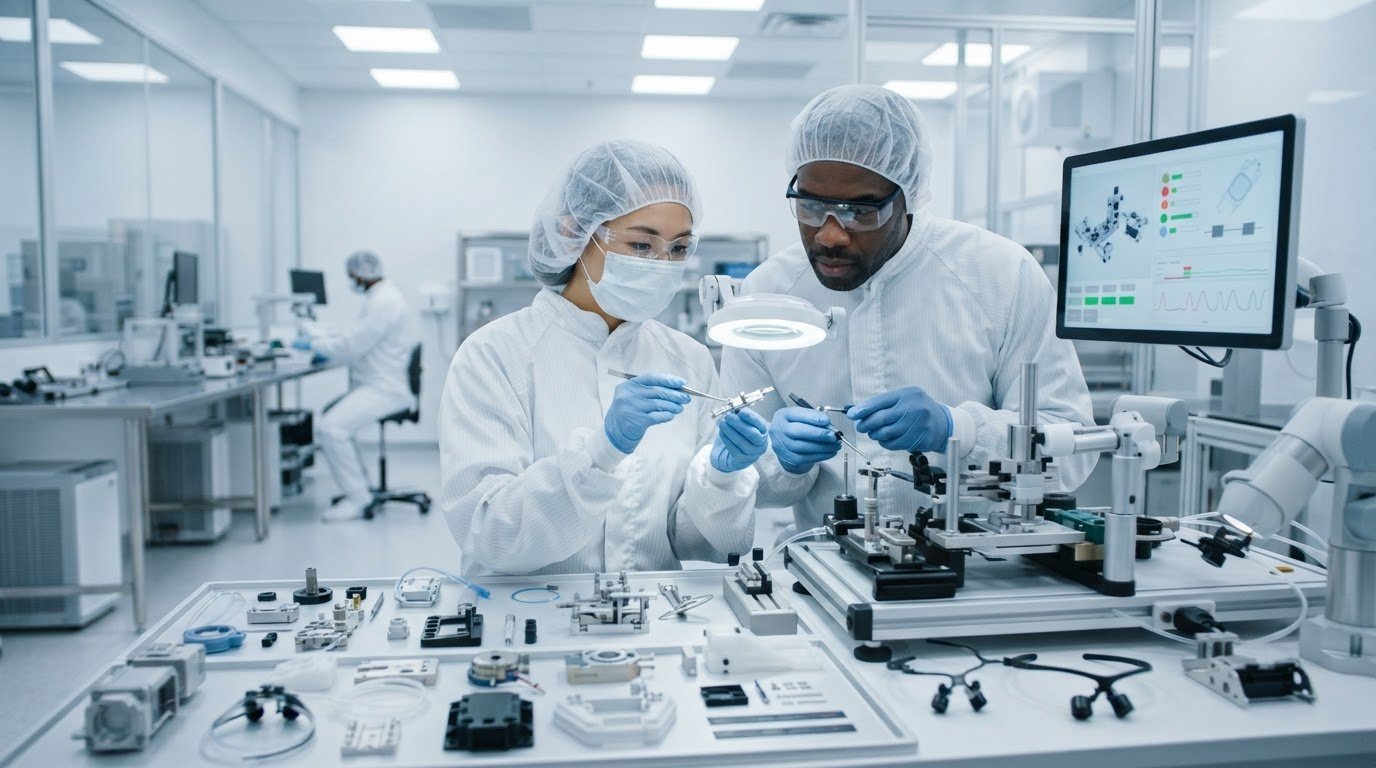
Manufacturing miniaturized medical components presents unique challenges in material stability and structural integrity. Integrating delicate optics with robust mechanical frameworks requires a deep understanding of thermal expansion and tactile feedback. Advanced micro-machined medical components often require dimensional tolerances as tight as +/- 0.001 millimeters to ensure the seamless integration of optical and mechanical sub-assemblies. Achieving this level of accuracy consistently requires a culture of discipline and technical mastery that a specialized partner provides. Design-for-Manufacturing (DFM) plays a critical role here, as it allows engineers to refine assembly sequences to reduce stack-up errors before production begins. Understanding how these precision standards are maintained during medical device scale up manufacturing from prototype to mass production is essential for any firm planning commercial expansion.
Technical excellence isn’t limited to the initial build. It extends to how a device performs over hundreds of cycles in a clinical environment. Explore our complex device assembly and micro-precision services to see how technical mastery can redefine your product’s performance and reliability.
Sustainable Lifecycle Management
The strategic value of a partnership often becomes most apparent during the post-market phase. While internal teams are frequently focused on the next product launch, a CDMO can manage the critical tasks of endoscope repair and refurbishment. This sustainable approach allows OEMs to offer cost-effective alternatives to new device production while maintaining original specifications. Refurbishment isn’t merely a cleaning process; it’s a rigorous technical restoration that ensures every reusable instrument continues to meet its validated safety profile. This lifecycle support is essential for high-value diagnostic equipment that must withstand repeated sterilization cycles without performance degradation.
Choosing between CDMO vs in-house medical device manufacturing means deciding who will be the “steady hand” throughout the device’s entire existence. A partner with 40 years of precision engineering experience ensures that original OEM specifications are protected during every repair and assembly. This continuity preserves the integrity of your brand and provides a reliable path for long-term post-market surveillance. By outsourcing these technical complexities, your internal team can stay focused on the high-level innovation that drives your market share.
The Decision Framework: Transitioning to a Strategic CDMO Partner
Transitioning from an internal production environment to an external partnership is a multi-phased process that requires technical and cultural alignment. The final resolution of the CDMO vs in-house medical device manufacturing debate isn’t merely found in a signed contract. It’s found in the successful transfer of design intent and quality standards. A robust decision framework ensures that intellectual property remains secure while production efficiency improves. This transition requires a methodical approach to tech transfer, where every process is validated against the original design specifications.
During the technical and quality audit, leadership must look beyond surface-level certifications. It’s vital to ask specific questions about the partner’s history with similar device classes. Consider these essential inquiries:
- Does the partner’s Quality Management System (QMS) demonstrate full alignment with the 2026 FDA QMSR and ISO 13485:2016?
- What specific validation protocols are used for micro-precision components with sub-millimeter tolerances?
- How does the organization manage the tech transfer process to prevent data loss or design drift?
- Can the partner provide evidence of long-term stability and consistent adherence to global standards?
Selecting the Right CDMO Partner
The Future of MedTech Partnerships
The industry is moving toward integrated solutions that manage the entire device lifecycle. This model encompasses everything from initial micro-precision component manufacturing to post-market refurbishment. Organizations like Fong’s Engineering provide over 40 years of institutional trust, acting as a visionary technician for global OEMs. This level of stability ensures that original specifications are maintained even as production scales or devices return for repair. This “one-stop-shop” approach reduces the complexity of managing multiple vendors and streamlines the path to market.
Building a collaborative partnership allows you to shift from fixed capital liability to operational agility. By selecting a partner with a culture of discipline, you secure your market position against regulatory bottlenecks and technical challenges. Discover how Fong’s Engineering can accelerate your device development and help you navigate the complexities of modern medical manufacturing.
Optimizing Your MedTech Manufacturing Strategy for 2026
Navigating the transition from fixed capital liability to variable operational agility is essential for MedTech leadership in 2026. The strategic choice between CDMO vs in-house medical device manufacturing ultimately centers on where your organization can achieve the highest precision while maintaining rigorous compliance. By shifting the burden of cleanroom maintenance and micro-precision engineering to a specialized partner, you preserve vital resources for clinical innovation and market expansion. It’s a move that transforms technical complexity from a bottleneck into a scalable advantage. To ensure your development process is fully optimized for rapid commercialization, consult our comprehensive medical device speed to market checklist for actionable steps aligned with the 2026 regulatory landscape.
Success in this landscape requires a partner with a proven history of technical mastery and a steady hand. Fong’s Engineering offers 40 years of precision engineering experience and an ISO 13485 certified quality management system to ensure your devices meet the highest global standards. Our comprehensive end-to-end medical device solutions encompass everything from complex assembly to post-market refurbishment. Accelerate your speed-to-market with Fong’s Engineering and secure a resilient foundation for your next generation of life-saving technology. We look forward to supporting your technical vision with the accuracy and discipline your products demand.
Frequently Asked Questions
What is the primary difference between a CMO and a CDMO in medical device manufacturing?
The primary difference lies in the scope of integrated engineering support. A CMO focuses strictly on the execution of established designs, while a CDMO provides comprehensive development services from the early stages. This includes Design-for-Manufacturing (DFM) analysis and technical refinement. These services help reduce design iterations and ensure the device is optimized for commercial-scale assembly before production begins.
Is my intellectual property (IP) safe when working with a medical CDMO?
Yes, IP security is a foundational element of a professional partnership. Reputable CDMOs utilize rigorous Master Service Agreements (MSAs) and non-disclosure protocols to protect proprietary designs. These organizations prioritize their reputation as a “steady hand” in the industry. They safeguard your innovations while providing the technical mastery needed to transform a concept into a validated medical device.
How does partnering with a CDMO affect the time-to-market for a new medical device?
Partnering with a CDMO typically accelerates speed-to-market by bypassing the lengthy phase of building internal infrastructure. By leveraging pre-validated quality systems and established production lines, you avoid the bottlenecks of facility construction and specialized labor recruitment. This agility is a key factor when evaluating CDMO vs in-house medical device manufacturing for a 2026 launch.
What are the typical cost savings when moving from in-house to CDMO manufacturing?
Moving to a CDMO converts fixed capital expenditure into variable operational costs. You eliminate the heavy overhead of cleanroom maintenance, equipment depreciation, and permanent technical payroll. These savings allow MedTech firms to reallocate capital toward core R&D and clinical trials rather than facility management. It’s a more efficient way to manage the financial architecture of a device lifecycle.
Can a CDMO help with FDA and ISO 13485 regulatory submissions?
Yes, a sophisticated partner provides the pre-validated data and technical documentation required for 510(k) or PMA submissions. Because their processes are already ISO 13485:2016 compliant, they streamline the path to global regulatory approval. This support reduces the risk of administrative delays. It ensures that your technical files are robust enough to withstand the scrutiny of notified bodies and the FDA.
What should be included in a technical transfer plan when moving to a CDMO?
A comprehensive tech transfer plan must include the Bill of Materials (BOM), detailed design specifications, and quality control protocols. It also requires validation reports and risk assessments such as Failure Mode and Effects Analysis (FMEA). This documentation ensures that every technical nuance is preserved during the transition. A well-documented plan prevents design drift and maintains the integrity of the original device specifications.
How does a CDMO handle micro-precision requirements for surgical tools?
CDMOs utilize specialized micro-machining technology, including Swiss-turning and micro-milling, to achieve tolerances as tight as +/- 0.001 millimeters. These organizations maintain the technical mastery required to integrate electronics and optics within miniaturized surgical housings. This level of precision is often difficult to replicate in general-purpose internal facilities. It requires a culture of discipline and significant investment in high-precision infrastructure.
Does a CDMO provide post-market services like endoscope repair or refurbishment?
Yes, strategic partners offer end-to-end solutions that include endoscope repair and refurbishment. This lifecycle management ensures that reusable devices continue to meet original OEM specifications after repeated clinical use. It’s a cost-effective and sustainable alternative to producing new devices for every replacement cycle. Proper refurbishment ensures that high-value diagnostic equipment maintains its validated safety profile throughout its entire operational life.