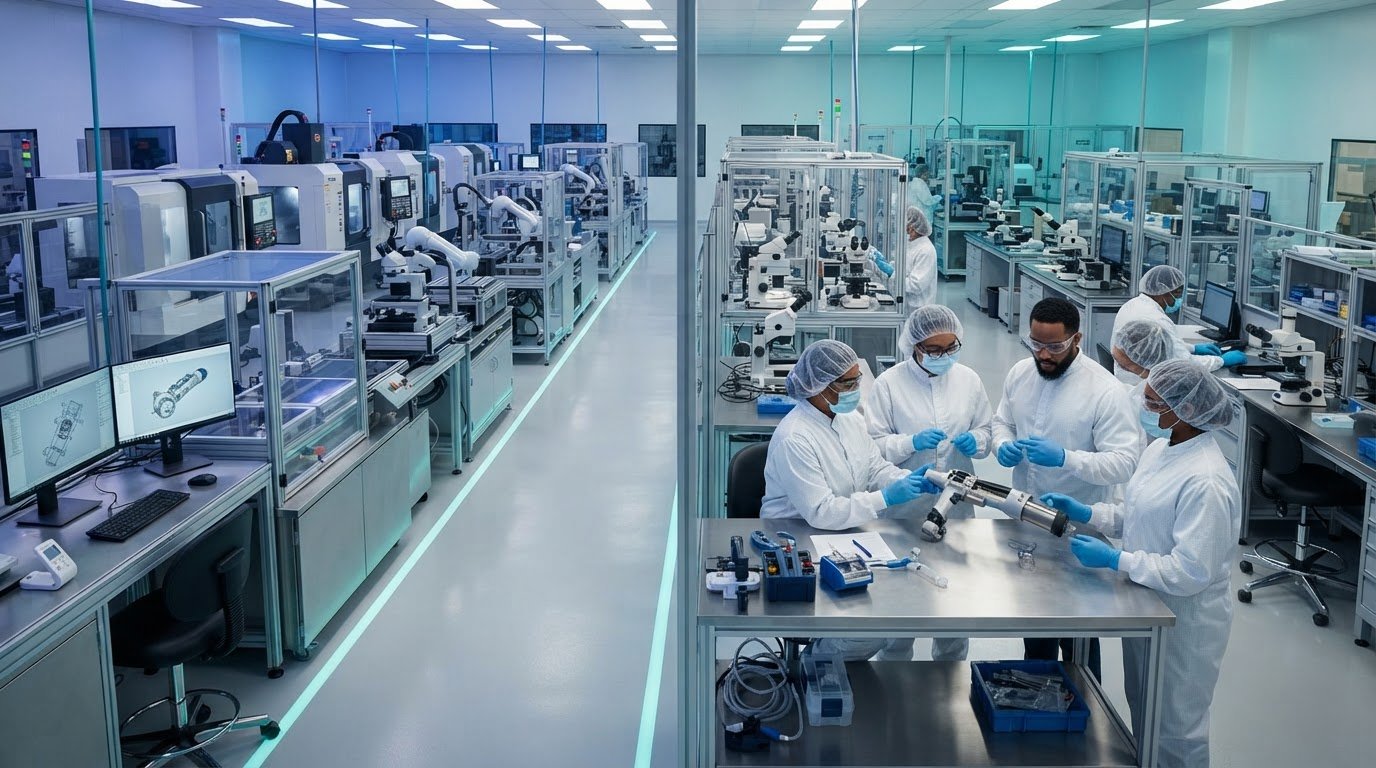


A design that excels in a lab but fails on the assembly line isn’t just a technical setback; in 2026, it’s a significant regulatory liability. You’ve likely experienced the frustration of a high-performance prototype that becomes prohibitively expensive or impossible to validate during scale-up. This gap between concept and commercialization often stems from a late-stage approach to medical device design for manufacturability. With the FDA’s Quality Management System Regulation (QMSR) taking full effect on February 2, 2026, the industry has moved toward mandatory harmonization with ISO 13485:2016. This shift requires that risk management and manufacturing feasibility are integrated into the very first sketches of your device.
We recognize that balancing micro-precision requirements with the need for high-volume output requires a steady hand and a disciplined engineering framework. This guide provides a strategic roadmap for leveraging advanced laser processing and smart manufacturing to bridge the gap between design and delivery. You’ll discover how early DFM integration reduces unit costs through optimized assembly and accelerates speed-to-market by eliminating redundant design iterations. We’ll examine the technical methodologies that ensure your complex surgical instruments aren’t just innovative, but are also robust, validated, and ready for the clinical environment.
Key Takeaways
- Distinguish between designing for a single prototype and designing for mass-market scalability to prevent late-stage production failures and cost overruns.
- Learn how to optimize component geometry for 5-axis CNC milling and auto-lathe production while ensuring strict adherence to material biocompatibility standards.
- Understand how integrating medical device design for manufacturability with advanced fiber-laser technologies ensures the structural integrity and hermetic sealing required for cardiovascular and surgical implants.
- Identify the critical stages of a disciplined DFM workflow, from initial feasibility studies to rapid prototyping, to validate mechanical functions before committing to full-scale production.
- Evaluate the strategic benefits of end-to-end CDMO partnerships that consolidate micro-precision machining, complex assembly, and secondary processes into a single, validated lifecycle.
Defining Medical Device Design for Manufacturability (DFM)
DFM isn’t just a review process; it’s a fundamental shift in how engineers approach medical innovation. It requires the deliberate integration of manufacturing constraints during the earliest conceptual stages. While ‘Design for Prototype’ focuses on proving a mechanical concept or achieving a single functional unit, Design for Manufacturability (DFM) prioritizes the repeatable, high-yield production of thousands of units. For high-stakes instruments like surgical endoscopes, this distinction is vital. A design that functions in a laboratory but demands manual, non-validated assembly steps will inevitably lead to clinical variability. Meticulous medical device design for manufacturability ensures that every component, from micro-precision gears to laser-welded housings, performs identically in every clinical procedure.
The Core Pillars: Quality, Compliance, and Scalability
In a Class 8 cleanroom environment, precision isn’t enough; repeatability is the benchmark. Effective medical device design for manufacturability aligns every tolerance and material choice with medical device manufacturing compliance requirements, particularly the risk management standards of ISO 13485. By anticipating how a part will be inspected by automated CMM systems or assembled by smart manufacturing lines, engineers can eliminate human error at the source. At its essence, DFM serves as the technical bridge that transforms a visionary medical innovation into a reliable, industrially viable reality.
Economic Advantages of Early-Stage DFM Intervention
Early intervention is the most effective way to control the total cost of ownership throughout a product’s lifecycle. Addressing manufacturing hurdles during the CAD phase is significantly more cost-effective than modifying hard tooling or re-validating processes after a failed pilot run. This ‘Right First Time’ engineering approach accelerates speed-to-market by reducing the number of design iterations required between the benchtop and the bedside. Beyond immediate production savings, meticulous DFM mitigates the catastrophic risks of product recalls and regulatory re-submissions. It builds a foundation of technical evidence that demonstrates a controlled, validated process, which is essential for maintaining institutional trust in global markets.
This operational integrity is equally important in the supply chain; for organizations managing the bulk transport of industrial liquids or dry raw materials, SIA Flexitanks offers specialized packaging solutions that ensure safety and efficiency across global routes.
Critical Dimensions of DFM for High-Precision Medical Instruments
Precision in medical engineering is a multi-dimensional challenge that extends far beyond simple CAD modeling. For devices used in robotic-assisted surgery or minimally invasive procedures, medical device design for manufacturability must account for extreme miniaturization without compromising structural integrity. This requires a granular evaluation of how component geometry interacts with advanced production methods. Designing for 5-axis CNC milling or Swiss-type auto-lathes allows for the creation of complex, multi-featured parts in a single setup. This reduces the risk of alignment errors that often plague multi-stage machining processes and ensures that every feature remains within specified tolerances.
Integrating micro precision medical components is essential for minimizing the overall device footprint. Smaller footprints allow for less invasive clinical access, but they also demand tighter tolerances that are difficult to sustain in mass production without a disciplined DFM approach. Engineers must decide early whether a device is optimized for automated assembly lines or manual cleanroom intervention. Automation provides high repeatability for high-volume disposables, while manual assembly may be necessary for low-volume, complex surgical instruments that require tactile feedback during the build process.
Material Selection and Biocompatibility Strategy
Biocompatibility is the baseline for any medical device, yet the most biocompatible materials are often the most difficult to machine. Specialized alloys like Nitinol and MP35N offer superior mechanical properties but present significant challenges in tool wear and thermal management. A robust DFM strategy accounts for these variables, as well as the impact of secondary processes such as electropolishing or Diamond-Like Carbon (DLC) coating. These finishes are not merely aesthetic; they are functional requirements for corrosion resistance and biocompatibility. The design must also ensure material stability through repeated sterilization cycles, whether using an autoclave or Ethylene Oxide (EtO), to maintain clinical reliability over the product’s lifecycle.
Component Simplification and Part Consolidation
The ‘Rule of Parsimony’ is a guiding principle in high-precision engineering. Reducing the total number of parts in an assembly directly correlates with a lower probability of assembly error and a more robust supply chain. Whenever possible, designers should consolidate multiple components into a single complex geometry. This approach reduces stack-up tolerances, which is critical when assembling multi-component surgical instruments where even a few microns of deviation can lead to mechanical failure. Using standard fasteners instead of custom-engineered couplers can also streamline the procurement and validation process. If your team is navigating the complexities of multi-material robotic tools, consulting with a technical expert during the design phase can identify these optimization opportunities early.
Leveraging Advanced Technologies for Producible Designs
Technical excellence in 2026 relies on aligning design intent with the specific capabilities of advanced laser and digital manufacturing platforms. For cardiovascular stents, fiber-laser cutting offers the precision necessary to create intricate strut patterns with minimal heat-affected zones. This level of accuracy doesn’t just improve device performance; it simplifies the validation of the manufacturing process itself. When engineers integrate 5-axis laser welding into their medical device design for manufacturability strategy, they can achieve hermetic seals on complex surgical implants that were previously impossible to join reliably. These technologies transform “difficult” designs into routine, high-yield production runs.
Smart manufacturing lines equipped with real-time dashboards provide a level of visibility that traditional facilities can’t match. By monitoring equipment utilization and process drift in real-time, manufacturers can adjust parameters before a part falls out of tolerance. Integrating unmanned CMM (Coordinate Measuring Machine) inspection into the design-for-test (DFT) strategy ensures that quality control is a continuous, 24-hour operation rather than a bottleneck at the end of the line. This automated approach is a cornerstone of effective medical device design for manufacturability, as it allows for 100% inspection of critical dimensions without slowing down the throughput of complex device assemblies. For teams scaling diagnostic hardware, specialized diagnostic equipment assembly services within a certified CDMO framework provide the validated cleanroom environments and smart manufacturing integration necessary to meet QMSR requirements at commercial scale.
Precision Laser Processing as a DFM Enabler
Ultrashort-pulse (USP) laser marking has become a standard requirement for UDI-compliant labeling because it creates a permanent, corrosion-resistant mark without penetrating the material’s protective oxide layer. This is particularly vital for stainless steel instruments that undergo aggressive sterilization. Similarly, femto laser technology enables the production of burr-free hypotubes, eliminating the need for manual deburring that can introduce mechanical variability. When designing joints for automated laser soldering or welding, engineers must prioritize fit-up tolerances and beam access. A well-designed joint geometry allows the laser to deliver energy precisely where it’s needed, ensuring a consistent, high-strength bond every time.
Smart Manufacturing and Automated Quality Control
The transition to 24-hour unmanned in-process measurement represents a significant leap in manufacturing reliability. By designing parts with specific features for robotic machine tending, such as standardized gripping points or orientation markers, manufacturers can maximize the efficiency of unmanned smart lines. This isn’t just about labor savings; it’s about removing human variability from the production cycle. Real-time data monitoring provides a feedback loop that informs iterative design refinements. If the data shows a consistent trend toward a tolerance limit, the design can be adjusted to create a more robust manufacturing window, ultimately leading to superior product reliability in clinical settings.
The DFM Workflow: From Prototype to Mass Production
The transition from a functional prototype to a commercially viable product is a critical phase where technical assumptions meet industrial reality. A disciplined medical device design for manufacturability workflow begins with a comprehensive feasibility study conducted by the CDMO’s engineering team. This review identifies potential manufacturing bottlenecks, such as overly tight tolerances or complex geometries that could lead to low yields. Rapid prototyping follows, serving as a validation tool for both mechanical function and the DFM assumptions established during the CAD phase. These early iterations allow for the refinement of the device before investing in expensive high-volume tooling. For teams engaged in medical device development Singapore projects, following a structured prototyping checklist ensures every milestone from concept to production is met with the necessary regulatory and engineering rigor.
Once the design is frozen, the focus shifts to pilot runs. These small-batch productions are essential for establishing a baseline for the manufacturing process and identifying any unforeseen variables in the assembly sequence. A robust Master Validation Plan (MVP) governs this entire lifecycle, ensuring that every step is documented and repeatable. This structured approach provides the technical evidence required for regulatory submissions and ensures that the device can scale seamlessly from the lab to global distribution. For a comprehensive overview of navigating this journey, the integrated medical device development and manufacturing guide for 2026 provides an in-depth framework covering concurrent engineering, Smart Manufacturing strategies, and CDMO partnership models.
Early Collaboration and Concurrent Engineering
Successful projects often involve engaging medical device contract manufacturing services during the conceptual stage. This concurrent engineering model allows for the early implementation of Process Failure Mode and Effects Analysis (PFMEA). By identifying potential process failures before they occur, engineers can design out risks that would otherwise lead to costly delays. Designers should utilize specialized design-for-assembly software tools to simulate assembly sequences and identify part interference early. This proactive strategy ensures that the final design is inherently optimized for the manufacturing floor.
Rigorous Process Validation (IQ, OQ, PQ)
Validation is the cornerstone of medical device design for manufacturability, providing the objective evidence that a process consistently produces a result meeting its predetermined specifications. The framework consists of three distinct stages:
- Installation Qualification (IQ): This stage verifies that all manufacturing equipment is installed correctly and meets the required design specifications.
- Operational Qualification (OQ): Engineers define the process windows and limits, testing the “worst-case” scenarios to ensure the process remains stable even under varied conditions.
- Performance Qualification (PQ): This final stage demonstrates long-term manufacturing stability through multiple production runs under normal operating conditions.
If you’re preparing to transition a complex instrument from prototype to mass production, request a technical feasibility review to ensure your validation strategy is robust.
Strategic Partnership: Maximizing DFM with a Global CDMO
Selecting the right partner is more than a procurement decision; it’s a strategic alignment of technical cultures. Fong’s Engineering & Manufacturing Private Limited, a CDMO with end-to-end capabilities, serves as a seamless extension of your engineering team, bridging the gap between a design concept and a validated product. This integration is vital for medical device design for manufacturability, as it allows for the early consolidation of micro-precision machining with in-house secondary processes like anodizing and heat treatment. By maintaining these specialized capabilities under one roof, you eliminate the logistical risks and quality drift often associated with fragmented supply chains. Leveraging an extensive global footprint with strategically located facilities provides the resilience needed to navigate shifting global markets while maintaining consistent ISO 13485 standards.
This commitment to precision and technical excellence is a defining characteristic of the Singaporean market, extending into other high-stakes domains such as the luxury marine industry, where the Grady-White Adventure 218 Singapore is sought after for its superior build quality and engineering integrity.
Comprehensive Lifecycle Support for Complex Devices
High-growth sectors like robotic-assisted surgery require specialized DFM strategies that generalist manufacturers can’t provide. Designing robotic surgical adapters or ultrasonic scalpel couplers involves managing complex multi-material interfaces and strict sterilization requirements. A global CDMO provides the infrastructure to manage the transition for both high-volume disposable components and high-value reusable instruments. Access to specialized testing labs for QA and R&D ensures that every design assumption is rigorously validated before mass production begins. This level of support is essential for maintaining the integrity of devices that operate in the most demanding clinical environments, where failure isn’t an option.
Driving Success through Institutional Expertise
Navigating the evolving regulatory landscape, including the FDA’s transition to the Quality Management System Regulation (QMSR) in February 2026, requires a partner with deep institutional knowledge. Harnessing over 40 years of precision engineering experience provides a “Steady Hand” that remains reliable throughout complex developmental cycles. This expertise is the difference between a project that stalls during validation and one that scales smoothly to market. Effective medical device design for manufacturability is a collaborative discipline that relies on technical evidence rather than marketing claims. To initiate a DFM-led project, the next step involves a technical deep-dive into your device’s critical-to-quality (CTQ) dimensions to align them with validated manufacturing windows and smart manufacturing protocols.
Securing Clinical Excellence Through Disciplined Engineering
The integration of manufacturing constraints into the early design phase is no longer an optional cost-saving measure. It’s a fundamental requirement for regulatory compliance and product reliability. Adopting a rigorous approach to medical device design for manufacturability ensures your most complex innovations are repeatable on a global scale. We’ve examined how advanced laser processing, smart manufacturing, and disciplined validation workflows create a robust foundation for high-precision surgical instruments.
Success in the 2026 MedTech landscape demands a partner with both technical mastery and a resilient global footprint. Fong’s Engineering & Manufacturing Private Limited provides the institutional expertise and ISO 13485 certified facilities necessary to navigate high-stakes developmental cycles. Our end-to-end capabilities across Singapore, China, and Malaysia support your journey from concept to mass production with technical precision and FDA-compliant rigor.
Partner with Fong’s for expert medical device design and development to transform your complex engineering challenges into validated clinical solutions. We’re ready to help you achieve technical excellence at every stage of the product lifecycle.
Frequently Asked Questions
What is the difference between DFA and DFM in medical device development?
DFM focuses on optimizing individual components for easier production, while DFA, or Design for Assembly, prioritizes the efficient joining of those parts. In high-precision manufacturing, DFM ensures a micro-precision gear is machinable with high yield. DFA ensures that same gear integrates into a surgical housing with minimal risk of orientation errors. Both are essential elements of a holistic medical device design for manufacturability strategy to ensure scalability.
How early should I engage a CDMO for DFM support?
You should engage a CDMO at the concept or early design stage to maximize the impact of engineering refinements. Early collaboration allows for the identification of technical risks before you invest in hard tooling or finalize validation plans. Waiting until the prototyping phase often results in costly redesigns. A disciplined partner provides feasibility studies during the initial CAD phase to ensure every feature is industrially viable and repeatable.
Can DFM help in achieving FDA 510(k) or CE Mark clearance?
DFM directly supports regulatory clearance by providing technical evidence of a controlled and validated manufacturing process. Under the FDA’s Quality Management System Regulation (QMSR), manufacturers must demonstrate that design intent matches the final produced device. Robust DFM documentation serves as a critical component of your Design History File. It proves that your production methods consistently meet safety and efficacy requirements across every unit produced.
What are the most common DFM mistakes in MedTech?
The most frequent mistake is over-specifying tolerances that don’t add functional value but significantly increase production costs. Other common errors include selecting materials that are biocompatible but nearly impossible to machine at scale. Many designers also fail to account for secondary processes like electropolishing or passivation during the initial design. These oversights lead to low yields and expensive re-validation cycles during the transition to mass production.
How does material selection impact the manufacturability of surgical tools?
Material selection dictates the machining strategy, tool life, and final surface integrity of surgical tools. While stainless steel 316L is a standard choice, specialized alloys like Nitinol require advanced laser processing to manage their unique thermal properties. The choice affects everything from cycle times to the ability to achieve hermetic seals. Your DFM strategy must balance these mechanical requirements with the necessity of maintaining biocompatibility through repeated sterilization cycles.
Does DFM compromise the creative aspects of medical device design?
DFM doesn’t stifle innovation; it provides the technical framework to make visionary designs commercially viable. It acts as a set of guardrails that prevents creative concepts from becoming industrial failures. By understanding manufacturing constraints early, designers find more elegant ways to achieve complex functions. This discipline often leads to simpler, more reliable devices that perform better in clinical environments than their over-engineered counterparts, enhancing overall product integrity.
How can DFM reduce the cost of complex robotic surgical components?
DFM reduces costs by consolidating parts and optimizing geometries for high-speed, 5-axis CNC milling. Reducing the part count minimizes the number of assembly steps and the associated risk of stack-up tolerances. Efficient medical device design for manufacturability also identifies opportunities for automated inspection, which lowers labor costs and improves yield. These refinements ensure that even the most complex robotic adapters remain economically viable throughout their entire product lifecycle.
What role does automation play in modern DFM strategies?
Automation serves as the benchmark for repeatability in modern DFM strategies. Designing parts with standardized features for robotic machine tending or automated CMM inspection allows for 24-hour unmanned production. This removes human variability from the assembly process, which is critical for high-stakes medical instruments. Automation-ready designs ensure that quality is built into the production line rather than being a post-process check, resulting in superior product reliability and throughput.