
Did you know that as of February 2026, the FDA’s Quality Management System Regulation now mandates direct harmonization with ISO 13485, granting inspectors explicit authority to review your internal supplier audits and management records? For medical device OEMs, the margin for error in surgical instrument contract manufacturing has never been thinner. You understand that a single failure in a micro-precision robotic adapter or a lapse in cleaning validation for reusable tools can jeopardize both patient safety and your market standing. It’s a high-stakes environment where inconsistent component quality and long prototyping lead times simply aren’t acceptable.
This guide offers a technical roadmap for evaluating and selecting a manufacturing partner that balances advanced engineering with global regulatory mastery. You’ll learn how to secure a validated, high-yield production line while accelerating your speed-to-market through smart manufacturing and automated metrology. We’ll explore the essential integration of ISO 13485 standards, the nuances of EU MDR compliance for reusable instruments, and the strategic value of comprehensive post-market refurbishment services at facilities like our dedicated repair center.
Key Takeaways
- Learn how to identify a surgical instrument contract manufacturing partner that integrates ISO 13485 compliance with Design for Manufacturability (DFM) to optimize production costs.
- Explore the impact of multi-axis CNC processing and advanced laser technologies in achieving the sub-micron tolerances required for complex robotic and minimally invasive tools.
- Understand how transitioning to smart manufacturing lines and 24-hour unmanned metrology can significantly reduce lead times while maintaining consistent quality during mass production.
- Discover strategies for extending the lifecycle of reusable devices through specialized refurbishment services that restore instruments to original OEM performance specifications.
- Evaluate the advantages of leveraging a global CDMO with deep institutional expertise and a robust international footprint to ensure seamless regulatory compliance and technical excellence.
Critical Criteria for Selecting a Surgical Instrument Contract Manufacturer
Selecting a partner for surgical instrument contract manufacturing requires a rigorous assessment of technical competency and institutional stability. It isn’t merely about finding a machine shop; it’s about securing a collaborator that understands the life-critical nature of every component. High-stakes instruments, particularly those used in robotic-assisted surgery, demand sub-micron tolerances and uncompromising material integrity.
A qualified CDMO must demonstrate mastery over specialized alloys. Whether working with the shape-memory properties of Nitinol, the high-strength fatigue resistance of MP35N, or the corrosion resistance of medical-grade stainless steel, the manufacturer’s metallurgical expertise is foundational. These materials form the basis of advanced surgical instruments that must perform reliably under extreme clinical stress. Assembly and packaging must also occur within controlled environments, such as ISO Class 8 or Class 100k cleanrooms, to mitigate bioburden risks before the device reaches the sterile field.
Regulatory Compliance and Quality Management Systems
Achieving global market entry depends on a robust Quality Management System (QMS) that aligns with ISO 13485 and FDA 510(k) requirements. This alignment ensures that every process is documented and validated through a comprehensive Master Validation Plan. This plan includes Installation Qualification (IQ), Operational Qualification (OQ), and Performance Qualification (PQ). These steps aren’t optional. They’re the evidence that your production line is stable and repeatable. Teams should also employ Process Failure Mode and Effects Analysis (PFMEA) to proactively identify and mitigate risks, ensuring patient safety is designed into the process from day one. This meticulous approach is vital for obtaining CE Marking and maintaining compliance across diverse international markets.
Engineering Depth: Beyond Basic Machining
True engineering depth separates a standard supplier from a strategic partner. Effective medical device design for manufacturability (DFM) identifies potential production bottlenecks early, reducing overall costs and accelerating speed-to-market. This is especially critical for complex assemblies like robotic surgical adapters, where mechanical precision must integrate perfectly with electronic sensors. An ideal partner maintains in-house R&D and QA laboratories. These facilities allow for rapid iteration and rigorous validation, providing the technical evidence needed to support regulatory filings and clinical confidence. This level of integration ensures that the transition from prototype to high-yield production is seamless and predictable.
Advanced Manufacturing Technologies for High-Precision Instruments
Modern surgical instrument contract manufacturing has transitioned from traditional machining to highly automated, technology-driven ecosystems. The production of intricate geometries, such as robotic wrist adapters and MIS tools, relies on the convergence of multi-axis CNC processing and advanced laser systems. Five-axis milling and auto-lathe precision allow for the creation of complex multi-linkage components in a single setup, which minimizes handling errors and ensures absolute concentricity. These technical capabilities are essential for specialized components like ultrasonic scalpel couplers and cardiovascular adapters, where sub-micron accuracy is a prerequisite for acoustic performance and fluid dynamic stability.
To ensure long-term durability and biocompatibility, these instruments undergo rigorous surface treatments. Electropolishing removes surface impurities to enhance corrosion resistance, while anodizing provides a functional oxide layer for color-coding and identification. For high-friction applications in robotic surgery, Diamond-Like Carbon (DLC) coatings are applied to reduce wear and extend the instrument’s operational life. Adhering to the latest FDA guidance on remanufacturing and servicing ensures these secondary processes maintain the device’s original safety and efficacy profile throughout its lifecycle.
Precision Laser Technologies in Surgical Tools
Laser innovations have revolutionized the manufacturing of high-stakes medical devices. Ultrashort-pulse (USP) marking, utilizing picosecond or femtosecond lasers, is now the industry benchmark for Unique Device Identifier (UDI) compliance. Unlike traditional fiber lasers, USP marking creates a dark, high-contrast mark without disrupting the chromium oxide passive layer of stainless steel. This prevents rust during repeated autoclave cycles. Additionally, femto laser cutting enables the production of ultra-thin stents and hypotubes with minimal heat-affected zones, while 5-axis laser welding provides the hermetic sealing required for complex reusable instruments.
Complex Assembly and Cleanroom Operations
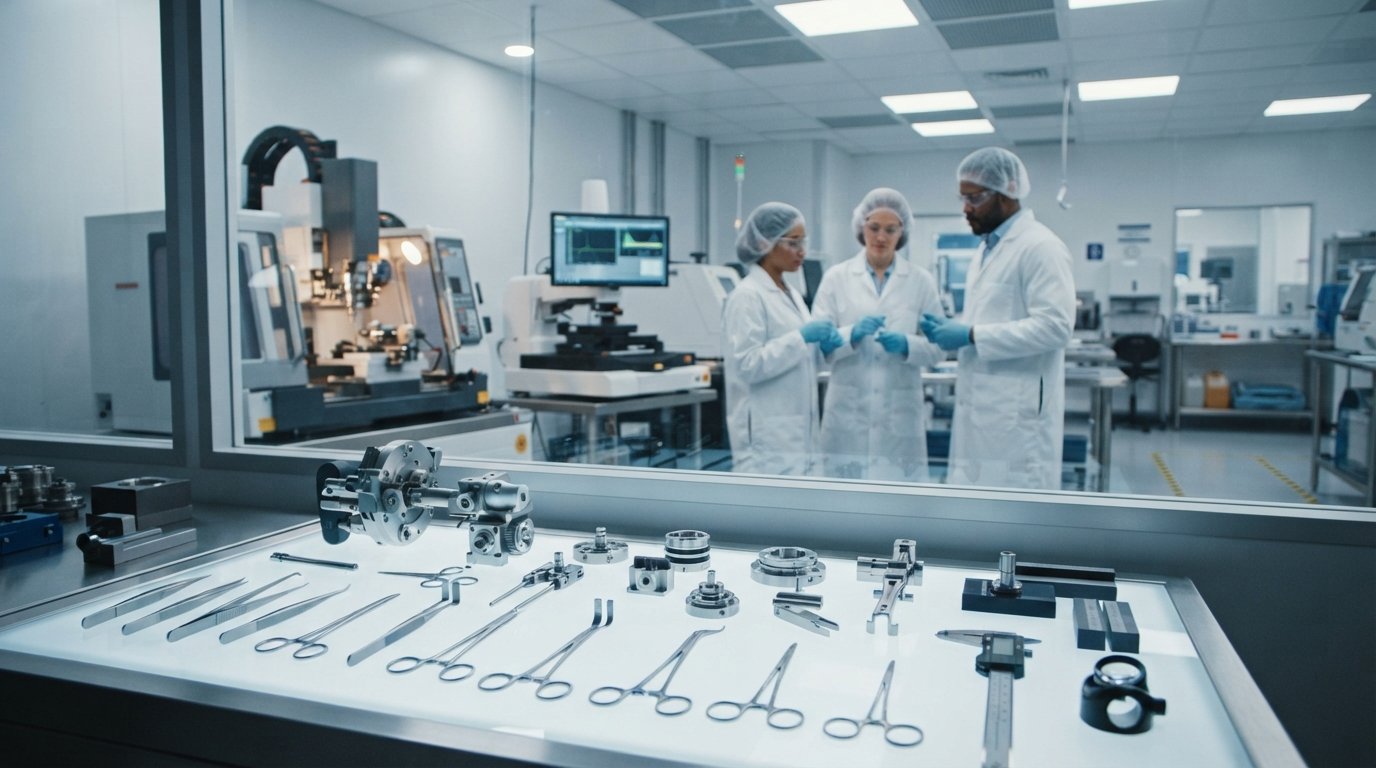
The final stage of production involves the integration of mechanical and electronic components within controlled environments. Assembly of sterile disposable surgical staplers, suction irrigators, and cryoablation fluid delivery tubes occurs in ISO Class 8 cleanrooms to maintain strict bioburden controls. These facilities support the transition from individual micro-precision components to fully functional device assemblies. Automated blister packaging and Tyvek pouching lines ensure that the sterile barrier remains intact until the point of use. If you’re looking to scale your production while maintaining these rigorous standards, you can consult with our engineering team regarding your specific assembly requirements.
Smart Manufacturing: Driving Efficiency and Quality at Scale
Scaling from a validated prototype to high-volume production requires a transition from manual oversight to a sophisticated digital ecosystem. In surgical instrument contract manufacturing, this evolution is powered by smart manufacturing lines that maintain sub-micron precision while operating at scale. By deploying robotic loading and unloading systems, manufacturers eliminate human variance and optimize operational efficiency. This automated approach allows for 24-hour unmanned production cycles, which directly compresses lead times for complex MIS tools and robotic adapters.
The adoption of digital manufacturing and digital thread integration provides real-time transparency across the entire supply chain. Digital dashboards monitor equipment performance and material flow, ensuring that any deviation is addressed before it impacts the yield. This level of technical oversight creates a “steady hand” in production, providing the stability required for long-term OEM partnerships and consistent device performance.
Automated Inspection and Quality Assurance
Precision isn’t just about the cut; it’s about the verification. Unmanned Coordinate Measuring Machine (CMM) inspection stations provide 100% dimensional accuracy without the risk of operator fatigue. These systems are integrated directly into the production cell, allowing for immediate feedback and adjustment. Beyond dimensions, in-process functional validation, such as inline voltage testing and leak detection, ensures that complex active instruments meet rigorous safety standards. This data-driven environment supports the implementation of robust Corrective and Preventive Actions (CAPA), moving quality management from a reactive to a proactive state.
Global Logistics and Supply Chain Resilience
A resilient supply chain requires geographic diversification and strategic proximity to logistics infrastructure. Fong’s (FSP Group) maintains a global footprint with high-capacity sites in Singapore and China, complemented by a new facility in Johor, Malaysia, opening in Q1 2027. This multi-site platform mitigates geopolitical risks while providing rapid logistics support. The Malaysia site is strategically located 20 minutes from Senai Airport and 90 minutes from Singapore Changi Airport, facilitating swift global distribution. To further streamline integration, Vendor Managed Inventory (VMI) programs allow MedTech OEMs to maintain lean operations while ensuring a reliable supply of critical components.
Post-Market Services: Repair, Refurbishment, and Lifecycle Management
A comprehensive approach to surgical instrument contract manufacturing extends far beyond the initial delivery of a validated component. True partnership in the MedTech space requires a commitment to the entire device lifecycle, particularly as hospitals and clinicians seek to maximize the utility of high-value assets. This is especially critical for reusable endoscopes, such as Ureteroscopes and Gastroscopes, which undergo significant mechanical stress and aggressive sterilization cycles. A lifecycle-focused CDMO ensures that these instruments maintain their original performance profile through years of clinical service.
The ROI of Surgical Instrument Refurbishment
Hospitals face constant pressure to manage capital equipment costs without compromising patient safety. Refurbishment provides a sustainable alternative to full replacement, offering a significant return on investment for complex reusable tools. Restoration to original OEM performance specifications ensures that the device remains safe and effective, adhering to the same rigorous standards applied during initial production. Meticulous adherence to these reprocessing standards isn’t just a cost-saving measure; it’s a regulatory necessity. You can explore our specific approach to endoscope repair and refurbishment to understand the technical rigor involved in restoring these sophisticated tools.
Technical Restoration Capabilities
Restoration involves more than surface-level maintenance. It requires precision recalibration of complex surgical adapters and the technical restoration of flexible endoscopes or electric scalpels. Each device undergoes rigorous validation and testing protocols, including leak testing and image quality verification, to ensure it meets its original functional requirements. This process is fully documented to support regulatory audits and hospital compliance mandates. By maintaining these strict protocols, we ensure that every refurbished instrument performs with the same reliability as a new component, protecting the clinician’s workflow and the patient’s outcome.
Strategic support for North American clients is enhanced by our dedicated US-based repair center in Irvine, California. This facility provides localized lifecycle support, ensuring rapid turnaround times and direct access to specialized engineering expertise. It serves as a vital hub for endoscope reprocessing and restoration, providing a steady hand for domestic supply chains. This localized presence bridges the gap between high-volume global surgical instrument contract manufacturing and immediate post-market service needs. If your organization requires technical restoration to maintain fleet performance, contact our Irvine-based support team for a lifecycle assessment.
Why Fong’s is the Global Partner of Choice for Surgical CDMO
Fong’s Engineering & Manufacturing Private Limited (FSP Group) represents more than four decades of institutional expertise in precision medical engineering. This longevity provides a foundation of stability for OEMs navigating the complexities of surgical instrument contract manufacturing. With a combined platform of over 1,000 production staff and more than 500,000 square feet of facility space, the organization possesses the scale required to manage high-yield production without sacrificing the meticulous precision that patient safety demands. We provide end-to-end capabilities that bridge the gap between initial concept and global mass production, ensuring every device meets the highest technical standards.
A Culture of Quality and Integrity
Our brand persona is defined by a deep commitment to the mission of advancing patient care through best-in-class medical devices. This isn’t marketing rhetoric; it’s a quality culture instilled across every level of our global operations. We maintain a professional distance that suggests technical mastery while remaining a collaborative partner for global MedTech OEMs and robotic surgery leaders. This balance of technical evidence and adherence to global standards has established FSP Group as a steady hand throughout complex developmental cycles. You can explore our comprehensive medical device contract manufacturing services to see how we integrate these values into every project we undertake.
Future-Ready Infrastructure
Technical leadership requires continuous investment in the next generation of manufacturing technology. We’ve prioritized the integration of femto laser systems and smart manufacturing lines to ensure our partners remain at the cutting edge of surgical innovation. These technologies allow for the sub-micron accuracy and corrosion-resistant marking discussed in previous sections, providing a future-ready foundation for robotic and minimally invasive tools.
This commitment to technical excellence is matched by our strategic geographic expansion. Our new 30,000 square foot facility in Johor, Malaysia, is scheduled to open in Q1 2027, featuring over 150 staff and rapid logistics access to Singapore. This expansion reinforces our ability to provide a globalized, resilient supply chain for the world’s most demanding medical applications. Choosing a CDMO partner is a decision that impacts the entire lifecycle of your device. We’re ready to apply our disciplined engineering approach to your specific requirements. Contact our engineering team today to discuss how our global platform can support your next surgical innovation.
Advancing Surgical Innovation Through Technical Mastery
Navigating the complexities of the modern medical device sector requires a partner that views manufacturing as a lifecycle commitment rather than a transactional service. Successful surgical instrument contract manufacturing hinges on the seamless integration of micro-precision engineering, automated quality verification, and rigorous regulatory compliance. By prioritizing Design for Manufacturability and smart production lines, OEMs can achieve the sub-micron tolerances necessary for robotic-assisted surgery while maintaining a validated, high-yield production environment.
Fong’s (FSP Group) brings over 40 years of precision engineering expertise to every collaboration. Our operations are anchored by ISO 13485 and FDA 510(k) certifications, ensuring your devices meet the most stringent global standards. Beyond initial production, our US-based repair center in Irvine, CA, provides the essential post-market support required for complex reusable instruments. This combination of global scale and localized technical support creates a stable foundation for your most ambitious surgical innovations. We’re ready to translate your technical requirements into a reliable, market-ready reality that prioritizes patient outcomes and operational excellence.
Partner with Fong’s for your next surgical instrument project
Frequently Asked Questions
What certifications are required for surgical instrument contract manufacturing?
It’s essential that contract manufacturers maintain ISO 13485 certification for quality management systems and adhere to FDA 510(k) or CE Marking requirements for specific device clearances. FSP Group operates under these rigorous frameworks, utilizing Master Validation Plans that include IQ, OQ, and PQ protocols. These standards ensure that every device, from complex robotic adapters to disposable staplers, meets the safety and efficacy benchmarks required for global market entry and patient care.
Can you handle the transition from prototyping to mass production?
Yes, our CDMO platform is structured to support the entire product lifecycle from initial concept through global mass production. We utilize specialized R&D and QA laboratories to refine designs before scaling to our 500,000 square foot manufacturing footprint. With over 1,000 production staff and smart manufacturing lines, we ensure a seamless transition that maintains technical integrity while optimizing for high-volume yield and supply chain resilience.
What materials are best suited for minimally invasive surgery (MIS) tools?
Minimally invasive surgery tools often require materials that balance biocompatibility with high mechanical performance, such as Nitinol, MP35N, and medical-grade stainless steel. Nitinol’s shape-memory properties are essential for stents and flexible tools, while MP35N provides the fatigue resistance needed for high-stress applications. We leverage precision machining and femto laser cutting to transform these specialized alloys into the sub-micron components required for advanced MIS procedures.
How do you ensure the precision of robotic surgical adapters?
Precision in robotic surgical adapters is achieved through a combination of 5-axis CNC milling and 24-hour unmanned CMM inspection. These automated systems eliminate the variances associated with manual handling, ensuring that every component meets exact dimensional specifications. We also implement real-time monitoring and in-process functional testing, such as voltage and leak detection, to validate that these complex mechanical and electronic interfaces perform reliably during high-stakes robotic procedures.
Do you provide repair services for reusable surgical instruments in the US?
Yes, FSP Group operates a dedicated repair center in Irvine, CA, specifically for the US market. This facility specializes in the technical restoration and reprocessing of reusable endoscopes, including Ureteroscopes and Gastroscopes. By restoring instruments to their original OEM performance specifications, we help hospitals extend asset lifecycles while maintaining strict compliance with FDA guidance on remanufacturing and servicing.
What are the benefits of smart manufacturing in medical device production?
Smart manufacturing provides significant advantages in surgical instrument contract manufacturing by integrating real-time telemetry and robotic automation. These lines utilize robotic loading and unloading to minimize human error and unmanned metrology to ensure 100% dimensional accuracy. This digital ecosystem reduces headcount and improves machine utilization, which directly compresses lead times and enhances the overall stability of the production process for complex medical devices.
How does Design for Manufacturability (DFM) affect the cost of surgical tools?
Design for Manufacturability identifies potential production challenges during the early engineering phase, which significantly reduces total production costs. By optimizing part geometries for 5-axis machining or laser welding, we can eliminate unnecessary processing steps and reduce material waste. This proactive approach ensures a high-yield production line and accelerates speed-to-market, allowing OEMs to launch innovative surgical tools with a more competitive cost structure.
What cleanroom standards do you maintain for surgical instrument assembly?
We maintain ISO Class 8 (100k) cleanroom environments for the assembly and packaging of both disposable and reusable medical devices. These controlled spaces are essential for managing bioburden and ensuring the sterility of components like heart valve ring catheters and suction irrigators. Our cleanroom operations include automated blister packaging and Tyvek pouching, providing a secure sterile barrier that meets the rigorous standards required for clinical use.