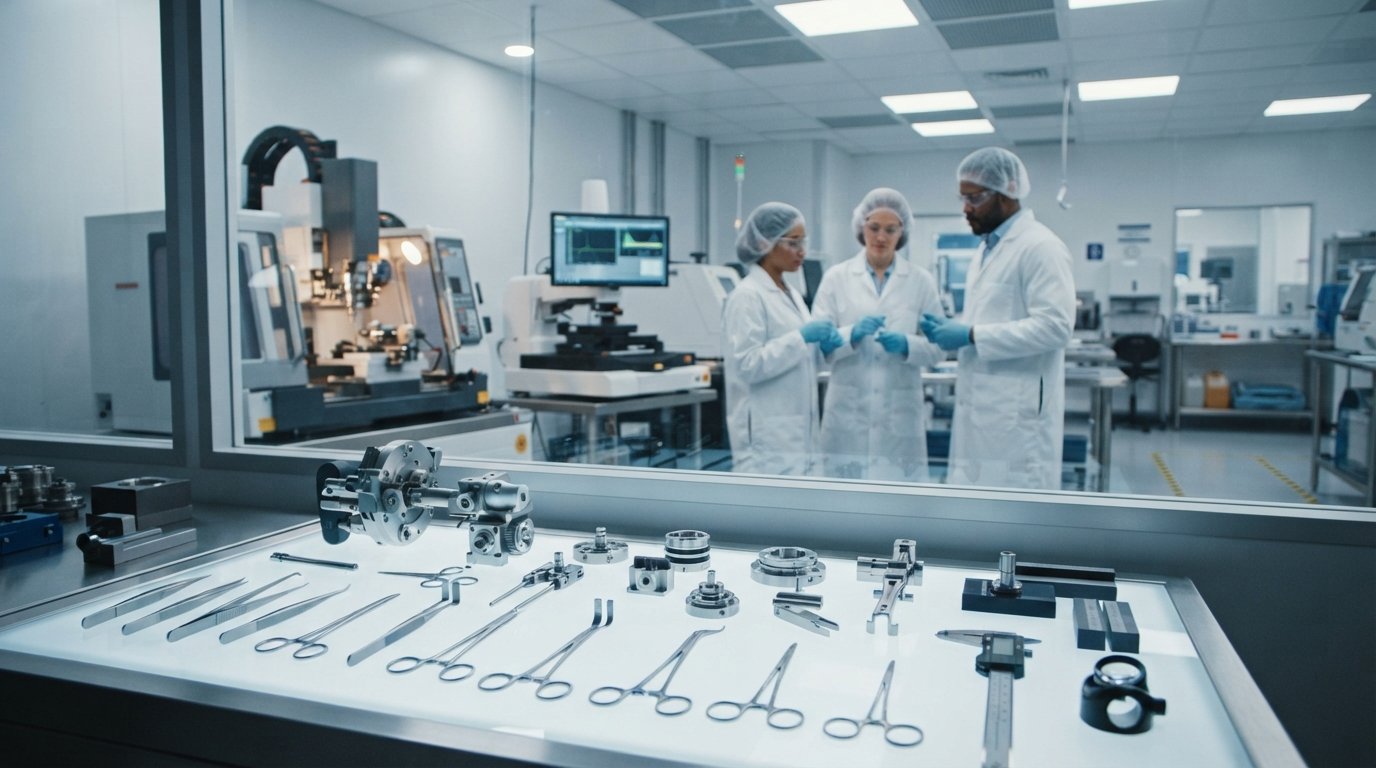


A medical device prototype that performs flawlessly in a controlled lab environment often becomes a liability when it reaches the assembly floor. If the design doesn’t account for high-volume repeatability, you risk high scrap rates and human errors that jeopardize patient safety. For many engineering teams, the transition from a clinical concept to a high-yield production line is where the most significant regulatory and financial delays occur. Design for manufacturing and assembly (DFMA) for medical devices isn’t merely a cost-saving measure; it’s a rigorous clinical reliability strategy that embeds compliance into the physical architecture of your product.
We recognize that precision is non-negotiable in the MedTech sector, whether you’re developing Ultrasonic Scalpel Couplers or Robotic Surgical Adapters. This guide provides the engineering framework necessary to bridge the gap between initial design and scalable mass production. You’ll learn how to refine complex assemblies, utilize micro-precision components, and leverage smart manufacturing to ensure a seamless transition to your CDMO partner. By mastering these principles, you’ll achieve lower unit costs and faster speed-to-market while maintaining the technical excellence your stakeholders expect. We’ll explore how disciplined engineering at the front end prevents the costly redesigns that often stall the product lifecycle.
Key Takeaways
- Understand the “Rule of Tens” to prevent exponential cost increases by addressing design errors before they reach the production floor.
- Optimize component geometry and material selection to ensure high-yield results during 5-axis CNC machining and micro-precision manufacturing.
- Implement Poka-Yoke principles in cleanroom assembly to minimize human error and reduce reliance on complex fixtures.
- Align design for manufacturing and assembly (DFMA) for medical devices with ISO 13485 requirements to bridge the gap between technical innovation and regulatory compliance.
- Learn how early CDMO involvement facilitates a seamless transition from prototype to mass production through advanced laser processing and smart manufacturing.
The Critical Role of DFMA in Medical Device Speed-to-Market
In the medical technology lifecycle, Design for Manufacturing and Assembly (DFMA) is the engineering methodology that prioritizes fabrication ease and assembly efficiency during the initial design phase. It’s not a generic manufacturing concept. Instead, it’s a critical framework for ensuring that a life-saving innovation can be produced reliably at scale. Implementing design for manufacturing and assembly (DFMA) for medical devices allows engineering teams to identify potential production bottlenecks before they become institutional crises.
A fundamental principle in this discipline is the “Rule of Tens.” This concept dictates that the cost of correcting a design flaw increases tenfold at each subsequent stage of the product lifecycle. A change that costs $1,000 during the initial design phase may cost $10,000 during prototyping, $100,000 during pilot runs, and upwards of $1,000,000 once the device is in mass production. By front-loading engineering efforts, manufacturers significantly improve medical device speed to market. This proactive approach reduces the risk of late-stage redesigns; these changes often trigger the need for entirely new FDA 510(k) filings and months of regulatory delays. When a design change occurs late in the cycle, it doesn’t just affect the factory floor. It often necessitates a re-evaluation of the risk file, potentially requiring new validation studies that push launch dates back by several quarters.
Bridging the Gap Between Concept and Commercialization
A prototype that functions perfectly in an R&D laboratory often fails to translate to a high-speed, automated production line. Laboratory settings allow for manual adjustments and “one-off” fixes that are impossible in a mass-production environment. A strategic CDMO partner plays a vital role here by identifying “unmanufacturable” features, such as overly tight tolerances on non-critical dimensions or geometries that hinder 5-axis CNC access, well before the tooling is cut. Fundamentally, DFMA is the synthesis of part optimization and assembly efficiency.
Economic and Clinical Drivers for DFMA
The primary goal of DFMA is to reduce the Cost of Goods Sold (COGS) without compromising clinical efficacy. Simplifying the assembly process directly reduces the potential for human error in the cleanroom, which is paramount for high-stakes devices like Robotic Surgical Adapters. Part consolidation is a key lever in this process. By reducing the total number of components, engineers can improve device sterilization pathways and ensure better biocompatibility by minimizing the number of joints or adhesives required. This meticulous refinement ensures that the final product remains robust, compliant, and cost-effective throughout its entire commercial life.
Core Principles of Design for Manufacture (DFM) for Medical Precision
Success in medical device fabrication begins with a granular analysis of materials. Selecting medical-grade alloys like Nitinol or 316L stainless steel requires an understanding of both their biocompatibility and their behavior during high-speed machining. Designers must account for the mechanical properties that affect tool wear and surface finish. For instance, the high elasticity of Nitinol necessitates specific cooling strategies and tool geometries to prevent work hardening. Proper material selection ensures that the device performs its clinical function while remaining cost-effective to produce at scale.
Beyond basic material choice, optimizing geometry for advanced fabrication methods is essential for maintaining tight tolerances. Utilizing medical device design for manufacturability principles ensures that components are optimized for 5-axis CNC milling and auto-lathe turning. This optimization reduces the number of setups required, which in turn minimizes the cumulative error introduced during part repositioning. If you’re struggling to balance these technical requirements, you can consult with our engineering team to refine your specifications early in the development cycle.
Standardization and Material Rationalization
Effective design for manufacturing and assembly (DFMA) for medical devices encourages the rationalization of the Bill of Materials (BOM). By standardizing fasteners and internal components, manufacturers reduce procurement complexity and inventory risk. It’s also vital to select materials that support advanced laser processing for hermetic welds. In our experience, choosing the right grade of stainless steel can significantly improve the stability of autoclave markings. Meticulous material selection ensures that laser-etched UDI codes remain legible through hundreds of sterilization cycles, maintaining regulatory compliance throughout the product’s life.
Tolerancing and Precision Engineering
Managing the “tolerance stack-up” is a primary challenge when developing complex assemblies like Robotic Surgical Adapters. When multiple micro-precision components are integrated, even minor deviations in individual parts can lead to assembly failure or mechanical binding. Precision engineering requires a shift toward 5-axis CNC milling to achieve complex geometries in a single operation. For ultra-thin wall components like hypotubes, utilizing femto laser cutting provides the necessary accuracy without inducing thermal damage. This level of precision is critical for maintaining the structural integrity of the device while ensuring high-yield production. Designing for secondary processes like electropolishing or DLC coating must also happen concurrently to ensure final dimensions remain within the specified range after surface treatment.
Design for Assembly (DFA): Streamlining the Cleanroom Environment
Within the controlled environment of a Class 8 cleanroom, every movement must be intentional and every assembly step verified. Design for manufacturing and assembly (DFMA) for medical devices addresses the human factor by implementing Poka-Yoke principles. This mistake-proofing methodology involves designing parts with asymmetrical features or unique mating geometries that ensure components can only be joined in the correct orientation. By eliminating the possibility of incorrect assembly, manufacturers reduce the risk of latent defects that could compromise clinical outcomes. This meticulous approach to design ensures that the assembly process is both repeatable and verifiable, which is essential for high-stakes medical technology.
Efficient assembly also requires minimizing the reliance on specialized tools or complex fixtures. In a cleanroom, every additional tool introduces a potential source of contamination and increases the complexity of the sterilization protocol. Strategic DFA focuses on self-locating features and snap-fits that allow for rapid, secure assembly without external hardware. This is particularly critical when integrating diagnostic equipment assembly services, where high-precision alignment is often required for optical or fluidic sensors. The scope of DFA extends even to the final sterile barrier. Designing the device with its primary packaging in mind ensures that Tyvek pouches or blister packs can be loaded efficiently. Sharp edges or protruding features must be eliminated to prevent puncturing the sterile barrier during transit or handling.
Part Consolidation and Simplification
Reusable devices like gastroscopes or ureteroscopes present unique DFA challenges compared to single-use disposables. While disposables prioritize high-volume part consolidation to drive down unit costs, reusables require designs that facilitate thorough cleaning and sterilization. Combining multiple components into a single machined part reduces the number of seams and crevices where bioburden can accumulate. Reducing the count of fasteners, adhesives, and welds in surgical instruments not only simplifies initial assembly but also enhances the long-term reliability of the device through repeated autoclave cycles. This simplification process results in a more robust product that is easier to maintain and less prone to mechanical failure.
Automated Assembly and Smart Manufacturing
Smart manufacturing transitions assembly from a manual task to a data-driven process. Designing for robotic loading and unmanned CMM inspection allows for 24-hour operation with minimal human intervention. Features like integrated grip points for robotic arms and fiducial markers for vision systems facilitate real-time monitoring and in-process leak testing. This structured approach ensures that high-speed automated blister packaging lines operate at peak efficiency. By designing for manufacturing and assembly (DFMA) for medical devices with automation in mind, companies can achieve the scale necessary for global distribution while maintaining the rigorous quality standards required by regulatory bodies.
Integrating DFMA with ISO 13485 and Risk Management
Design for manufacturing and assembly (DFMA) for medical devices must be integrated into the Design Controls required by ISO 13485. It’s not an isolated engineering exercise; it’s a fundamental component of institutional risk management. When engineers simplify a device architecture, they aren’t merely pursuing cost reduction. They’re actively reducing the probability of manufacturing defects that could lead to clinical failure. This methodology directly informs the Process Failure Mode and Effects Analysis (PFMEA). By identifying potential assembly errors during the design phase, teams implement physical safeguards that lower the Risk Priority Number (RPN) before the first production run begins.
Rigorous documentation is essential throughout this process. Any design modification intended to improve manufacturability must be processed through a formal change control system. If a production bottleneck necessitates a design adjustment, it often enters the Corrective and Preventive Action (CAPA) framework. This ensures that the original design intent and safety profile remain intact while the manufacturing process is refined for higher yields. Maintaining this level of discipline is how medical device manufacturing compliance is secured across the entire product lifecycle.
DFMA as a Risk Mitigation Strategy
Simplified designs inherently mitigate long-term clinical risks. For reusable surgical instruments, reducing the total number of components eliminates hard-to-clean crevices where bio-burden can accumulate. This makes the sterilization process more predictable and effective. Even as parts are consolidated, maintaining meticulous traceability remains a priority. Each integrated sub-assembly must be clearly defined in the Device Master Record (DMR). This ensures that material origins and processing history remain transparent, which is vital during regulatory audits or field safety evaluations.
Validation Efficiency
Mastering design for manufacturing and assembly (DFMA) for medical devices significantly streamlines the Master Validation Plan. A reduced part count translates to fewer test methods that require validation during Installation Qualification (IQ) and Operational Qualification (OQ). Designing for automated voltage or leak testing allows for 100% in-process inspection rather than relying on statistical sampling. This consistency is particularly valuable during Performance Qualification (PQ), where the process must demonstrate repeatability under actual production conditions. If you require assistance aligning your technical designs with these rigorous regulatory expectations, you can contact us to discuss your project’s validation requirements.
Strategic CDMO Partnership: Accelerating Development with Fong’s
Early engagement with a CDMO partner like Fong’s transforms design for manufacturing and assembly (DFMA) for medical devices from a theoretical exercise into a scalable industrial reality. By involving our engineering teams during the initial concept phase, MedTech firms can validate complex geometries and material selections before significant capital is committed to tooling. We utilize advanced laser welding to achieve hermetic seals and 5-axis CNC machining to produce micro-precision components with minimal setups. This technical integration ensures that high-complexity tools, such as Ultrasonic Scalpel Couplers, move from the R&D lab to mass production without the typical iterative delays that stall commercialization.
Our comprehensive manufacturing capabilities provide the supply chain resilience required in a competitive national market. This strategic approach allows for a seamless transition from initial prototyping to the full-scale assembly of robotic surgical systems. By leveraging our advanced production infrastructure, we ensure that technical standards remain consistent while optimizing logistics and lead times for domestic distribution. Our facilities are designed to handle the rigorous requirements of ISO 13485 and FDA 510(k) standards, ensuring that every device meets the highest levels of clinical reliability.
End-to-End Capabilities from Concept to Mass Production
We provide a comprehensive development pathway that spans the entire product lifecycle. Our R&D labs facilitate rapid prototyping and immediate DFMA iteration, allowing engineers to refine part features in real-time based on actual fabrication data. Once the design is frozen, we scale production to smart manufacturing lines equipped with real-time dashboards and 24-hour unmanned in-process measurement. This level of automation is particularly vital for producing intricate components like Robotic Surgical Adapters, where absolute precision is non-negotiable for surgical success.
The Future of MedTech Manufacturing
The integration of AI and advanced robotics is defining the next generation of DFMA-optimized production. These technologies allow for predictive maintenance and even tighter control over manufacturing variances, further reducing the risk of late-stage defects. In an industry where precision engineering serves as the steady hand against market fluctuations, our commitment to technical mastery remains absolute. We invite you to leverage our expertise to bridge the gap between your next innovation and high-yield production. Contact our engineering team for a DFMA consultation to ensure your design is optimized for manufacturing success.
Securing Clinical Excellence Through Manufacturing Precision
The successful commercialization of a medical device depends on the engineering rigor applied during its earliest stages. Implementing design for manufacturing and assembly (DFMA) for medical devices ensures that your product is not only clinically effective but also repeatable at a global scale. By prioritizing part consolidation and Poka-Yoke assembly principles, you mitigate the risk of human error and reduce the likelihood of costly late-stage redesigns. This disciplined approach transforms technical innovation into a reliable, compliant reality that stands up to the pressures of mass production.
Fong’s provides the steady hand needed to navigate these complex development cycles. Our ISO 13485 and FDA registered facilities utilize smart manufacturing and advanced laser processing to support high-complexity instruments, including Ultrasonic Scalpel Couplers and robotic surgery systems. With a global CDMO footprint across Singapore, China, and Malaysia, we offer the supply chain resilience and technical expertise required for sustained market success. Don’t leave your launch to chance. We look forward to refining your next breakthrough for high-yield production and long-term reliability.
Partner with Fong’s for Best-in-Class Medical Device Manufacturing
Frequently Asked Questions
What is the primary difference between DFM and DFA for medical devices?
DFM focuses on optimizing individual parts for production efficiency, while DFA concentrates on the integration and assembly process of those parts. In the context of design for manufacturing and assembly (DFMA) for medical devices, DFM ensures components like Ultrasonic Scalpel Couplers are easily machined. DFA ensures they can be assembled without error in a Class 8 cleanroom. Both disciplines must work in tandem to achieve a high-yield, compliant production environment that meets rigorous global standards.
At what stage of development should DFMA be implemented?
DFMA should be implemented during the earliest stages of the design phase, ideally before the prototype is finalized. Waiting until the pilot run often leads to the “Rule of Tens,” where design corrections cost significantly more at each subsequent lifecycle stage. Early involvement allows engineers to identify “unmanufacturable” features before tooling is cut. This proactive approach accelerates speed-to-market by preventing the late-stage redesigns that often trigger new regulatory filings or validation delays.
Can DFMA help with FDA 510(k) clearance?
Yes, DFMA supports FDA 510(k) clearance by strengthening the Design Controls and Risk Management files required for submission. A simplified design reduces the complexity of the Process Failure Mode and Effects Analysis (PFMEA), demonstrating a lower risk of manufacturing-induced defects. By embedding compliance into the physical architecture of the device, manufacturers provide the technical evidence needed to prove substantial equivalence while ensuring the production process remains consistently within validated parameters throughout the lifecycle.
How does DFMA impact the cost of surgical instruments?
DFMA significantly lowers the Cost of Goods Sold (COGS) by reducing part counts and simplifying assembly labor. In surgical instrument production, consolidating components reduces the bill of materials and procurement complexity. It also minimizes the need for specialized cleanroom fixtures and complex tools. These efficiencies allow for higher yields and lower scrap rates, ensuring that technical excellence doesn’t come at a prohibitive price point. This economic optimization is vital for maintaining a competitive edge in global MedTech.
Does reducing part count affect medical device reliability?
Reducing part count generally improves medical device reliability by eliminating potential points of failure, such as joints, fasteners, or adhesives. Fewer components lead to more robust assemblies that are less susceptible to mechanical binding or tolerance stack-up issues. For reusable tools, simplified designs also reduce bio-burden risks by eliminating hard-to-clean crevices. This structural simplification ensures consistent performance throughout the product’s entire lifecycle, from the initial clinical use through repeated cycles of high-temperature sterilization.
What are the most common DFMA mistakes in MedTech?
Common mistakes include over-tolerancing non-critical dimensions, choosing materials that don’t support advanced laser processing, and neglecting cleanroom assembly ergonomics. Many teams focus exclusively on prototype performance without considering high-volume repeatability. This often results in “unmanufacturable” geometries that require multiple CNC setups, increasing the risk of cumulative error. Failing to integrate design for manufacturing and assembly (DFMA) for medical devices with the Master Validation Plan is another frequent oversight that causes significant regulatory friction.
How does Fong’s support DFMA for robotic-assisted surgery components?
Fong’s supports robotic-assisted surgery components through 5-axis CNC machining and advanced laser processing for complex Robotic Surgical Adapters. We utilize smart manufacturing lines with real-time dashboards and unmanned CMM inspection to ensure absolute precision. Our R&D labs facilitate rapid prototyping, allowing for immediate DFMA iteration on high-complexity parts. This technical infrastructure ensures that intricate robotic components meet the rigorous standards required for surgical accuracy, hermetic sealing, and long-term durability in high-stakes clinical environments.
Is DFMA applicable to both disposable and reusable medical devices?
DFMA is applicable to both, though the objectives vary based on the device’s intended use. For disposable devices, the priority is high-volume part consolidation to drive down unit costs and simplify automated packaging. For reusable devices, such as gastroscopes or ureteroscopes, DFMA focuses on material durability and the elimination of crevices to facilitate effective sterilization. Both categories benefit from Poka-Yoke principles that ensure error-free assembly in controlled cleanroom environments, regardless of the production volume.