

Biocompatibility is not a static property of a medical grade material; it is the cumulative result of every process, chemical, and environmental exposure within the manufacturing lifecycle. Even the most carefully selected polymers can fail biological evaluation if manufacturing residues or specialized processing aids are introduced during production. Coordinating biocompatibility testing for outsourced medical devices requires more than just a relationship with a testing lab; it demands a CDMO partner that views compliance as an integrated engineering discipline rather than a final regulatory checkbox.
We understand that the fear of regulatory rejection due to unknown contaminants is a significant hurdle in device development. This 2026 compliance guide provides the technical roadmap necessary to navigate the complexities of ISO 10993 and rigorous validation requirements. We’ll examine how to identify biological risks early in the development cycle, bridge the communication gap between production and the laboratory, and implement a risk-based approach that accelerates speed-to-market. By integrating Design for Manufacturing with biological safety standards, you can reduce the risk of unforeseen failures and ensure your device reaches the clinical environment without costly delays.
Key Takeaways
- Establish a comprehensive Biological Evaluation Plan (BEP) early in the development cycle to provide a structured roadmap for ISO 10993-1 compliance.
- Prioritize ISO 10993-18 chemical characterization to provide the precise data required for biocompatibility testing for outsourced medical devices.
- Evaluate how manufacturing residues and specialized processing aids can introduce biological risks that don’t appear in the initial material specifications.
- Leverage a CDMO partner that integrates rigorous QA validation and cleanroom assembly to mitigate the burden of regulatory rejection.
- Implement a risk-based strategy that identifies potential failures during the prototype phase rather than at the final testing stage.
The Role of Biocompatibility Testing in Medical Device Outsourcing
Biocompatibility describes the ability of a medical device to perform its intended function while eliciting an appropriate host response. It’s not a static attribute of a material but a dynamic outcome of the entire manufacturing lifecycle. For OEMs, managing biocompatibility testing for outsourced medical devices involves verifying that the CDMO’s production environment hasn’t introduced sub-visible contaminants. Third-party manufacturing residues, such as machining lubricants, detergents, or specialized processing aids, can fundamentally alter the biological profile of a validated material. Audit focus has shifted; evaluators now look for evidence that the manufacturer understands the intersection of material science and process chemistry.
Regulatory auditors from the FDA and European notified bodies now prioritize a risk-based approach over rote testing. This methodology follows the ISO 10993 biocompatibility standard, which requires a Biological Evaluation Plan (BEP) to justify the testing strategy. A well-constructed BEP uses existing data and chemical characterization to minimize unnecessary biological testing, ensuring a more efficient path to market. This necessitates a deep collaboration between the OEM and the CDMO to ensure every process step is documented and validated for biological safety.
Understanding the Host-Device Interaction
The intensity of biological evaluation depends on how the device contacts the patient. Regulatory frameworks categorize devices by contact type, such as surface, external communicating, or implant, and by duration. Contact is classified as limited (under 24 hours), prolonged (up to 30 days), or permanent (over 30 days). Each category requires a different depth of data to prove safety. For long-term implants like Nitinol stents, biological risk is the potential for chronic inflammatory responses or localized tissue toxicity caused by the sustained leaching of metallic ions into the surrounding tissue.
The Strategic Importance of Early-Stage Assessment
Successful device development requires integrating biocompatibility into the initial medical device design for manufacturability phase. Early material screening prevents the catastrophic costs of late-stage redesigns when a device fails a final toxicity test. By identifying potential incompatibilities during the prototype stage, engineers can adjust material grades or refining processes before significant capital is committed. This proactive stance ensures that the final validation confirms a safe design, maintaining the project’s momentum toward regulatory approval.
Navigating the ISO 10993 Framework for Outsourced Manufacturing
ISO 10993-1 serves as the regulatory cornerstone for biological evaluation, providing a logic flow rather than a simple checklist. It requires manufacturers to develop a Biological Evaluation Plan (BEP) before any laboratory work begins. This plan identifies potential biological risks based on the device’s intended use and material composition. For OEMs, coordinating biocompatibility testing for outsourced medical devices means ensuring the CDMO provides granular data on every processing aid and environmental factor. A failure to document a single machining lubricant or cleaning detergent can invalidate an entire test series, leading to significant market delays.
The transition from testing to a risk-based evaluation requires a deep understanding of the FDA guidance on ISO 10993-1 biological evaluation. This document emphasizes that biological safety isn’t just about the final product; it’s about the consistency of the manufacturing process. A CDMO’s ISO 13485 quality system must be robust enough to support this documentation burden, providing the technical evidence needed to bridge the gap between the production floor and the testing lab.
The 3-Step Compliance Roadmap
The modern regulatory environment favors a tiered approach to safety. We follow a structured three-step roadmap to ensure compliance:
- Step 1: Physical and Chemical Characterization. We identify the materials of construction and any chemicals introduced during manufacturing processes like laser processing or micro-machining.
- Step 2: Risk Assessment and Gap Analysis. Our team evaluates existing toxicological data to determine if the identified chemicals pose a risk, identifying specific gaps where data is missing.
- Step 3: Supplemental Biological Testing. We perform targeted in-vitro or in-vivo testing only when the previous steps leave unresolved safety questions, reducing unnecessary animal testing and costs.
Documentation and the Master Validation Plan
At Fong’s, we integrate biocompatibility requirements directly into the Master Validation Plan (MVP). This integration ensures that biological safety is verified alongside mechanical performance. Traceability is paramount, particularly for high-risk components like Nitinol stents or complex surgical tools. We maintain a “steady hand” throughout the IQ/OQ/PQ process, ensuring that every manufacturing variable is controlled and documented. This meticulous approach to validation provides the transparency required for successful 510(k) or CE Mark submissions. If you’re currently structuring your validation protocols, connect with our technical experts to align your requirements with our precision manufacturing capabilities.
Chemical Characterization vs. Biological Testing: A Strategic Comparison
The regulatory landscape for biocompatibility testing for outsourced medical devices has undergone a significant paradigm shift with the maturation of ISO 10993-18. Auditors increasingly favor chemical characterization as the primary investigative tool. This “Chemistry First” approach allows manufacturers to identify and quantify specific chemical constituents that might migrate from a device during clinical use. Extractables and Leachables (E&L) studies provide a level of analytical precision that traditional biological assays cannot match. By identifying specific volatile, semi-volatile, and non-volatile organic compounds, engineers can perform a toxicological risk assessment based on established exposure limits. This data-driven strategy often results in faster regulatory clearance and reduced development costs.
When to Prioritize Chemical Characterization
Chemical characterization is particularly advantageous when managing material changes, manufacturing process updates, or legacy device evaluations. In these scenarios, providing analytical evidence of chemical equivalence can often bypass the need for lengthy and expensive animal studies. E&L studies offer a granular view of patient risk by simulating worst-case clinical exposures through various solvent extractions. The 3Rs principle of Replacement, Reduction, and Refinement represents the global regulatory commitment to minimizing animal use in medical safety evaluations through advanced analytical methods. However, chemistry has technical limitations. For devices with complex surface geometries, internal lumens, or porous structures, ensuring complete solvent penetration for extraction requires specialized laboratory protocols. If the extraction isn’t exhaustive, the resulting data may not fully represent the device’s biological risk profile.
The Necessity of Biological In-Vitro/In-Vivo Testing
While chemical characterization provides a robust data foundation, it isn’t a universal replacement for biological testing. When introducing novel polymers or innovative manufacturing techniques where toxicological data is scarce, biological assays remain mandatory. The “Big Three” tests, which include cytotoxicity, sensitization, and irritation, act as the final safety net to detect unexpected biological reactions that chemical analysis might overlook. Integrating these tests into the complex medical device assembly workflow ensures that the final finished device is safe for its intended contact. Strategic planning for biocompatibility testing for outsourced medical devices requires a nuanced understanding of when to pivot from the lab to the computer. A strategic combination of chemistry and biology provides the most defensible regulatory submission. It balances the precision of analytical chemistry with the holistic safety confirmation of biological response.
Managing Manufacturing Residues and Process-Induced Risks
Biocompatibility is often compromised by manufacturing residues that remain invisible to the naked eye. Machining oils, detergents, and specialized cleaning agents used during production can leave traces that trigger adverse biological responses. When coordinating biocompatibility testing for outsourced medical devices, OEMs must account for these process-induced risks. A CDMO must demonstrate that their cleaning protocols effectively remove these contaminants without introducing new chemical risks. It’s a meticulous balancing act where the production environment is just as critical as the material itself.
Processes like ultrasonic cleaning and passivation are essential for surface-contact devices, yet they require rigorous validation. While these steps improve corrosion resistance and surface cleanliness, they must be monitored to ensure they don’t alter the material’s biological profile. Sterilization methods also play a transformative role. Ethylene Oxide (EtO) or Gamma radiation can induce chemical changes in polymers or leave residues that impact the final safety assessment. A reliable partner evaluates these effects during the validation phase rather than waiting for a failure in the final testing cycle.
Controlling Cleanroom and Assembly Environments
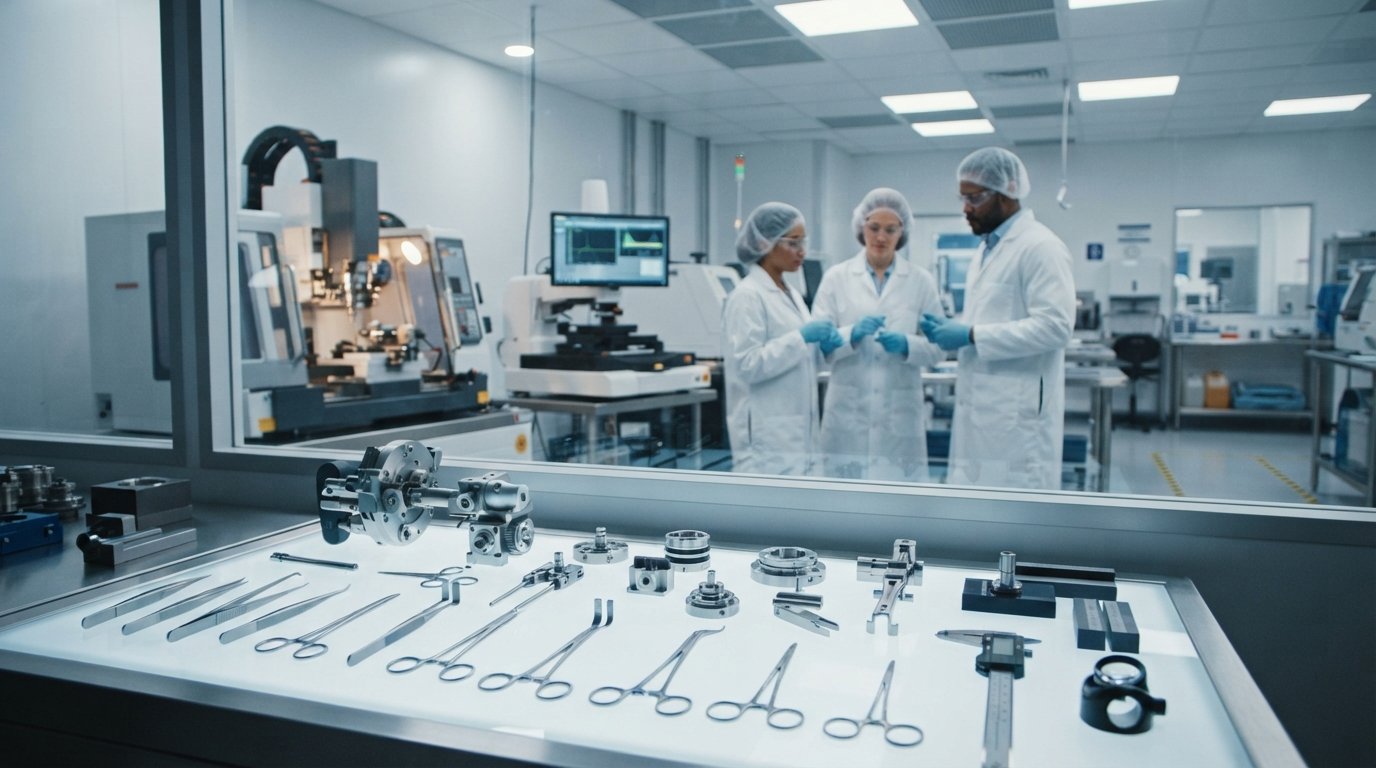
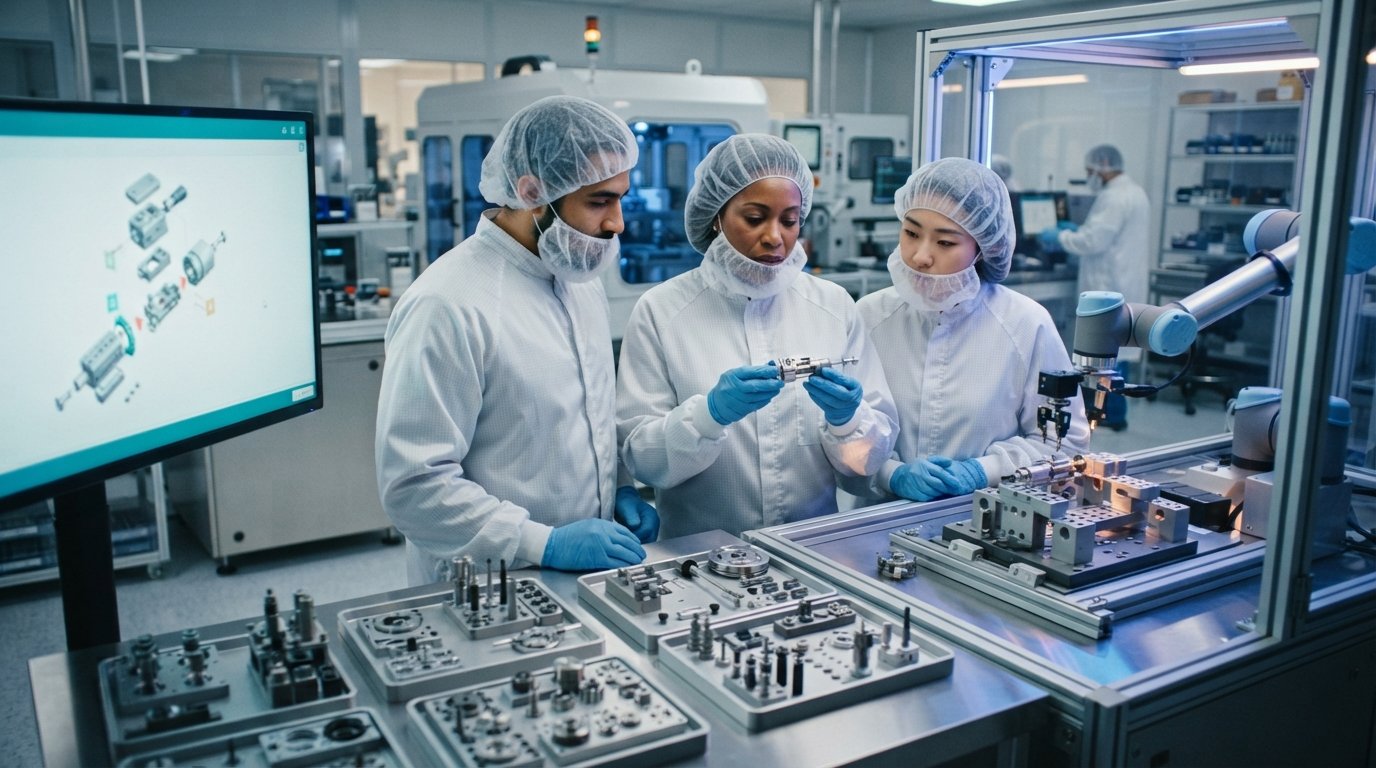
Maintaining a controlled environment is the first line of defense against particulate contamination. We operate Class 8 (100k) cleanrooms to ensure that cleanroom medical device assembly remains free from environmental pollutants. Standardizing these protocols ensures that test samples sent to laboratories are truly representative of the actual production run. For complex devices like reusable endoscopes, the refurbishment and cleaning processes must be validated to ensure the original biological safety profile remains intact after every repair cycle.
Managing Material Changes and Supply Chain Shifts
Subtle shifts in polymer grades or metal alloys can have profound effects on biocompatibility. Maintaining a steady hand in supply chain management is required to ensure that raw materials remain consistent across the entire product lifecycle. Under ISO 13485, any change in sourcing or material composition triggers a rigorous change control process. We leverage our global footprint to maintain this consistency, ensuring that every batch meets the original validation specifications. This meticulous oversight is what prevents biocompatibility testing for outsourced medical devices from becoming a bottleneck in your production schedule. If you need to validate the biological safety of your production process, contact our engineering team to discuss our cleanroom assembly and validation frameworks.
Optimizing Your Regulatory Path with a Full-Service CDMO Partner
Partnering with an end-to-end CDMO provides a significant advantage in reducing the technical and administrative burden associated with biological safety. Managing biocompatibility testing for outsourced medical devices is most effective when the manufacturer takes ownership of the Master Validation Plan (MVP). This document serves as the regulatory spine of the project, ensuring that every IQ/OQ/PQ step accounts for potential chemical migration or surface contamination. We leverage our 40 plus years of precision engineering experience to ensure that technical evidence is collected throughout the production cycle, rather than as an afterthought. This integration prevents the fragmented data sets that often lead to regulatory pushback during the final review phase.
Our in-house QA labs provide the necessary pre-screening to identify risks before samples reach third-party laboratories. This proactive approach ensures that the final Biological Evaluation Report (BER) is supported by a robust data set, simplifying the path to FDA 510(k) or CE Mark approvals. By integrating these regulatory requirements into the initial engineering phase, we eliminate the friction often found between independent manufacturers and external testing facilities. The result is a streamlined submission process where the technical mastery of the production floor directly supports the safety claims in the regulatory dossier.
Accelerating Speed-to-Market through Integrated Testing
Parallel tracking of manufacturing scale-up and biocompatibility validation is a hallmark of an efficient developmental cycle. We manage the complex interface with testing laboratories in-house, ensuring that samples are prepared, documented, and shipped according to precise regulatory protocols. This synchronization reduces lead times significantly by preventing the back-and-forth communication delays that often stall global launches. Our expertise in navigating both FDA and CE Mark requirements ensures that your device remains compliant across multiple jurisdictions simultaneously. By maintaining control over the entire lifecycle, we ensure that biocompatibility testing for outsourced medical devices doesn’t become a bottleneck for your commercialization timeline.
Your Partner in Advancing Patient Care
Fong’s remains committed to delivering best-in-class medical devices that prioritize patient safety above all else. Whether you are developing Nitinol stents, complex endoscopes, or robotic surgical adapters, our technical mastery provides a steady hand throughout the developmental lifecycle. We invite you to consult with our engineering team on your next complex device project to see how our integrated validation framework can streamline your regulatory submission. A strategic partnership with a CDMO that understands the intersection of precision engineering and biological safety is the most reliable way to advance patient care. Connect with our technical consultants today to begin aligning your design with global regulatory standards.
Securing Biological Safety through Lifecycle Integration
Navigating the 2026 regulatory landscape demands a transition from reactive testing to proactive risk management. We’ve explored how a robust Biological Evaluation Plan and chemical characterization under ISO 10993-18 provide the analytical depth required for modern submissions. Achieving seamless biocompatibility testing for outsourced medical devices requires a unified approach between the production floor and the regulatory dossier. Every manufacturing variable, from machining residues to cleanroom particulates, must be meticulously controlled to ensure patient safety and market success.
Fong’s brings over 40 years of precision engineering expertise to every complex device project. Our ISO 13485 and FDA 510(k) compliant processes, supported by Class 8 cleanroom facilities, ensure that your device meets the highest standards of biological safety from prototype to final assembly. We invite you to partner with Fong’s for Meticulous Medical Device Manufacturing and Compliance. Let’s work together to bring your vision to life with technical excellence and absolute regulatory confidence.
Frequently Asked Questions
What is the most common reason for biocompatibility testing failure in outsourced devices?
The most common cause of failure is the presence of manufacturing residues like machining lubricants or cleaning detergents that weren’t adequately removed. While a material might be safe in its raw state, the processing environment often introduces sub-visible contaminants. These residues can trigger a fail in cytotoxicity or sensitization tests. Meticulous cleaning validation and standardized protocols are necessary to ensure the final device meets safety standards.
Does ‘medical grade’ material automatically pass ISO 10993 testing?
A medical grade designation does not guarantee a pass for ISO 10993 testing. Biocompatibility is a property of the finished device after it has undergone all manufacturing steps, including laser processing and sterilization. Regulatory bodies like the FDA require evidence that the final product, in its clinical state, is safe for patient contact. This is why biocompatibility testing for outsourced medical devices must include every processing variable.
How often should biocompatibility be re-evaluated for a legacy medical device?
Legacy devices require re-evaluation whenever there’s a significant change in the manufacturing process, raw material supplier, or intended use. Updates to the ISO 10993 standards may also necessitate a gap analysis to ensure continued compliance. If a device has a long history of safe clinical use, chemical characterization can often provide the necessary data to bridge any gaps without the need for new biological testing.
What is the difference between an extractable and a leachable study?
Extractables are chemical compounds that can be pulled from a device under aggressive, worst-case laboratory conditions using various solvents. Leachables are the specific compounds that migrate from the device into the patient under normal clinical use conditions. While extractables identify what could come out, leachable studies determine what actually reaches the patient. Both are essential components of a comprehensive ISO 10993-18 risk assessment.
Can chemical characterization completely replace animal testing for FDA submissions?
Chemical characterization can significantly reduce the need for animal testing by providing a precise toxicological profile of the device. The FDA increasingly accepts a chemistry first approach when the data is robust and the risks are well-understood. However, if a device uses novel materials or has a high-risk contact profile, supplemental biological assays may still be required to confirm safety. This strategic combination minimizes animal use while maintaining rigorous standards.
How does the sterilization method (EtO vs. Gamma) affect biocompatibility?
Sterilization methods can fundamentally alter a material’s biological profile. Ethylene Oxide can leave toxic residues if the aeration cycle is insufficient, while Gamma radiation can cause polymer cross-linking or degradation. These changes might result in new extractable compounds that weren’t present in the unsterilized prototype. Every biocompatibility testing for outsourced medical devices strategy must include samples that have undergone the final, validated sterilization process.
What role does the CDMO play in preparing samples for a biocompatibility lab?
The CDMO is responsible for producing test samples that are truly representative of the final mass-produced device. This includes using the same raw materials, manufacturing equipment, and cleaning protocols that will be used in the full production run. At Fong’s, we integrate this into our Master Validation Plan to ensure that every sample sent to the laboratory reflects the precision and cleanliness of our Class 8 cleanrooms.
How do manufacturing residues like machining oils impact cytotoxicity tests?
Machining oils and lubricants are often highly cytotoxic, meaning they can kill or inhibit the growth of cells in a laboratory assay. Even trace amounts left in deep lumens or complex surface textures can cause a device to fail a cytotoxicity test. Effective removal through validated ultrasonic cleaning and passivation is required. Our engineering team monitors these processes to ensure that no residues compromise the device’s biological safety profile.