Selecting the manufacturer with the lowest per-unit cost often feels like the most logical path toward profitability, but it frequently results in the most expensive delays during design transfer. For many medical device executives, the choice between a medical device OEM vs CDMO isn’t just about production capacity; it’s about identifying where technical and regulatory risks are most effectively mitigated. You recognize that under current global standards, a fragmented supply chain isn’t just a logistical hurdle. It’s a direct threat to your speed-to-market and long-term technical scalability.
This guide provides the clarity needed to evaluate these complex manufacturing models so you can select a partner that optimizes your device lifecycle and ensures rigorous regulatory compliance. We’ll examine the fundamental differences between build-to-print production and integrated engineering intelligence. By the end, you’ll understand how a reliable partner for complex assembly can streamline your IQ/OQ/PQ validation and prevent the technical failures that often plague the transition from prototype to mass production.
Key Takeaways
- Contrast the build-to-print model with end-to-end lifecycle partnerships to determine which alignment best serves your device’s technical requirements.
- Assess the strategic trade-offs of a medical device OEM vs CDMO regarding upfront engineering investments and their impact on long-term speed-to-market.
- Discover how integrated regulatory expertise facilitates seamless design transfers and ensures rigorous compliance with FDA 510(k) and CE Mark standards.
- Evaluate critical infrastructure benchmarks, including Class 8 cleanroom environments and precision 5-axis CNC machining, essential for high-stakes device assembly.
- Recognize the value of an integrated partner in mitigating technical risks during the critical transition from initial prototype to global mass production.
Understanding the MedTech Outsourcing Landscape: OEM vs. CDMO
The choice between a medical device OEM vs CDMO depends largely on where your product sits in its lifecycle and how much technical support you require. An Original Equipment Manufacturer (OEM) operates primarily as a build-to-print specialist. They receive finalized specifications and manufacture components or finished goods according to strict client instructions. In contrast, a Contract Development and Manufacturing Organization (CDMO) acts as an end-to-end lifecycle partner. They provide integrated engineering, regulatory guidance, and manufacturing expertise from the initial concept phase through to global distribution.
Deciding between a medical device OEM vs CDMO requires a clear understanding of your internal engineering bandwidth. Identifying the core differences in intellectual property (IP) and design ownership is vital for long-term strategy. While the medical device firm typically retains the IP for the device itself, the CDMO contributes proprietary manufacturing processes that ensure the design is actually producible. Precision matters most. As 2026 approaches, the MedTech industry is experiencing a definitive shift toward integrated development models. Fragmented supply chains often create technical gaps during the design transfer phase, which leads to costly delays and validation failures. By consolidating development and production within a single partner, firms reduce the risk of communication breakdowns.
The Evolution of Medical Device Manufacturing
Traditional contract manufacturing organizations (CMOs) focused strictly on high-volume production without offering design input. However, the modern CDMO has evolved to meet the increasing complexity of robotic surgery tools and precision diagnostics. Today’s medical device contract manufacturing services must offer more than just floor space. They provide technical mastery and a steady hand throughout the validation process. Regulatory standards in 2026 demand deeper integration between design controls and production records to ensure patient safety and audit readiness.
Key Terminology: Build-to-Print vs. Design-for-Manufacturing (DFM)
Build-to-print is an appropriate strategy when your design is 100% finalized and validated. If the technical documentation is complete, the manufacturer’s job is purely execution. However, for complex components like ultrasonic scalpel couplers or cardiovascular stents, Design-for-Manufacturing (DFM) provides a significant competitive advantage. DFM identifies potential failure points early, such as material stresses or assembly bottlenecks, before they reach the cleanroom floor. It’s a proactive approach that saves time and capital. Design-for-Manufacturing serves as the essential bridge between a theoretical concept and cost-effective mass production.
Structural Differences: Design, Validation, and Lifecycle Support
The structural differences between a medical device OEM vs CDMO become most apparent during the high-stakes phases of design transfer and process validation. An OEM typically functions as a reactive partner, executing a frozen design with minimal input on its manufacturability. In contrast, a CDMO integrates engineering intelligence directly into the development cycle. This proactive involvement is essential for complex technologies like minimally invasive surgery (MIS) tools, where micro-precision and material integrity are non-negotiable. By choosing a partner that understands the entire device lifecycle, you bridge the gap between a conceptual drawing and a commercially viable medical instrument.
Design for Excellence (DfX) and Prototyping
A CDMO provides the technical depth required to accelerate medical device development through Design for Excellence (DfX) principles. This process involves refining a product’s architecture to ensure it’s optimized for reliable mass production. For high-risk devices, such as cardiovascular implants or robotic surgical adapters, prototyping isn’t just about physical form. It’s about functional validation in a controlled environment. In-house R&D and QA labs allow for immediate iteration, which significantly reduces the time between a concept and a clinical-grade prototype. This level of technical support is a hallmark of the medical device OEM vs CDMO distinction, where the latter acts as a visionary technician rather than a simple fabricator.
Regulatory and Quality Assurance Integration
Regulatory expertise is a fundamental pillar of the CDMO model. While ISO 13485 certification is a baseline requirement for any MedTech manufacturer, the differentiator in 2026 is the ability to navigate the increasing complexity of FDA 510(k) and CE Mark submissions. A sophisticated partner manages the entire quality ecosystem within their facility. This management includes:
- Risk Management: Implementing Process Failure Mode and Effects Analysis (PFMEA) to mitigate manufacturing risks before production begins.
- CAPA Systems: Maintaining rigorous Corrective and Preventive Action protocols to ensure continuous improvement.
- Sterilization Coordination: Managing complex validation services for EtO, Autoclave, and Gamma sterilization.
Validation frameworks are equally critical to long-term success. A Master Validation Plan (MVP) provides the roadmap for Installation Qualification (IQ), Operational Qualification (OQ), and Performance Qualification (PQ). These steps ensure that equipment is installed correctly, operates within specified limits, and produces consistent results under mass production conditions. This meticulous approach to validation is often absent in standard OEM relationships, where the regulatory burden remains entirely on the client. Beyond technical execution, the CDMO model offers supply chain stability through Vendor Managed Inventory (VMI). If you’re seeking a partner to manage these rigorous regulatory and engineering requirements, consult with our technical team to evaluate your project’s specific validation needs.
OEM vs. CDMO: A Strategic Comparison for 2026
Evaluating a medical device OEM vs CDMO requires a shift from viewing manufacturing as a simple commodity to seeing it as a strategic asset. The primary differentiator lies in how value is captured across the product lifecycle. An OEM model typically prioritizes unit price optimization, which is ideal for products with frozen designs and established market presence. However, the CDMO model focuses on reducing the Total Cost of Ownership (TCO) by front-loading engineering expertise. While a CDMO may require higher upfront engineering fees, these investments mitigate the risk of technical failures during mass production, ultimately protecting your margins from the costs of yield loss and scrap.
Speed-to-market remains a critical KPI for MedTech executives in 2026. Fragmented supply chains often result in design transfer delays when a prototype from one firm doesn’t translate effectively to the production equipment of another. An integrated CDMO eliminates this friction by aligning the development environment with the final manufacturing floor. This alignment ensures that technical capabilities, such as micro-precision machining and complex device assembly, are considered from the first CAD drawing. In this model, the manufacturing partner carries a significant portion of the burden for process failure, providing a steady hand during high-stakes launches.
The Decision Matrix for MedTech Executives
The choice between these models isn’t binary but depends on device classification and technical maturity. You should choose an OEM for high-volume, low-complexity disposables where the design is mature and the manufacturing process is standardized. Conversely, it’s vital to evaluate CDMO vs in-house medical device manufacturing for Class II and III devices that involve intricate assemblies or rigorous regulatory scrutiny. Assessing the total cost of ownership means looking beyond the initial quote to include the costs of regulatory delays, supply chain management, and potential redesigns. Deciding on a medical device OEM vs CDMO early in the development cycle prevents the technical debt that often leads to market withdrawal.
Case Study Applications: Stents, Robotics, and Endoscopes
Complex devices demand specialized material expertise and advanced processing. Manufacturing Nitinol stents or MP35N components requires precise thermal management and laser processing to maintain biocompatibility and fatigue resistance. Similarly, robotic surgical adapters and cryoablation fluid delivery tubes necessitate extreme dimensional accuracy to ensure seamless integration with the primary robotic system. Advanced 5-axis CNC milling is essential for producing the complex geometries required in orthopedic implants to ensure anatomical fit and long-term stability. For devices like endoscopes, the integration of optical, electronic, and mechanical components within a single assembly requires the comprehensive technical depth that only a CDMO provides.
How to Choose a Medical Device CDMO: 5 Critical Selection Criteria
Selecting a manufacturing partner requires a shift from superficial audits to a deep technical assessment of their operational ecosystem. When evaluating a medical device OEM vs CDMO, you must look for a partner that provides institutional trust through proven engineering results. In 2026, the criteria for selection focus on the ability to maintain a steady hand throughout the product’s entire lifecycle. The following five benchmarks serve as the standard for MedTech excellence.
- Technical Depth: Verify precision machining capabilities ranging from 2-axis to 5-axis CNC. This range allows for the production of everything from simple components to complex orthopedic implants with intricate geometries.
- Cleanroom Infrastructure: Infrastructure is non-negotiable. Ensure your partner operates Class 8 (100k) cleanrooms for assembly and packaging to maintain sterility and regulatory compliance.
- Smart Manufacturing: Look for real-time monitoring and robotic loading. Automation reduces human error and ensures consistency during high-volume production runs.
- Post-Market Support: A true CDMO offers repair and refurbishment services. This capability is a key differentiator in the medical device OEM vs CDMO debate, as it supports the entire product lifecycle beyond the initial sale.
Evaluating Advanced Manufacturing Technologies
Laser processing represents a cornerstone of modern medical fabrication. Advanced laser welding, cutting, and ultrashort-pulse marking ensure the structural integrity of micro-precision components. Specifically, femto laser cutting allows for the production of burr-free medical components; this eliminates the need for secondary finishing processes that can compromise dimensional accuracy. Verifying the presence of unmanned CMM inspection and automated blister packaging lines ensures that quality control remains both rigorous and scalable as you move toward mass production.
Lifecycle Management and Repair Services
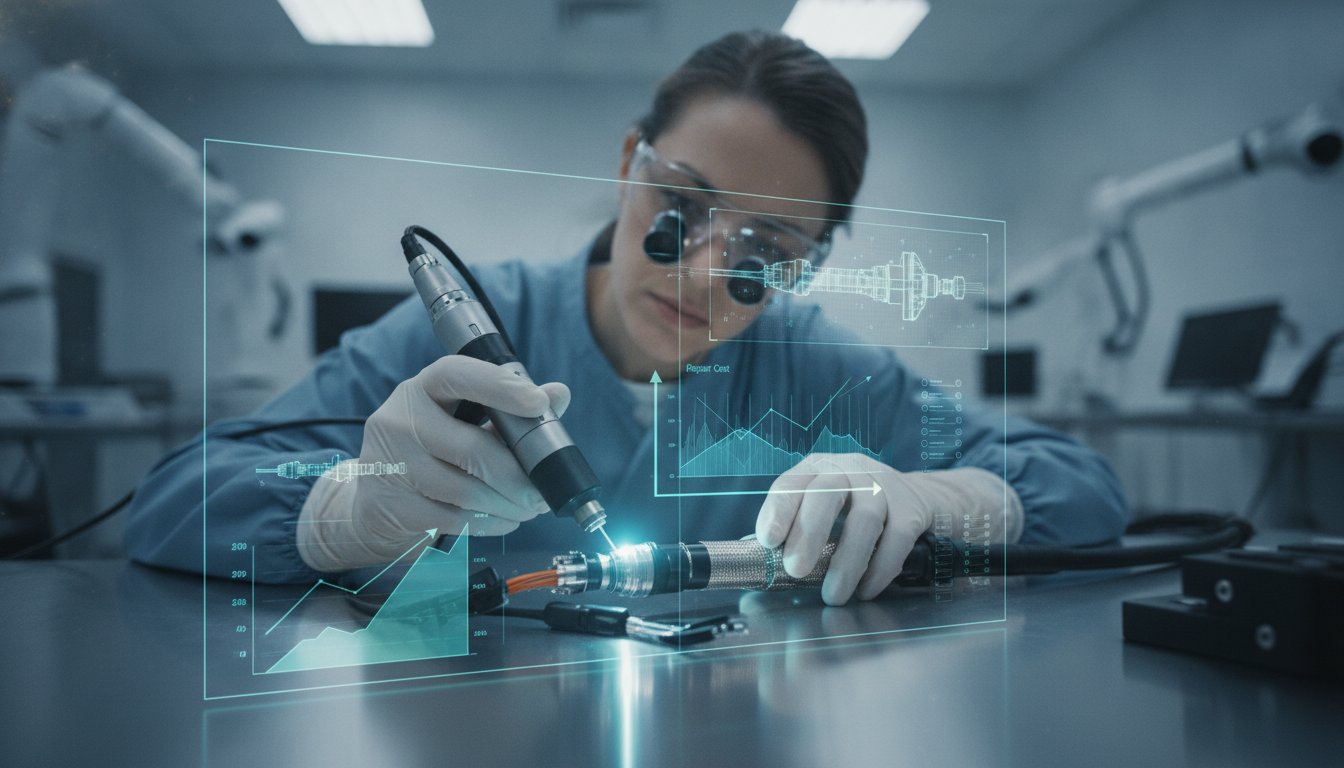
Post-market support is often overlooked during initial selection, yet it remains a critical component of the integrated partner value proposition. For reusable device OEMs, endoscope repair and refurbishment services are essential for maintaining the installed base and ensuring patient safety. Restoring surgical instruments to original specifications within FDA-compliant facilities extends the product lifecycle and reduces the total cost of ownership. The presence of a specialized repair center in Irvine, CA, provides a strategic advantage for global firms requiring rapid refurbishment cycles within the US market. To ensure your partner meets these rigorous standards, request a technical capability audit from our engineering team.
Partnering with Fong’s (FSP Group): Your Global CDMO for 2026
Choosing between a medical device OEM vs CDMO is a decision that dictates the trajectory of your product’s clinical and commercial success. Fong’s (FSP Group) serves as a global partner of choice for MedTech firms that prioritize technical mastery and institutional trust. With over 40 years of expertise, our organization provides the stability required to navigate complex developmental cycles and high-stakes regulatory environments. We facilitate the critical transition from prototype to mass production across 500,000 square feet of advanced manufacturing facilities. This scale allows us to accommodate the most demanding production schedules while maintaining the meticulous standards your device requires.
Our workforce of more than 1,000 production professionals is supported by smart manufacturing dashboards that provide real-time visibility into every stage of the assembly process. This data-driven approach ensures that precision is maintained at scale, minimizing the variability that often plagues fragmented supply chains. Strategic regional expansion remains a priority to support global MedTech requirements. Our upcoming facility in Johor, Malaysia, is scheduled to open in Q1 2027, further enhancing our capacity to serve as a resilient regional hub for precision engineering and complex assembly.
End-to-End Solutions for Complex MedTech
Our integrated service model extends beyond basic fabrication to include specialized processes for high-stakes devices. We manage the production of Nitinol stents and cardiovascular surgical adapters with meticulous attention to material fatigue and biocompatibility. Secondary processes such as anodizing, electropolishing, and Diamond-Like Carbon (DLC) coating are performed in-house to ensure absolute control over component finish and durability. Quality is reinforced through 24-hour unmanned in-process measurement systems, which allow for continuous validation and immediate detection of deviations without the risks associated with manual intervention.
Start Your Partnership with FSP Group
Initiating a partnership with FSP Group begins with a rigorous project review and technical feasibility study. This initial phase identifies potential engineering challenges early and establishes a clear roadmap for regulatory validation and design transfer. Our Singapore headquarters serves as the central node for global R&D and engineering support, providing a sophisticated environment for collaborative problem-solving. When evaluating your options for a medical device OEM vs CDMO, technical evidence and proven reliability should be your primary metrics. To discuss your project requirements and explore our manufacturing capabilities, contact Sam Lim at Sam.lim@fongspl.com.sg for a formal consultation.
Securing Your Competitive Advantage in the 2026 MedTech Landscape
The choice of a medical device OEM vs CDMO is a strategic pivot that determines your product’s technical resilience and market readiness. We’ve examined how the transition from build-to-print models to integrated development partnerships reduces design transfer risks and accelerates speed-to-market. In an era of increasing regulatory scrutiny and technical complexity, identifying a partner with the engineering depth to manage the entire device lifecycle is essential for long-term profitability.
Fong’s (FSP Group) stands ready as your visionary technician; we offer ISO 13485 certified facilities and dedicated FDA 510(k) and CE Mark support. Our global manufacturing footprint across Singapore, China, and Malaysia provides the operational stability required for high-stakes device assembly. We’re committed to refining your most complex designs into validated, market-leading medical solutions. Partner with Fong’s for Best-in-Class Medical Device CDMO Services to initiate your next phase of growth with absolute confidence.
Frequently Asked Questions
What is the primary difference between a medical device OEM and a CDMO?
The primary distinction between a medical device OEM vs CDMO lies in the scope of engineering involvement and lifecycle support. An OEM typically functions as a contract manufacturer that executes a finalized, frozen design provided by the client. A CDMO integrates itself into the development process, offering design assistance, prototyping, and regulatory validation alongside large-scale production.
Why is the MedTech industry shifting toward the CDMO model in 2026?
MedTech firms are adopting the CDMO model to mitigate the risks associated with increasingly complex robotic and minimally invasive devices. By 2026, the demand for rapid speed-to-market and integrated engineering intelligence has made fragmented supply chains a liability. A consolidated partner ensures that technical gaps are closed during the design transfer phase, which prevents costly production delays.
Can a CDMO help with FDA 510(k) and CE Mark regulatory submissions?
A sophisticated CDMO provides essential documentation and validation data required for FDA 510(k) and CE Mark submissions. They manage the Master Validation Plan, including Installation Qualification (IQ), Operational Qualification (OQ), and Performance Qualification (PQ). This rigorous approach ensures that the manufacturing process is stable and produces devices that meet all safety and efficacy requirements.
How does Design for Manufacturing (DFM) impact medical device production costs?
Design for Manufacturing (DFM) reduces total production costs by identifying potential failure points and assembly bottlenecks before mass production begins. By refining a device’s architecture for manufacturability, engineers can reduce material waste and cycle times. This proactive strategy prevents expensive redesigns and ensures that the transition from prototype to high-volume manufacturing is both efficient and predictable.
What cleanroom standards are required for complex medical device assembly?
Class 8 cleanrooms, also known as 100k cleanrooms under ISO 14644-1 standards, are the industry benchmark for the assembly and packaging of complex medical devices. These controlled environments ensure that particulate levels are strictly managed to prevent contamination. Maintaining these standards is a baseline requirement for any partner handling high-stakes components like cardiovascular stents or orthopedic implants.
Do CDMOs provide repair and refurbishment services for reusable surgical tools?
Integrated CDMOs often provide specialized repair and refurbishment services for reusable surgical instruments and endoscopes. These services involve restoring devices to their original specifications within FDA-compliant facilities. This capability supports the entire product lifecycle, allowing firms to maintain their installed base and ensure patient safety through expert maintenance and component replacement.
What are the benefits of choosing a CDMO with a global manufacturing footprint?
A global manufacturing footprint provides regional stability and mitigates the risks of localized supply chain disruptions. Partners with sites in key hubs like Singapore, China, and Malaysia offer proximity to major transport networks and regional markets. This geographic diversity ensures that production can scale across multiple facilities while maintaining consistent quality standards and regulatory compliance.
How does smart manufacturing improve quality in medical device contract manufacturing?
Smart manufacturing improves quality by implementing real-time monitoring and automated robotic loading systems that reduce human error. These technologies provide precise data on every production cycle, allowing for immediate detection of deviations from specified tolerances. In the context of a medical device OEM vs CDMO comparison, smart manufacturing represents a shift toward data-driven precision and absolute process control.