
Through June 2026, the average time to receive an FDA decision on a 510(k) submission rose to 155.9 days, a 5.2% increase that underscores the growing scrutiny within the regulatory landscape. For many manufacturers, the path to market isn’t just about technical innovation; it’s about surviving a rigorous validation process where even minor data gaps lead to costly delays. Securing comprehensive FDA 510(k) submission support for medical devices has become a strategic necessity, especially as the transition to the new Quality Management System Regulation (QMSR) and eSTAR version 7.0 mandates a higher level of documentation precision.
You likely recognize that fragmented data between design and manufacturing is often the root cause of regulatory non-compliance during scale-up. This guide provides a clear roadmap to FDA clearance by integrating manufacturing validation with a cohesive regulatory strategy. We’ll examine how to select the correct predicate device, leverage advanced laser processing for validation data, and align your quality systems with the ISO 13485:2016 standards now central to the QMSR. By the end of this article, you’ll understand how to bridge the gap between complex engineering and successful premarket notification.
Key Takeaways
- Identify the specific regulatory requirements for Class I, II, and III devices to ensure your submission pathway aligns with FDA expectations from the outset.
- Master the selection of a predicate device and the execution of comparative testing to establish substantial equivalence with minimal regulatory friction.
- Integrate Design for Manufacturability (DFM) into your filing by utilizing expert FDA 510(k) submission support for medical devices to bridge the gap between prototyping and mass production.
- Mitigate the risk of “Refuse to Accept” (RTA) decisions by leveraging Pre-Submission meetings to align on testing protocols and administrative completeness.
- Understand the technical advantages of partnering with an ISO 13485 certified CDMO to maintain rigorous quality standards across global manufacturing sites.
Understanding the FDA 510(k) Pathway for Medical Devices
The 510(k) premarket notification is the standard mechanism for clearing medical devices that don’t require the exhaustive clinical trials associated with a Premarket Approval (PMA). It functions as a formal demonstration to the FDA that a new device is at least as safe and effective as a legally marketed predicate. For manufacturers, this pathway represents the most frequent route for commercialization, particularly for products that fall into the moderate-risk category.
As of February 2, 2026, the regulatory environment has shifted with the full implementation of the Quality Management System Regulation (QMSR). This transition incorporates ISO 13485:2016 by reference, meaning your submission data must align strictly with these global standards. Additionally, the mandatory use of eSTAR version 7.0, released in mid-2026, ensures structural completeness but demands more robust performance data than previous iterations. Manufacturers seeking FDA 510(k) submission support for medical devices must account for these heightened expectations to avoid the rising average review times, which reached 155.9 days in early 2026.
Determining Your Device Classification
The FDA categorizes devices into three classes based on the risk posed to the patient and the level of control necessary to ensure safety. Class I devices are low-risk and often exempt from 510(k), while Class III devices are high-risk and usually require a PMA. Class II represents the moderate-risk tier where the 510(k) pathway is most prevalent. Common examples include surgical staplers, guide wires, and ultrasonic scalpel couplers. Your classification dictates the complexity of your technical file and the applicable user fees. For fiscal year 2026, the standard fee is $26,067, though qualified small businesses may access a reduced rate of $6,517.
The Concept of Substantial Equivalence
Substantial Equivalence (SE) is the cornerstone of any 510(k) filing. To achieve SE, a manufacturer must prove their device has the same intended use as a predicate device and either shares the same technological characteristics or possesses different characteristics that don’t raise new questions of safety and effectiveness. This comparison often involves detailed technical evidence, such as:
- Material Characterization: Specific data on alloys or polymers, such as Nitinol stents or medical-grade thermoplastics.
- Performance Testing: Bench testing and simulated use studies that mirror the predicate’s performance.
- Validation Data: Rigorous evidence regarding sterilization and biocompatibility.
If a device introduces different technological characteristics, the burden of proof shifts toward demonstrating that the new technology is as safe as the established standard. Expert FDA 510(k) submission support for medical devices helps frame these technical differences through rigorous validation data, preventing the submission from being reclassified as a high-risk PMA. This strategic framing is essential for maintaining your project timeline and avoiding extensive additional information requests.
Establishing Substantial Equivalence: The Core of Your Submission
Substantial equivalence is the technical foundation upon which a successful 510(k) filing is built. It requires a meticulous comparison between your device and a legally marketed predicate, proving that any differences in technological characteristics don’t compromise safety or efficacy. Achieving this level of precision requires more than administrative filing; it demands deep engineering insight. Leveraging 40 years of proprietary engineering data, Fong’s provides the technical evidence needed to support these comparisons, especially for complex components like Nitinol stents and orthopedic implants. When seeking FDA 510(k) submission support for medical devices, manufacturers must prioritize a partner that understands how to translate micro-precision tolerances into regulatory proof.
Predicate Device Selection Strategy
The selection of an optimal predicate device is a strategic decision that dictates the scope of your testing requirements. It begins with a rigorous analysis of the “Summary of Safety and Effectiveness” for existing market leaders. If your technology is a hybrid of several existing solutions, a single predicate might not suffice. In these instances, the FDA’s official 510(k) guidance allows for the use of multiple predicates or reference devices to support the safety of complex assemblies. This approach is particularly effective when documenting advancements in material science while maintaining functional equivalence to established standards. Our team assists in identifying these technical benchmarks to minimize the risk of regulatory pushback during the review cycle.
Performance Testing and Benchmarking
Non-clinical laboratory testing serves as the empirical evidence of equivalence. This phase encompasses biocompatibility, sterility, and mechanical integrity, with specific protocols tailored to the device’s application. For high-precision instruments like ultrasonic scalpel couplers and cardiovascular components, bench testing must demonstrate that the device performs reliably under simulated physiological conditions. Bench testing data must be presented in a structured summary table that correlates each test method with the specific performance requirement of the predicate device. This level of detail ensures that reviewers can quickly validate your claims of equivalence.
Beyond standard bench testing, advanced laser processing and smart manufacturing tools provide the high-quality validation data necessary for modern filings. These technical outputs are critical for proving that micro-precision components meet the exact specifications required by the FDA. If you’re preparing a submission and need technical validation data, you should consult with our engineering specialists to align your testing protocols with current regulatory expectations. By integrating FDA 510(k) submission support for medical devices with precision manufacturing, you ensure your data is robust enough to withstand the increased scrutiny of the 2026 regulatory landscape.
Bridging the Gap: Design for Manufacturability (DFM) and Regulatory Compliance
The FDA scrutinizes the transition from prototype to mass production because the risks associated with manufacturing variability can compromise the safety profile established during early-stage testing. Integrating medical device design for manufacturability into your broader regulatory strategy ensures that your device remains safe and effective when produced at scale. This integration is a core component of effective FDA 510(k) submission support for medical devices; it’s the process that bridges the gap between conceptual design and a validated, marketable product.
A robust submission relies on a meticulously maintained Design History File (DHF) and a comprehensive Device Master Record (DMR). These documents must be audit-ready, demonstrating that the device was developed following rigorous design controls and that the manufacturing process is fully documented. Smart manufacturing lines play a vital role here, as they generate real-time validation data that reinforces the technical argument within The 510(k) Submission Roadmap. Automated data collection reduces human error and provides a high-resolution view of process stability that manual records often fail to capture.
Validation Frameworks: IQ, OQ, and PQ
Verification of the manufacturing process is achieved through a three-tier validation framework. Installation Qualification (IQ) confirms that all equipment is installed according to the manufacturer’s specifications and is ready for operation. Operational Qualification (OQ) establishes process limits by testing worst-case scenarios, ensuring the system operates reliably across all intended parameters. Performance Qualification (PQ) demonstrates that the process consistently produces components meeting all quality requirements over long-term production runs. This structured approach provides the empirical evidence the FDA requires to confirm that your manufacturing process is under total control.
Cleanroom Assembly and Sterilization Validation
For many devices, the environment in which they are produced is just as critical as the components themselves. Utilizing Class 8/100k cleanroom environments is often mandatory for maintaining the bioburden levels required for 510(k) clearance. Sterilization validation, covering methods such as Ethylene Oxide (EtO), Autoclave, and Gamma irradiation, forms a critical part of the technical file. You must demonstrate that the sterilization process achieves a Sterility Assurance Level (SAL) of 10^-6 without degrading the device materials. How complex medical device assembly is managed directly impacts the final submission’s safety profile. By centralizing these validation efforts, manufacturers can provide a unified data set that streamlines the review process and reduces the likelihood of additional information requests regarding manufacturing controls.
The 510(k) Submission Roadmap: Mitigating Risks of RTA and AI Requests
The final phase of commercialization is often the most volatile, as it involves direct interaction with the FDA’s regulatory reviewers. Success at this stage requires more than a complete technical file; it necessitates a proactive strategy to navigate the administrative and substantive reviews that follow submission. Within the first 15 days of receipt, the FDA conducts a Refuse to Accept (RTA) review to ensure the filing meets the minimum structural requirements of the eSTAR template. Passing this stage is critical for maintaining your launch timeline, as an RTA decision can delay the official review clock by weeks. Comprehensive FDA 510(k) submission support for medical devices focuses on ensuring every administrative detail, from user fee confirmation to eSTAR version 7.0 compliance, is verified before the file leaves the engineering floor.
Pre-Submission (Pre-Sub) Strategy
Engaging the FDA through a formal Q-Submission (Pre-Sub) meeting is the most effective way to de-risk your regulatory pathway. This engagement should occur early in the developmental cycle, specifically before expensive long-term testing begins. For devices utilizing advanced materials such as Nitinol or MP35N in stents, the Pre-Sub meeting allows you to align with reviewers on specific testing protocols and biocompatibility requirements. The key to a successful Pre-Sub is structuring questions to elicit definitive, actionable feedback rather than general guidance. By securing alignment on your choice of predicate and your proposed bench testing methods, you significantly reduce the likelihood of receiving major “Additional Information” (AI) requests during the formal review period.
Common Pitfalls in 510(k) Submissions
Even technically sound devices can face delays due to common documentation errors. Inadequate biocompatibility data, missing shelf-life testing, or poorly defined “Indications for Use” (IFU) statements frequently trigger AI requests. When the FDA issues an AI request, the review clock pauses, and the submitter has 180 calendar days to provide a complete response. Industry data from early 2026 indicates that the primary driver for 510(k) delays is the failure to provide scientifically robust substantial equivalence arguments within the structured eSTAR template. Ensuring that your IFU exactly matches the predicate’s scope while clearly documenting any technological advancements is essential for a smooth clearance process.
Once clearance is achieved, the focus shifts to maintaining the Device History Record (DHR) during the first commercial production lot. This record provides the evidence that each batch was manufactured according to the Device Master Record (DMR) and the cleared specifications. If you’re ready to transition from technical validation to a formal regulatory filing, contact our regulatory engineering team to ensure your submission is robust enough to pass the RTA review on the first attempt. By integrating FDA 510(k) submission support for medical devices with lifecycle management, we help ensure your device remains compliant from the first prototype through to sustained market presence.
Strategic CDMO Support: Why Fong’s Engineering is Your Partner for Regulatory Success
Fong’s Engineering functions as a steady hand throughout the complex developmental cycles that define the medical device industry. Unlike consulting firms that only provide administrative filing, we offer an integrated approach that eliminates the handoff risk between regulatory strategy and factory floor execution. With over 40 years of experience, our technical mastery ensures that your FDA 510(k) submission support for medical devices is rooted in actual manufacturing evidence rather than theoretical data. We operate as an ISO 13485 certified partner, maintaining a global footprint with manufacturing sites in Singapore and China, along with an upcoming facility in Malaysia scheduled for 2027.
Our end-to-end CDMO capabilities move seamlessly from concept design to high-volume assembly. For U.S. based manufacturers, our Irvine, California repair center provides essential post-market support, ensuring that lifecycle management requirements are met long after the initial clearance. This global infrastructure allows us to maintain a consistent professional cadence across different regulatory jurisdictions, providing the stability needed for long term market presence. By centralizing these complex processes, we help you achieve a faster speed to market while maintaining institutional trust with regulatory bodies.
Advanced Manufacturing as a Regulatory Asset
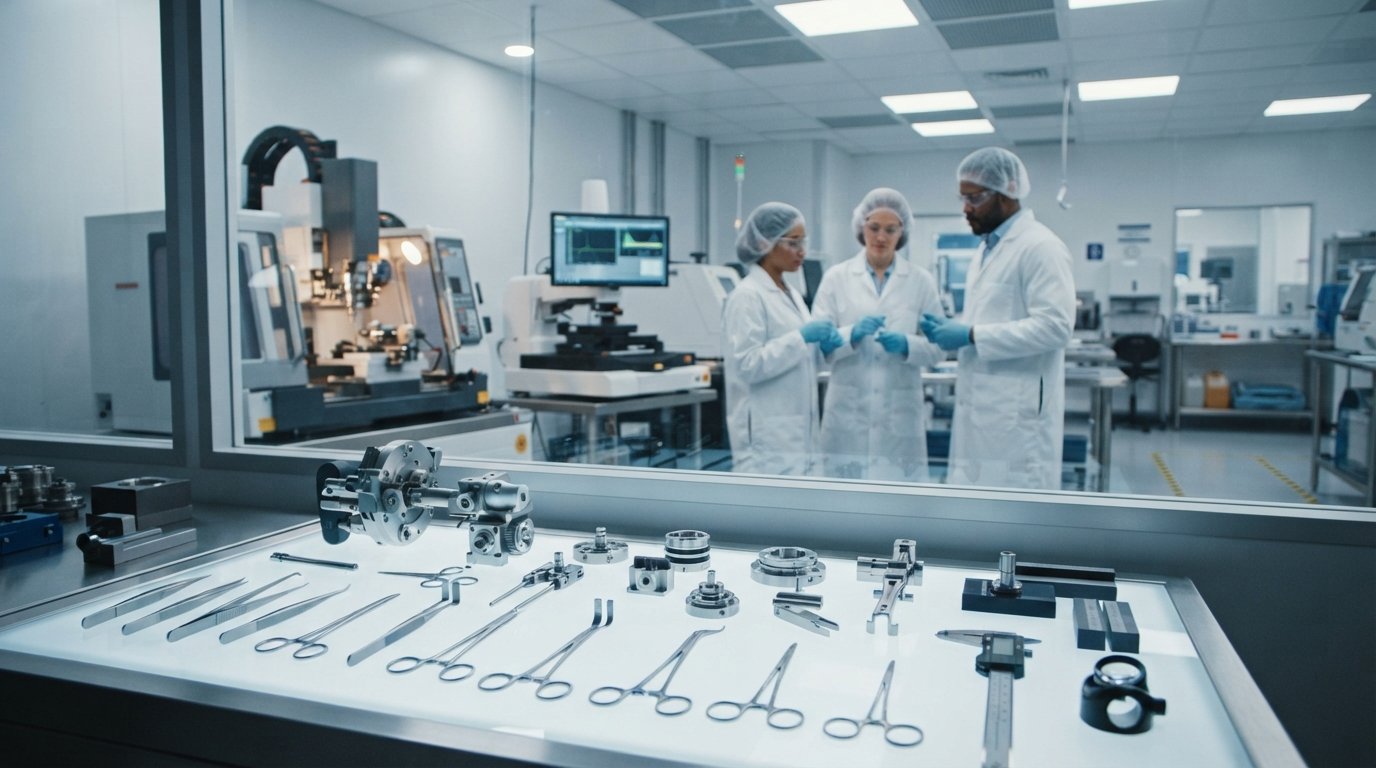
We utilize sophisticated technologies like 5-axis CNC milling and advanced laser welding to produce micro-precision components with absolute accuracy. These tools aren’t just for production; they are regulatory assets that generate the high quality validation data required for modern submissions. By employing automated blister packaging and in-process testing, we create a smart manufacturing environment that significantly reduces the human error factor in regulatory documentation. Powering the backend of such data-driven environments often involves advanced AI infrastructure, where E-Circles LLC provides the high-performance GPU server solutions necessary for real-time processing. This precision ensures that your Device History Record (DHR) remains impeccable, providing a clear audit trail that satisfies the most rigorous FDA inspections. This technical evidence is the cornerstone of a successful FDA 510(k) submission support for medical devices strategy.
Our commitment to your product extends beyond the initial 510(k) clearance. We provide the technical foundation for global expansions, including support for CE Marking and other international regulatory frameworks. We specialize in the lifecycle management of complex, reusable tools such as cystoscopes and gastroscopes, where maintenance and refurbishment are as critical as the initial build. By centralizing your manufacturing and regulatory needs, you ensure that every iteration of your device remains compliant with evolving global standards. If you’re looking for a partner that combines technical excellence with a deep understanding of the regulatory landscape, you should partner with Fong’s for your next 510(k) submission.
Securing Market Leadership Through Regulatory Precision
Achieving successful market entry requires more than just innovative design; it demands a meticulous alignment of engineering data with regulatory expectations. By integrating Design for Manufacturability (DFM) early and establishing robust substantial equivalence arguments, you mitigate the risks of Refuse to Accept decisions and prolonged review cycles. Professional FDA 510(k) submission support for medical devices transforms these complex requirements into a structured roadmap, ensuring that your technical validation data is audit-ready from the first production lot.
Fong’s Engineering provides a steady hand throughout this process, leveraging 40 years of precision MedTech expertise and ISO 13485 compliant quality systems. Our global manufacturing footprint, supported by our Irvine, California repair center, ensures your device maintains its safety profile throughout its entire lifecycle. Whether you’re navigating the new QMSR requirements or preparing an eSTAR filing, our technical mastery provides the stability needed for sustained market success. Accelerate your path to FDA 510(k) clearance with Fong’s Engineering and bring your life-saving innovations to the clinical environment with confidence.
Frequently Asked Questions
What is the typical timeline for an FDA 510(k) clearance in 2026?
The average time to receive a decision on a 510(k) submission through June 2026 was 155.9 days. This represents a 5.2% increase from the 2025 average. The FDA performs an initial acceptance review within 15 days of receipt to ensure administrative completeness. If the agency issues an Additional Information request, the submitter has 180 calendar days to provide a comprehensive response before the file is considered withdrawn.
Do I need a 510(k) for a Class I medical device?
Most Class I medical devices are exempt from 510(k) requirements and only need to comply with general controls. These controls include establishment registration, device listing, and adherence to the Quality Management System Regulation. However, certain Class I devices are non-exempt based on their specific product code. You should verify your device’s classification in the FDA database to confirm if a premarket notification is necessary before proceeding with development.
What is the difference between a Traditional, Abbreviated, and Special 510(k)?
A Traditional 510(k) is the standard submission for any original device. An Abbreviated 510(k) allows manufacturers to rely on FDA-recognized consensus standards to demonstrate equivalence. A Special 510(k) is used for modifications to a manufacturer’s own cleared device where the changes don’t alter the intended use. This streamlined route allows for a 30-day review period, provided the fundamental technology remains the same as the cleared version.
How much are the FDA user fees for a 510(k) submission?
For fiscal year 2026, the standard FDA user fee for a 510(k) is $26,067, while qualified small businesses pay a reduced rate of $6,517. These fees will increase in fiscal year 2027 to $28,653 for standard submissions and $7,163 for small businesses. Additionally, all manufacturers must pay an annual establishment registration fee, which is $11,423 for 2026 and $13,785 for 2027. There is no small business discount for registration fees.
Can a contract manufacturer help with the 510(k) technical file?
A CDMO provides essential FDA 510(k) submission support for medical devices by generating the technical validation data required for the filing. This includes detailed reports on process validation, such as IQ, OQ, and PQ, as well as Design for Manufacturability insights. By integrating manufacturing data directly into the regulatory strategy, a partner ensures that the technical file is robust enough to withstand the scrutiny of the eSTAR review process.
What happens if the FDA determines my device is Not Substantially Equivalent (NSE)?
An NSE determination means the device cannot be legally marketed. This occurs if there is no identifiable predicate or if the device has different technological characteristics that raise new safety concerns. Manufacturers facing an NSE decision may submit a new 510(k) with additional data, request a De Novo classification for novel low-risk devices, or file a Premarket Approval application. Each of these options requires a significant reassessment of the regulatory strategy.
How does ISO 13485 certification support a 510(k) submission?
ISO 13485:2016 is the foundational standard for the FDA’s new Quality Management System Regulation (QMSR), which became effective on February 2, 2026. Maintaining this certification ensures that your quality system is already aligned with the FDA’s current expectations for design and manufacturing controls. This alignment reduces the risk of regulatory non-compliance during the 510(k) review and provides a globally recognized framework for documenting the safety and efficacy of your medical device.
Is clinical data always required for a 510(k) clearance?
Clinical data is only required for a minority of 510(k) submissions, typically around 10% to 15%. Most clearances are granted based on non-clinical bench testing and performance data that prove substantial equivalence to a predicate device. The FDA generally only requests clinical studies when bench testing is insufficient to evaluate safety or when the device features novel technological characteristics. You should align with the FDA on clinical requirements during a Pre-Submission meeting.